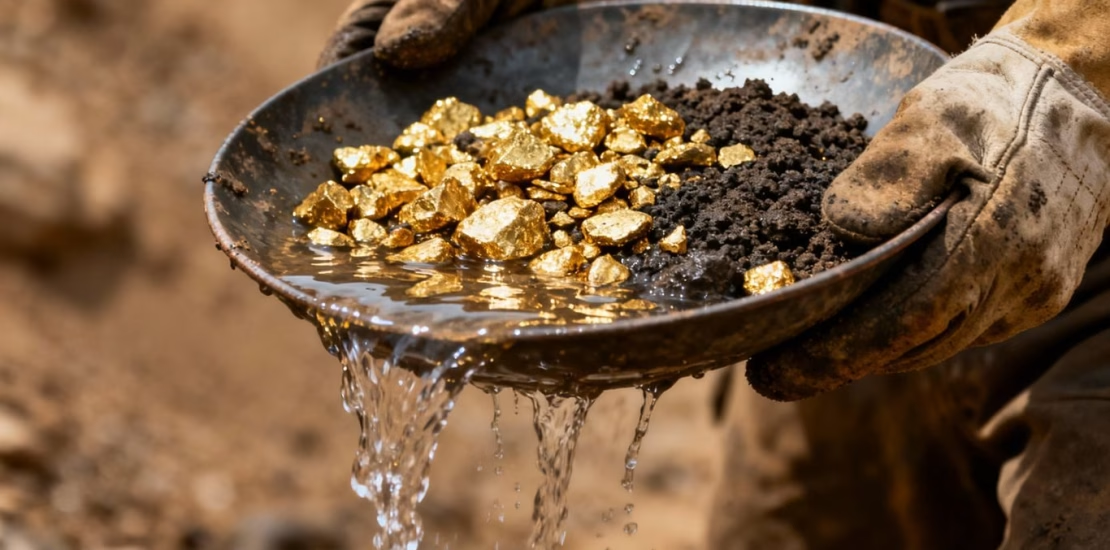
Are you curious to know how gold is found and extracted? It's a fascinating question, as this precious metal has captivated humanity for millennia. Gold mining is an art, a blend of science, technology, and sometimes even patience. Together, we'll explore the different ways gold is extracted from the earth, from the most ancient methods to modern processes. Prepare to discover the secrets of this age-old quest.
Key points
- The discovery of gold deposits begins with geological studies and drilling to assess the richness of the site.
- Mining methods vary: open-pit mines for shallow deposits, and underground mines for deeper ones.
- Extraction methods include cyanidation (with cyanide), amalgamation (with mercury, which is rarer and more polluting) and techniques based on the density of gold.
- After extraction, the ore is crushed, ground, and then chemically or physically treated to separate the gold.
- The process ends with refining, where the gold is purified by melting and electrolysis to reach its final form.
How does gold mining work?
So, you want to know how we dig up this precious yellow metal? It's a bit more complex than it seems, but we'll break it down together. Gold mining starts long before you even dig. First, you have to find where it's hidden.
The different methods of gold extraction
There isn't just one way to extract gold from the ground, far from it. Methods vary considerably depending on the location and the amount of gold expected to be found. Several main approaches can be distinguished:
- Cyanidation: This is the most common method today. Basically, a cyanide solution is used to dissolve the gold in the crushed ore. It's quite effective, but you have to be careful with cyanide; it's no laughing matter for the environment.
- Mercury amalgamation: An older technique, which uses mercury to
Mining prospecting and exploitation techniques
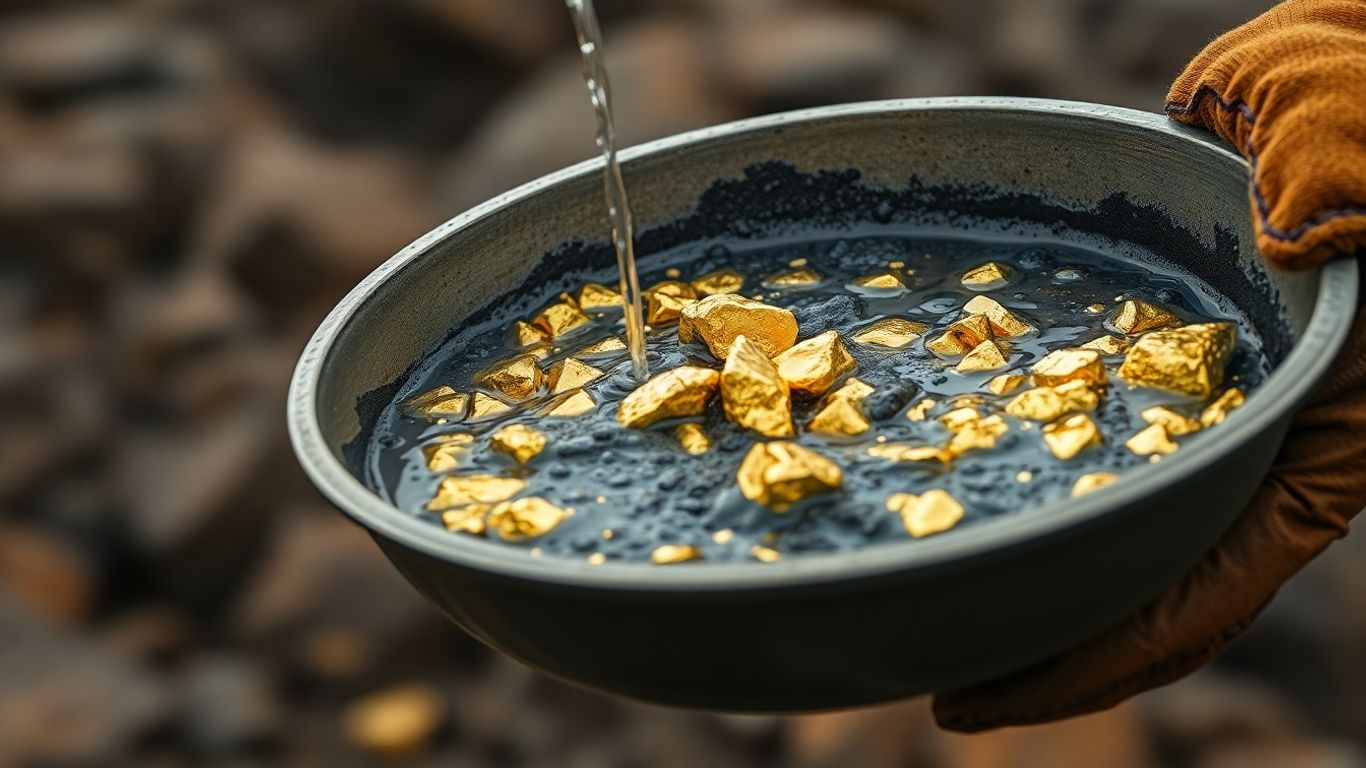
Before even thinking about extracting a single gram of gold, you have to know where it is. That's where prospecting comes in, a step that requires patience and a keen eye. Geologists, often called prospectors, use various methods to find these precious deposits.
Discovery of gold deposits
To identify a potential deposit, the process often begins with field studies. Geological mapping helps to understand the structure of the rocks, while geochemical sampling analyzes the composition of soils and waterways to detect traces of gold. Geophysical techniques, such as measuring magnetic or electric fields, can also help identify anomalies beneath the surface. Once a site appears promising, exploratory drilling is carried out. These boreholes allow for the extraction of rock samples from deep underground, which are then analyzed in the laboratory to determine the gold content. Only if these analyses show that there is enough gold to make mining profitable does the process proceed to the next stage.
Extraction methods according to the type of deposit
The method used to extract gold depends heavily on its natural occurrence. There is no single method that is suitable for all situations.
- Alluvial deposits (or placers) This type of gold is found in the sediments of rivers, streambeds, or beaches. Gold, being denser, separates naturally from sand and gravel. The methods used here involve washing and sifting these materials, often with water. Artisanal miners use dredges or simple shovels and sieves, while larger operations may employ more sophisticated dredges.
- Vein deposits (hard rock) Gold is embedded in solid rock formations, often in the form of veins. If the deposit is close to the surface (up to about 400 meters deep), the following is used:open-pit miningThis involves digging huge pits to access the ore. Machinery such as bulldozers and trucks are used to extract and transport the rock. For deeper deposits, theunderground mining is necessary. Shafts and then tunnels (called workings) are dug to reach the gold veins. Extraction is often done using explosives to break up the rock, which is then removed by conveyors or trucks.
Native gold and gold veins
Native gold is pure gold, such as that found in nuggets or flakes. This is the ideal scenario, but quite rare. More frequently, gold is found in gold-bearing veins. These are concentrations of gold, often in the form of thin flakes, lodged in fissures in the rock. Sometimes, the gold is so finely dispersed in the rock that it is almost invisible to the naked eye; this is called disseminated gold. The gold content in these veins or rocks can vary enormously, ranging from a few grams per ton to several kilograms. It is this content, combined with the ease of access to the deposit, that determines the economic viability of mining.
The choice of extraction method is therefore a careful mix of the geology of the site, the depth of the deposit, the form in which the gold is found, and of course, economic and environmental considerations.
Chemical processes for extracting gold
Once you've located and extracted the ore, you still need to separate the gold. This is where chemical processes come into play, and they're quite fascinating, even if they require great care. You don't mess around with these products without knowing what you're doing.
Cyanidation: a proven method
Cyanidation is something of a star among modern gold extraction methods. The idea is to use a cyanide solution to dissolve the gold contained in crushed ore. This usually takes place in large vats. In the presence of oxygen, the cyanide forms a complex with the gold, making it soluble in water. It's a bit like the gold leaches out into the solution.
Several factors influence the effectiveness of this process:
- Particle size: The finer the gold is ground, the larger the contact surface area, and the faster the reaction. Makes sense, right?
- Cyanide concentration: The dosage needs to be just right. Too little, and the gold doesn't dissolve properly. Too much, and it becomes expensive and bad for the environment.
- pH: A pH between 10,5 and 11,5 is generally maintained, often by adding lime. This helps to keep the solution stable.
- The temperature: A moderate temperature, around 20 to 30°C, is ideal. Too hot, and more cyanide is consumed.
- Oxygen: Essential for the reaction to occur. This is ensured by stirring the mud or injecting air.
The entire process can take from 24 to 72 hours. Once the gold has dissolved, the solution is separated from the solid ore. Sometimes, activated carbon is used to bind the gold, making it easier to recover. This is called the CIL (Carbon in Leach) or CIP (Carbon in Pulp) process, depending on whether the adsorption occurs simultaneously with or after leaching. It is a proven technique for gold mining.
Cyanidation is a chemical method that uses cyanide to dissolve gold from ore. It is effective but requires significant precautions due to the toxicity of cyanide.
Mercury amalgamation: an ancient technique
Before cyanidation, there was amalgamation. This is an older method that uses mercury. Gold and mercury have the characteristic of forming an amalgam, a kind of solid paste. Once this amalgam is obtained, it is heated to separate the mercury from the gold. The mercury evaporates (and this is where the danger to health and the environment is greatest), leaving the gold behind. This technique is still used in some artisanal mines, but it is becoming less and less common due to its toxicity.
Factors influencing leaching
As we saw with cyanidation, several elements play a role in the efficiency of leaching, that is, the process of dissolving gold. These include:
- The particle size of the ore: the finer it is, the better.
- The concentration of the chemical reagent (cyanide, for example).
- The pH of the solution.
- The temperature of the reaction medium.
- The presence of oxygen for redox reactions.
- The mineralogy of the ore: certain minerals can hinder or, on the contrary, help the dissolution of gold.
Understanding and mastering these factors allows for optimized gold recovery and makes the process more profitable and safer.
From raw ore to purified gold
Once you've extracted the ore from the earth, the journey to pure gold truly begins. It's not like finding a shiny nugget and picking it up; there's a whole process involved in getting the most out of it. Think of it like preparing a complex dish: every step counts toward the final result.
Crushing and grinding of ore
The first step is to reduce these large chunks of rock into something much more manageable. First, large machines called crushers are used to break the rocks into smaller pieces, about the size of gravel. Then, these pieces go through other machines that reduce them even further, until they become a fine powder. It's a bit like grinding coffee, but on an industrial scale and with rocks! This step is crucial because it releases the tiny gold particles trapped within the rock. Without proper grinding, the gold would remain inaccessible.
The separation of gold by density
Now that you have this fine powder, you need to separate the gold from the rest. Gold is incredibly dense, much more so than ordinary rock. We use this difference in weight to our advantage. A common method is to run the slurry (crushed ore mixed with water) over vibrating tables. The gold, being heavier, settles to the bottom, while the lighter materials are carried away. Other techniques, such as spirals or centrifuges, exploit the same principle: making the heavier gold naturally separate from the other elements. It's a trick of nature that we use to our advantage.
Electrolysis and gold melting
After gold is concentrated, it is often still mixed with other metals or impurities. To obtain very pure gold, more advanced processes are used. Electrolysis is a technique where an electric current is used to deposit pure gold onto an electrode, leaving the impurities behind. Another, more traditional method is smelting. The gold concentrate is heated to very high temperatures in a furnace. The gold melts and, as it cools, forms ingots. This is where gold is truly obtained in its most recognizable form, ready for the final stages of purification or for further processing. gold ingots.
The transformation of raw ore into purified gold is a meticulous process that demands precision at every stage. From rock reduction to density separation, each action aims to isolate this precious metal from its rocky environment.
Gold refining and processing
Once you have your raw gold, it still needs to be purified to become truly usable. This is where refining comes in, a rather technical but extremely important step.
The refining stages for maximum purity
After the initial separation stages, you generally obtain bars called "gold bars." These are already gold, but not yet pure enough to be considered fine gold. A purity of around 90-95% is often mentioned. To reach the coveted 99,99% or higher, several methods are used.
- Chlorination: The gold is melted and chlorine gas is bubbled through it. This chlorine reacts with other metals present (such as silver or copper) to form compounds that rise to the surface and can then be removed. This is quite effective at removing a significant amount of impurities.
- Electrolysis (Wohlwill process): This is a more advanced method. An electrolytic cell is used where gold acts as the anode, and pure gold is deposited onto a cathode. Impurities either remain in the solution or form a sludge at the bottom. This technique allows for very high levels of purity.
- The Miller process: Another common technique that also uses chlorine gas to purify molten gold.
The choice of method often depends on the quantity of gold to be processed, the impurities present, and the desired final purity level. Each step is closely monitored to guarantee quality.
The manufacture of gold bars
Once gold is sufficiently purified, it is ready to be transformed into finished products. The most common form for refined gold, especially for investment, is the bar or ingot. Molten gold is poured into molds of standardized shapes and weights. Ingots are available in all sizes, from a single gram to large bars weighing several kilograms.
Here are some common formats:
- Ingots from 1g to 10g: Ideal for beginners or as a gift.
- Ingots of 50g, 100g, 250g, 500g: Larger formats require larger investments.
- 1kg ingots: The classic format for serious investors.
- 400-ounce bars: Often used by central banks.
Each ingot is then marked with important information: its weight, its purity (often 999,9‰), a unique serial number for traceability, and the refiner's hallmark. It is often sealed in a security blister pack.
Quality standards for gold
For gold to be accepted on international markets and have recognized value, it must meet strict standards. The best-known is the LBMA's (London Bullion Market Association) "Good Delivery" standard. Refiners who produce gold that meets these standards are accredited by the LBMA. This guarantees that the gold is of high purity and can be easily traded between major financial institutions. It's a bit like a quality label that reassures everyone.
Gold in History and its Economic Role
Gold, a precious metal since Antiquity
You know, gold has fascinated humanity for millennia. We find traces of it dating back to the end of prehistory, and it was the second metal humans learned to work, right after copper. The oldest gold objects ever found come from the Varna necropolis in Bulgaria. At that time, gold was mainly used to adorn the powerful and for religious ceremonies. It was really in Antiquity, with the kings of Lydia, that the first gold coins began to be minted, around the 8th century BC. It's pretty amazing to think that this metal has always been synonymous with wealth and power.
Gold as a safe haven asset and monetary reserve
Over time, gold became a cornerstone of monetary policy. Consider the Louis d'or coin under Louis XIII, which became an international symbol of safe investment. The search for gold was even one of the reasons for the conquest of America! The influx of gold from the New World mines enriched Spain and Portugal, before benefiting other European countries. In the mid-19th century, the California Gold Rush also contributed significantly to the expansion of the American West.
Gold served as the sole monetary standard, known as the gold standard. This system ended with the First World War. Later, the dollar was defined in relation to a weight of gold, but the United States suspended this convertibility in 1971. Since then, gold has no longer played an official monetary role, but it remains an essential safe-haven asset.
- Safe haven: In times of economic uncertainty, gold is often the first place people turn to protect their money. It is less sensitive to market fluctuations than traditional currencies.
- Central bank reserves: Most of the world's central banks hold significant gold reserves. In the United States, for example, the Federal Reserve Bank of New York has the largest reserve in the world. In 2003, it was estimated that central banks held approximately 28,554 tonnes of gold.
- Economic indicator: Le Gold pricesListed on major stock exchanges like New York or London, it is often considered a barometer of global economic health, especially in times of crisis.
The evolution of the price of gold
The price of gold, expressed in ounces (approximately 31,1 grams), fluctuates considerably. Several factors come into play:
- Central bank stocks.
- Demand from jewellers, particularly in India and China.
- Industrial demand (electronics, etc.).
- Mining production costs and volumes.
- Speculation on financial markets.
We have seen spectacular increases, such as in 1980 when the ounce approached $850, or more recently when it exceeded $2000. It is a complex market, sometimes a little opaque, particularly because of the illegal gold mining that has developed in certain regions.
Gold, beyond its brilliance, represents a rich history, a symbol of power, and an anchor of stability in the financial world. Its journey, from ancient adornment to modern monetary reserve, testifies to its timeless value and its constant economic role throughout the ages.
Gold has always been important throughout history, serving as both a treasure and a tool for trade. It has played a key role in the economies of many civilizations, from ancient empires to modern times. Its stable value has made it a preferred choice for investment and wealth preservation. Want to learn more about gold and how it can benefit you today? Visit our website to find out how. invest in gold and secure your financial future.
So, ready to get started?
So, now you know how that shining gold is extracted. It's quite a process, isn't it? From raw rock to polished ingot, it's a long journey and requires considerable skill. Whether you're simply curious or considering investing, I hope this has shed some light on the subject. Remember that gold is more than just a metal; it's a story, a value that transcends time. So, the next time you see a gold coin or a piece of jewelry, perhaps you'll think about all the work that went into it!
Frequently Asked Questions
How is gold found underground?
To find gold, experts use techniques such as soil mapping and special analyses. Sometimes, they also use detectors that make a noise when they approach a gold concentration. If a good deposit is found, samples are dug to verify the amount of gold present. It's a bit like a geological treasure hunt!
What are the methods for extracting gold from rock?
Once the gold-bearing rock is found, it must be broken into very small pieces, like powder. Then, chemicals such as cyanide are used to dissolve the gold. Older methods like mercury can also be used, but this is less common today because it is polluting. Sometimes, gravity is also used because gold is very heavy!
Is the extracted gold immediately usable?
Not quite! Gold extracted from the ground is often mixed with other metals or impurities. It therefore needs to be purified. This is done by melting it in very hot furnaces and using special techniques to remove anything that isn't pure gold. Only after this purification process is high-quality gold obtained, ready for further processing.
How does gold become a bar or a piece of jewelry?
After being purified, gold is often melted down again and poured into molds to form bars, which are called ingots. These ingots are then sent to factories where they are processed. To make jewelry, it can be mixed with other metals to make it more durable or change its color. Care is taken to ensure that the ingots are very pure and clearly marked.
Why has gold been considered precious for so long?
Gold has been fascinating for thousands of years! It shines, it doesn't rust, and it's quite rare. In ancient times, it was reserved for kings and important ceremonies. Today, it's seen as a safe haven, especially when the economy is struggling. That's why it's often used to make jewelry, special coins, and as a reserve currency for countries.
Can gold mining be dangerous for the environment?
Yes, gold mining can have an impact on the environment. The use of chemicals like cyanide requires great care to avoid polluting water and soil. Large mines can also alter the landscape. That's why it's important to adhere to strict regulations and seek more environmentally friendly methods to minimize these impacts.