Gold is a highly prized precious metal in the jewelry world. However, not all gold is created equal. The difference between 14K, 18K, and 24K gold lies primarily in their pure gold content. Each type of gold has its own characteristics, advantages, and disadvantages, which can influence your choice when purchasing jewelry. This article will explore these distinctions to help you better understand the difference between 14K, 18K, and 24K gold.
Key points
- 24K gold is 99,99% pure and is considered the most precious gold.
- 18K gold contains 75% pure gold, making it a good balance between durability and aesthetics.
- 14K gold is 58,3% pure gold, making it more affordable and scratch resistant.
- The choice between these types of gold depends on the intended use and personal preferences.
- 24K gold is often used for investments, while 14K and 18K gold are more common in jewelry.
Understanding Gold Karats
Definition of carats
So, what exactly is a carat? Basically, when we talk about gold, a carat is a unit of measurement that indicates the purity of the metal. Imagine dividing something into 24 parts. 24 karat gold is 99,99% pure gold.The higher the karat number, the purer gold there is in your jewelry. It's as simple as that!
Importance of carats in jewelry
Why do these carats matter? Well, it affects everything! Value, color, durability... A piece of 24-karat gold jewelry will be more expensive than a piece of 14-karat gold jewelry because there's more gold in it. But pure gold is also very soft. That's why gold is often mixed with other metals, like copper or silver, to make it stronger. This is where karats come into play to determine the quality of gold.
Gold purity scale
The gold purity scale is a bit like a guide to what you're buying. Here's a quick overview:
- 24 carat (24K): Pure gold (99,9%). This is the most expensive, but also the most fragile.
- 18 carat (18K): 75% pure gold. A good compromise between value and durability.
- 14 carat (14K): 58,3% pure gold. Stronger, often less expensive. It's a popular choice for engagement rings.
- 9 carat (9K): 37,5% pure gold. Even stronger, but less valuable. We can determine the number of carats easily.
Understanding this scale is essential to making an informed choice. Each level of clarity has its pros and cons, and the best choice really depends on what you're looking for in a piece of jewelry.
Characteristics of 24K gold
Composition and purity
24K gold is the pinnacle of purity. It is made of 99,9% pure gold, which means it contains virtually no other metal. This is the highest degree of purity found in commercial gold. To recognize a piece of 24-carat gold jewelry, look for the seahorse hallmark, 999, or the word 24K.
Benefits of 24K Gold
- Its color is a bright, truly intense yellow. This is what makes it so prized in some cultures.
- It is considered a safe investment. In times of economic uncertainty, many turn to 24K gold as a safe haven. Gold can be invested in in several forms.
- It doesn't tarnish. Pure gold doesn't react with oxygen, so it retains its shine over time.
24K gold is often seen as a symbol of wealth and status. Its high intrinsic value makes it a preferred choice for those looking to invest in a tangible and durable asset.
Disadvantages of 24K Gold
- It's extremely soft. This is the main problem. Pure gold scratches and warps very easily, making it impractical for everyday jewelry.
- Its price is high. Inevitably, with such purity, the gold price skyrockets. It's a significant investment.
- It is not ideal for all types of jewelry. Because of its malleability, it is rarely used for rings or bracelets that are subjected to harsh conditions.
Characteristics of 18K gold
18K gold is a bit like the happy medium in the jewelry world. Neither too pure nor too hard, it offers a beautiful balance between brilliance and strength. It's a popular choice, and for good reason!
Composition and purity
18K gold is composed of 75% pure gold and 25% other metals, such as copper, silver, or zinc. It is this mixture that gives it its color and strength. The “750” hallmark indicates that the jewel is indeed made of 18K gold.
| Carat | Golden ratio | Purity (%) |
|---|---|---|
| 18K | 18/24 | 75% |
Benefits of 18K Gold
- Rich color: 18K gold has a more pronounced yellow hue than 14K gold, which makes it very attractive for jewelry. It is a beautiful shine that catches the eye.
- Good compromise between durability and purity: It is durable enough for everyday use while retaining a good proportion of pure gold.
- Hypoallergenic (relatively): Less likely to cause allergic reactions than alloys with less gold, especially if you have nickel sensitivities.
Disadvantages of 18K Gold
- Higher price: Obviously, the purer the gold, the higher the price. 18K gold is more expensive than 14K gold.
- Less resistant than 14K gold: Although it is more durable than 24K gold, it is still more susceptible to scratches and dents than 14K gold. A little more care is required.
- Wear: Over time, 18K gold jewelry may show signs of wear, especially if worn daily. Regular maintenance is therefore recommended.
18K gold is an excellent choice if you're looking for jewelry with beautiful color and good durability. It's a safe investment, provided you take care of it. Remember to clean it regularly and store it in a safe place to avoid scratches.
Characteristics of 14K gold
Composition and purity
14K gold is a bit like the ideal compromise in the world of jewelry. It is composed of 58,3% pure gold and 41,7% other metals, often a mixture of copper, silver, and zinc. This composition gives it a good balance between the value of gold and the durability needed for everyday wear. Roughly speaking, out of 24 parts, 14 are gold, hence its name. It's a popular choice, especially for engagement rings and wedding bands, as it offers good value for money.
Benefits of 14K Gold
14K gold has several advantages up its sleeve:
- Durability: Thanks to its alloy, it is more resistant to scratches and deformation than 18K or 24K gold. This is a significant advantage if you wear your jewelry every day.
- Price: It's more affordable than 18K or 24K gold, making it accessible to more people. You can get a beautiful piece without breaking the bank.
- Color: It offers a beautiful golden color, less intense than 24K gold, but still warm and attractive. It's a good compromise if you like the look of gold without the flashy side.
- Less risk of allergies: Although it contains alloys, the risk of allergic reaction remains low for most people. However, if you have known allergies to certain metals, it is always a good idea to check the exact composition.
Disadvantages of 14K Gold
Despite its many advantages, 14K gold also has some disadvantages:
- Less pure than 18K or 24K gold: If purity is your top priority, 14K gold may not be the best choice. It contains less pure gold, which can be an important factor for some.
- Less intense color: Its golden color is less rich than that of 18K or 24K gold. If you are looking for a very pronounced golden color, you may be disappointed.
- Allergenic potential: Although rare, it can cause allergic reactions in people sensitive to alloy metals like copper or nickel. It's important to be aware of your allergies before purchasing 14K gold jewelry.
14K gold is a smart choice for those seeking a balance between beauty, durability, and price. It's perfect for everyday jewelry that needs to stand the test of time. However, if you prioritize purity or a very intense gold color, other options may be more appropriate. Remember to check the exact composition if you have any known allergies. Dental alloys are important for durability.
Comparison between 14K, 18K and 24K gold
Price differences
Le gold price is directly linked to its purity. Logically, 24K gold, being the purest, is also the most expensive. 18K gold is less expensive than 24K, but more expensive than 14K. Price is an important factor, especially if you are on a budget. You should know that the price fluctuates depending on the market. To get an idea of the current price, you can check the price per gram of gold gram of gold in real time.
Differences in durability
Durability is another crucial aspect. Pure gold (24K) is very malleable and scratches easily. This is why it is often alloyed with other metals to increase its strength. 14K gold, with its highest proportion of alloys, is the most durable of the three. 18K gold offers a good compromise between purity and durability.
Differences in appearance
Appearance is subjective, but there are notable differences. 24K gold has a bright, intense yellow color. 18K gold has a softer yellow color, while 14K gold has a paler yellow color due to the higher proportion of alloys. The choice depends on personal preference. Some prefer the pure brilliance of 24K gold, while others prefer the subtlety of 14K gold.
It is important to note that the color of gold can also be modified by the alloys used. For example, rose gold is obtained by adding copper, while white gold is obtained by adding palladium or nickel.
Here is a simplified comparison table:
| Carat | Purity | Price | Sustainability | Appearence |
|---|---|---|---|---|
| 24K | 99.9% | High | Low | Bright yellow |
| 18K | 75% | Medium | Average | Soft yellow |
| 14K | 58.3% | Bas | Élevée | Jaune pale |
In summary, Choosing between 14K, 18K, and 24K gold depends on your priorities: budget, durability, and appearance.
Common uses of each type of gold
24K gold jewelry
24K gold, being the purest, is often used in regions where the value of gold is more important than its durability. It is frequently found in traditional Asian jewelry, particularly in India and China. These pieces of jewelry are often designed with simple shapes, as pure gold is malleable and easily deformed. It is also used for investment pieces, as its purity is guaranteed.
24K gold is an excellent choice for those who value the intrinsic value of the metal and are willing to accept greater fragility.
18K gold jewelry
18K gold is a popular choice for high-quality jewelry in Europe and North America. It offers a good balance of purity, color, and durability. It is found in engagement rings, wedding bands, luxury watches, and other fine jewelry. Its composition, with 75% pure gold, gives it a beautiful yellow color and good resistance to oxidation. Jewelry designers value 18K gold for its versatility and luxurious appearance. It is often hallmarked with the 18K or 750 marks.
- Engagement rings and wedding bands
- High-end necklaces and pendants
- Luxury watches
14K gold jewelry
14K gold is widely used in the United States and Nordic countries. It is valued for its durability and more affordable price than 18K gold. At approximately 58,3% pure gold, it is more resistant to scratches and daily wear. It is an ideal choice for everyday jewelry, such as earrings, bracelets, and rings. 14K gold is also a good choice for children's jewelry because it is more resistant to shocks. It is often hallmarked with the 14K or 585 marks. For those looking to invest in gold, it is important to understand the different options available.
| Carat | Percentage of gold | Common use |
|---|---|---|
| 14K | 58.3% | Everyday jewelry, children's jewelry |
| 18K | 75% | Engagement rings, luxury watches, fine jewelry |
| 24K | 99.9% | Traditional jewelry, investment pieces |
Choosing the Right Type of Gold for Your Jewelry
Factors to consider
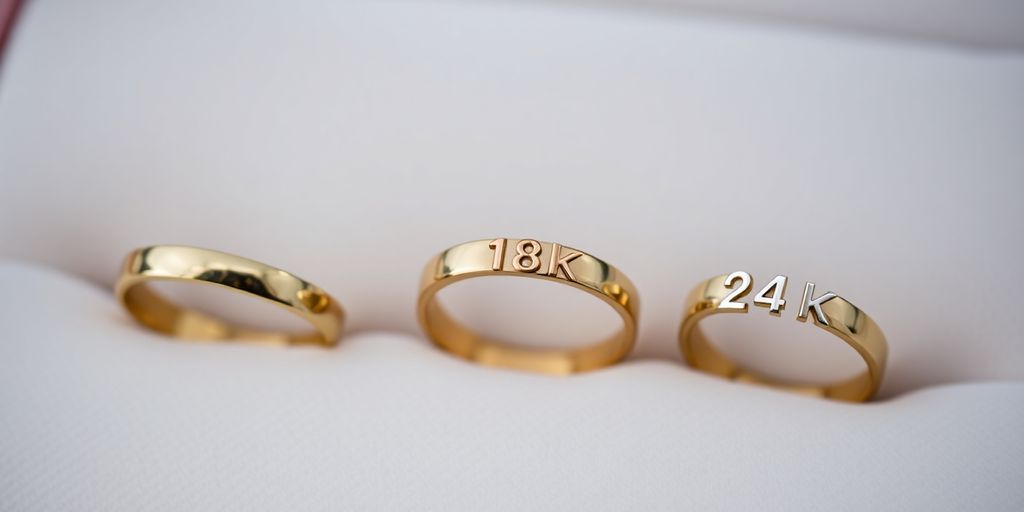
Okay, so you want to buy gold jewelry, but you're confused between 14K, 18K, and 24K? Don't panic, we'll sort it out together. Choosing the right type of gold really depends on what you're looking for. There are several things to consider: your budget, your lifestyle and your personal preferences.
- Your budget: 24K gold is the most expensive, followed by 18K gold, and then 14K gold. If you're on a budget, 14K gold can be a great compromise. In fact, if you're on a tight budget, 14K gold may be the best choice.
- Your lifestyle: If you're active and wear your jewelry every day, 14K gold is more resistant to scratches and dents. If you're more careful, 18K gold may be a good option.
- Your personal preferences: Do you prefer a more yellow, pure glow (18K or 24K) or a more subtle, long-lasting look (14K)?
Tips for purchasing
Before you take out your wallet, here are some tips to avoid making a mistake:
- Always check the hallmark: It indicates the number of carats of the jewel. A hallmark seahorse indicates a 24K gold jewel.
- Ask for a certificate of authenticity: Especially if you're buying a valuable piece of jewelry. This guarantees that the gold is as advertised.
- Compare prices: Don't hesitate to shop around to find the best value for your money. The most common gold purity levels are 10K (karat), 14K, 18K, and 24K.
Choosing the right type of gold is a bit like choosing the right wine. There's no one-size-fits-all answer; it all depends on your tastes and the occasion. Take the time to think carefully and don't hesitate to seek professional advice.
Personal preferences
Ultimately, choosing the right type of gold is a very personal choice. Some people love the pure, intense shine of 24K gold, while others prefer the durability and understated appeal of 14K gold. There's no right or wrong answer. Follow your heart and choose the piece that resonates with you! 14K gold is generally the best for jewelry. It sits at the sweet spot in terms of durability, appeal, and price.
When choosing gold for your jewelry, it's important to understand the different types available. Yellow, white, and rose gold each have their own charm and can suit different styles. Think about what you like and what will look good with your outfits. To learn more about gold options and make the best choice for your jewelry, visit our website!
Conclusion
In short, choosing between 14K, 18K, and 24K gold really depends on what you're looking for. 24K gold is pure, but it's also very soft and not ideal for everyday jewelry. 18K gold, with its beautiful color and durability, is often preferred for valuable pieces. 14K gold, on the other hand, is more affordable and durable, making it a popular choice for everyday jewelry. Consider your needs and budget before making your choice, as each type of gold has its own advantages.
Frequently Asked Questions
What is the difference between 14K, 18K and 24K gold?
24K gold is 100% pure, while 18K gold contains 75% pure gold and 14K gold contains 58,3% pure gold. This means that the higher the karat number, the purer the gold.
Why is 24K gold less used for jewelry?
24K gold is very soft and scratches easily, making it impractical for jewelry that is worn frequently.
What are the advantages of 18K gold?
18K gold is a good compromise between purity and durability. It has a beautiful shine and is durable enough for everyday use.
Is 14K gold a good choice for jewelry?
Yes, 14K gold is popular because it is durable and less expensive than 18K or 24K gold, while still looking good.
How do you know what type of gold to choose for jewelry?
Durability, price, and appearance should be considered. 14K gold is often chosen for everyday jewelry, while 18K gold is preferred for more precious pieces.
Does 24K gold have a better resale value?
Yes, 24K gold generally has a better resale value because it is pure, but it is less practical for wearable jewelry.