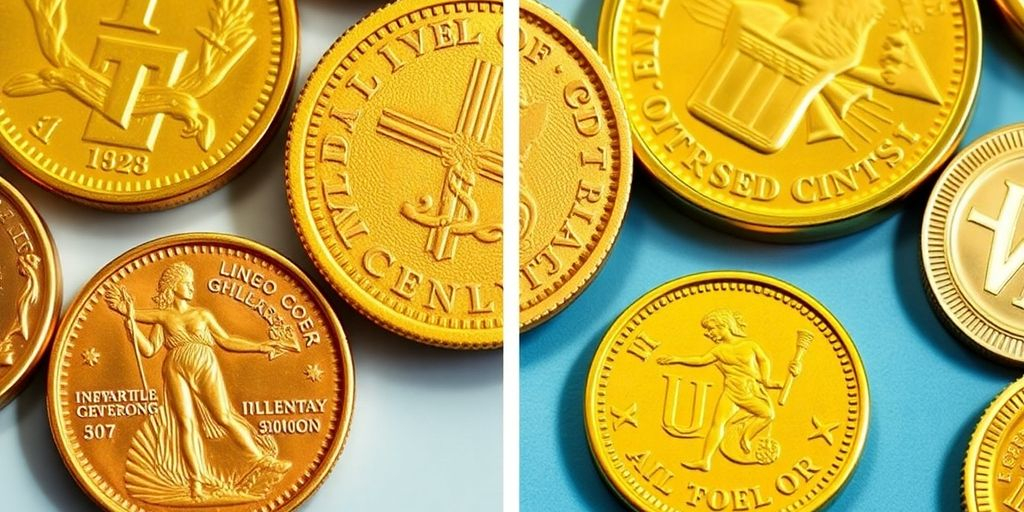
In the world of gold, it's important to distinguish between bullion coins and collectible coins. Each has its own characteristics, values, and uses. This article will help you understand the differences between bullion coins and collectible gold coins so you can make informed choices whether you're considering investing or collecting.
Key points
- Bullion coins are primarily valued on their gold weight and purity.
- Collectible pieces are distinguished by their rarity and state of preservation.
- Taxes vary depending on the type of coin, with specific rules for collectible coins.
- Professional expertise is essential to properly assess the value of coins.
- Proper preservation of coins is crucial to maintain their value over the long term.
Types of Gold Coins
There are three main categories of gold coins, each with its own characteristics and attracting different types of investors and collectors. It's important to understand these differences before you get started!
Investment Coins
Investment coins, also called tradable coins, are mainly made for invest in gold. Their value is mainly linked to the weight of the gold they contain. They are often produced in large quantities, which makes them more accessible. Examples include:
- The American Eagle
- The Canadian Maple Leaf
- The Vienna Philharmonic
These coins are typically of high purity (often 999,9/1000) and are recognized worldwide, making them easy to buy and resell. They're perfect if you're looking for an easy way to invest in physical gold.
Collectibles
Collectible coins, on the other hand, are a different story. Their value depends not only on the weight of the gold, but also on their scarcity, their condition, their historical interest, and collector demand. A rare coin in perfect condition can be worth much more than its gold value. Think of old French coins, limited editions, etc. This is a more specialized market, where expertise is important.
Limited Edition Pieces
These coins are a bit of a mix of both. They are minted in limited quantities, which can increase their collectible value, but they also contain gold, which gives them intrinsic value. They can be issued to commemorate an event, a personality, etc. This is a good compromise if you like the idea of having a rare coin, but with a solid gold base.
It's important to note that the distinction between these categories isn't always clear. Some coins can be considered both investment and collectible coins, depending on the criteria you consider. That's why it's always a good idea to consult experts before making a purchase.
The Value of Gold Coins
The value of a gold coin is a bit like a mystery to be solved. There's not just one thing that matters, but a bunch of intertwined factors. We're going to dissect all of this together, I promise, it'll be clearer later!
Valeur Intrinsèque
Intrinsic value is the basis. It's simple, it's the weight of the gold contained in the coin multiplied by the current price of gold. This price changes all the time, depending on supply and demand on world markets. So, even if a coin is old or damaged, it will always have a minimum value based on its weight in pure gold. It's a bit like having a gold bar miniature, its value is guaranteed by the precious metal it contains.
Numismatic Value
Ah, numismatic value! Now it gets a little complicated, but that's where it gets interesting. It's the value that collectors are willing to pay in addition to the intrinsic value. It depends on a lot of things: the rarity of the coin, its condition, its history, the number of minted copies, etc. A rare coin in perfect condition can be worth a fortune, much more than its mere weight in gold. It's like a masterpiece; its value isn't limited to the canvas and paint.
Factors Influencing Value
Okay, we've covered the basics, but what are the things that really make a coin's value go up or down?
- Scarcity : The rarer a coin is, the more sought-after it is, and the higher its price. Logical, right?
- The state of conservation: A coin in perfect condition (called "Fleur de coin") will be worth much more than a worn or damaged coin.
- Requirement : If everyone wants the same part, prices skyrocket. It's the law of supply and demand.
Basically, to evaluate a coin, you need to look at its age, condition, rarity, and whether it's a hot commodity among collectors. It's a bit like an investigation; you need to piece together all the clues to get an idea of its true value. Never overlook the importance of a coin's history and provenance.
Selection Criteria
So, are we going to start buying gold coins? Great! But before you get out your credit card, you need to know what you're looking at. It's not just gold; there are criteria that make all the difference in the price and value of the coin. We'll break it down together, we promise, it's less complicated than it seems.
Purity and Weight
Purity is the percentage of fine gold in the piece. We often refer to it in carats. A 24-karat gold piece is 99,9% pure gold. Obviously, the purer it is, the more it's worth. Weight is expressed in grams or ounces. Le gold price is calculated by weight, so it is an essential criterion.
- Always check the titration (the number of carats).
- Compare the weight of the coin with the standards.
- Be careful of coins that seem lighter, they could be counterfeit.
State of Conservation
The condition of the coin is its physical state. Is it new, worn, or scratched? This has a huge impact on its value, especially for collectibles. A coin in perfect condition (called "Fleur de coin") will be worth much more than a damaged one. It's like a classic car, really.
- Fleur de coin (FDC): Perfect condition, never circulated.
- Very Well Preserved (VGC): Light wear, details still clear.
- Well Preserved (BC): Visible wear, less precise details.
Condition assessment is subjective, but standardized grading scales exist. Don't hesitate to seek expert advice for an accurate assessment.
Rarity and Demand
Rarity is the number of coins minted. A rare coin is one that was produced in small quantities. Demand is the interest of collectors in that coin. If a coin is rare and in high demand, its price explodes. It's simply the law of supply and demand. To identify the authenticity of gold coins, these factors must be carefully examined.
- Ask about the mintage of the coin.
- Consult the quotation catalogs.
- Follow the auctions to see the prices achieved.
Associated Taxes
Okay, let's talk taxes, a subject that's never really fun, but crucial when you're dealing with gold. Taxation of investment and collectible coins is a little different, so you might as well be prepared to avoid unpleasant surprises. Basically, the important thing to remember is that the type of coin and how you sell it will influence the applicable taxes. It's not always easy, but we'll try to break it down together.
Tax on Investment Coins
For investment coins, it's pretty clear. When purchasing, generally, no VAT. That's already good news, right? However, when it comes to resale, things get a little more complicated. In France, you have two options:
- La precious metals tax (TMP), which is a fixed percentage of the sale price. Currently, it is 11,5% (including the CRDS). The advantage is that it's simple: you don't have to declare anything; the seller takes care of it.
- Capital gains tax (CGT), if you can prove the purchase price. It's 36,2%, but there's a 5% annual reduction starting from the third year of ownership. After 22 years, you're exempt! It's more complicated, but it can be more advantageous if you have a good capital gain and keep your coins for a long time.
Tax on Collectible Coins
Collectible coins are a bit like the Wild West when it comes to taxes. Taxation depends a lot on the value of the coin and how it's sold. If the coin is sold at public auction, for example, there are specific rules. Often, the tax on personal property applies, but this can vary. It's best to consult an expert before selling to avoid making a mistake.
Tax Exemptions
There are a few exemptions, but they are quite specific. For example, if the sale of your gold coins is less than a certain amount (€5000), you may be exempt from capital gains tax. Also, as mentioned above, after 22 years of ownership, you are exempt from capital gains tax.
Keep all your purchase receipts; they can be useful! And if you have any doubts, don't hesitate to consult a tax advisor or a precious metals expert. Prevention is better than cure, especially when it comes to finances.
The Importance of Expertise
Okay, let's face it, when we talk about gold coins, whether for investing or collecting, we quickly enter an area where it's easy to get lost. This is where expertise becomes super important. We're not just talking about knowing if it's gold or not, but understanding the actual value of the room. Believe me, it changes everything.
Professional Assessment
Having your coins appraised by a professional is a bit like going to the doctor for a check-up. They have an eye for spotting the details that make all the difference. An expert will look at the condition of the coin, its year of minting, its rarity, and many other things. They can even tell you if it's been cleaned (and trust me, that can lower its value!). This is an investment in itself, as it saves you from making costly mistakes. At GOLDMARKET, experts examine your collectibles meticulously.
Buying Advice
Imagine buying a car without consulting a mechanic. Risky, right? It's the same with gold coins. An expert can give you personalized advice based on your goals. Do you want to invest? Collect? They'll be able to guide you toward the best options. investment coins that match your needs. They can also help you negotiate prices and avoid paying too much.
Avoiding Scams
The world of gold coins is a bit of a jungle. There are honest people, but also scammers who are just waiting to take advantage of your ignorance. An expert is your shield against this. They can authenticate coins, detect counterfeits, and keep you from falling into traps. It's a bit like having a bodyguard for your finances.
Basically, don't skip out on expertise. It's an investment that can save you a lot of money and hassle. And it's always reassuring to know you've done things correctly, right?
How to Store Your Coins
Okay, so we've invested in some beautiful gold pieces, now we can't let them get ruined by letting them get damaged! Here are some tips for keeping them in pristine condition, whether they're investment pieces or collectibles. It's not rocket science, we promise!
Storage Conditions
The most important thing is to protect them from moisture and air. Think of your rooms as vampires: they hate direct sunlight and humid places.
Here are some simple tips:
- Keep your coins in one place sec. Like, really dry. Not the bathroom, though.
- Avoid mixing them with your other jewelry, especially silver jewelry. This can cause traces of oxidation, and it's not pretty pretty.
- Direct sunlight is a no-no. A drawer, a chest, a box... the important thing is that it's sheltered.
One piece of advice I often give is to keep them in a place where the temperature is stable. Temperature fluctuations aren't ideal for long-term storage.
Protection Against Damage
You don't handle a collectible coin the same way you would a regular coin. Every touch can leave tiny scratches, and over time, they become noticeable.
- The best thing to do is to store them in individual capsules. It's a bit like a box for each piece.
- If you don't have capsules, neutral plastic sleeves (PVC-free) are a good alternative. Avoid direct contact with your fingers.
- Never clean them with abrasive products! A simple soft cloth may be enough to remove dust, but if the piece is really dirty, it's best to seek professional advice.
Property Insurance
We don't always think about it, but it's important. If your coins have value, you might as well insure them, right?
- Have your coins appraised by an expert. This will give you a basis for insurance.
- Contact your insurer to see what options are available. Some home insurance policies cover valuables, but often require an extended warranty.
- Keep all purchase receipts and certificates of authenticity safe. This will make things easier to resolve in the event of a problem.
Basically, it's like everything else: a little care and prevention, and your coins will remain beautiful and valuable for a long time. And if you have any doubts, don't hesitate to ask a numismatist for advice. That's what they're there for!
Gold Coin Markets
The gold coin market is a bit like a bazaar where history, finance, and collecting collide. You'll find everything from investment coins to rare collectibles, and you need to know your way around to make the right choices. It's a global market, influenced by economic, political, and even cultural factors.
Where to Buy Parts
There are several options available to you when purchasing gold coins. The most common are:
- Authorized dealers: They offer a guarantee of authenticity and quality, but their prices may be a little higher. It's a bit like buying a car from a dealership: you pay a little more, but you get peace of mind.
- Banks: Some banks offer gold coins, but their supply is often limited.
- Online platforms: Be careful, you must be vigilant and check the seller's reputation. It's a bit like shopping online: you have to read reviews and check guarantees.
- Auctions: You can get some great deals, but you have to be an expert to avoid getting ripped off. It's a bit like playing poker: you have to know the rules and know how to bluff.
The important thing is to do your research before buying and compare prices. Don't hesitate to ask an expert for advice.
Online vs. In-Store Sales
Both online and in-store shopping have their advantages and disadvantages. Online, you have access to a wider selection and often more competitive prices. However, you can't examine the piece up close before purchasing it. In-store, you can see and touch the piece, but the prices are often higher and the selection more limited.
| Characteristic | Online sales | Sell in store |
|---|---|---|
| Choice | wide | Limit |
| Price | Competitive | Higher |
| Review of the room | Impossible before purchase | Possible |
| Tips | Limited (often by chat or email) | Custom |
| Safety | Risk of counterfeiting | More secure |
Price Evolution
Gold coin prices are influenced by several factors. Gold prices is obviously the main factor, but there's also the coin's rarity, its condition, and collector demand. Economic and political events can also have an impact on prices. For example, during times of crisis, gold coin prices tend to rise because they're considered a safe haven. It's important to follow market trends to know when to buy or sell. It's a bit like the stock market, you have to be attentive and responsive.
The Benefits of Investing in Gold
Safe Haven Value
Gold is often considered a safe investment, especially in times of economic uncertainty. When stock markets fall or geopolitical tensions rise, investors turn to gold, which tends to drive up its price. It's a bit like having an umbrella when it's raining cats and dogs in the financial markets.
Protection Against Inflation
Inflation is the enemy of purchasing power. Fortunately, gold has historically proven its ability to maintain its value, or even increase it, during times of inflation. Essentially, when the cost of living rises, gold follows suit, protecting your savings. It's like having a shield against the erosion of your money.
Portfolio Diversification
Investing only in stocks or bonds is a bit like putting all your eggs in one basket. Gold, on the other hand, often has a low correlation with other asset classes. This means that when your stocks go down, gold can go up, and vice versa. This helps smooth out your portfolio's performance and reduce overall risk. It's like having a wild card in your investment game.
Gold can be a valuable asset in a diversified portfolio, providing protection against economic crises and inflation. It's important to understand the different types of gold investments and choose the ones that best suit your goals and risk tolerance.
Here are some key benefits of investing in gold:
- Preservation of capital in times of uncertainty.
- Long-term growth potential.
- Portfolio diversification.
- Ease of buying and selling (liquidity).
Liquidity Differences
Okay, let's talk about how easy it is to turn your gold into cash, because let's face it, it matters! Let's take a look at how it works for investment and collectible coins.
Ease of Sale
When we talk about liquidity, we're talking about how quickly you can sell an asset without losing too much value. Imagine, you need money quickly. Can you easily get rid of your gold coins? That's the question.
Investment Coin Market
Investment coins are a bit like the sales highway. They are designed to be easily exchangeable. Why? Because they are standardized, globally recognized, and their value is primarily linked to Gold prices. So, finding a buyer is usually pretty straightforward. You can sell them to gold dealers, banks, or even online.
Collectible Coin Market
Collectible pieces are a different story. Their value depends on a host of factors: rarity, condition, collector interest, etc. As a result, it's not always easy to find someone willing to pay the price you're estimating. You often have to go through auctions and specialized collectors, and that can take time.
Basically, if you're looking for an investment you can resell quickly, bullion coins are a better choice. If you're willing to wait and find the right buyer, collectible coins can be interesting, but you have to be patient!
Mistakes to Avoid
When embarking on the adventure of gold coins, whether for investment or collecting, there are a few pitfalls to avoid. Believe me, it's better to be forewarned than to end up with a worthless coin or, worse, a counterfeit. We'll break down the most common mistakes together so you can invest with complete peace of mind.
Ignore Part State
Condition is a bit like your coin's identity card. A coin in perfect condition (known as "Fleur de Coin" or "FDC") will be worth much more than a worn or damaged coin. Scratches, dents, and general wear and tear can significantly reduce the value of a collectible. It's not just a matter of aesthetics, it's a matter of numismatic value. So, keep your eyes open and don't hesitate to ask an expert for advice.
Do Not Check Purity
Gold is gold, right? Well, not always. The purity of gold, expressed in karats, is super important. A 24-karat gold coin (pure gold) will have a higher intrinsic value than a 22-karat gold coin, for example. Always make sure you know the exact purity of the coin you're buying. Hallmarks and certificates of authenticity are your friends. If you have any doubts, have the coin tested by a professional. It's an investment that can save you from unpleasant surprises. It's crucial to check the authenticity of the coins before any purchase.
Neglecting Associated Costs
We tend to focus on the purchase price of the piece, but there are other costs to consider. Transaction fees, seller commissions, secure storage costs, and even potential taxes can quickly add up. Not to mention insurance, if you want to protect your collection from theft or damage.
- Transaction fees (purchase and sale)
- Storage costs (safe, etc.)
- Insurance costs
Don't forget to budget for these additional costs to get a clear picture of your investment. It's a bit like buying a house: there's not just the purchase price, there are also notary fees, property taxes, and more.
In short, investing in gold coins is a bit like playing chess: you have to plan ahead, do your research, and avoid making big mistakes. With a little caution and common sense, you can build a solid and profitable collection or investment portfolio. And above all, don't hesitate to seek professional help. That's what they're there for!
Current Trends
Popularity of Collectible Coins
There's a growing interest in collectibles. It's not just about investment, but also about passion and history. People are increasingly drawn to numismatic value and the unique look of each piece. It's a bit like owning a piece of history, which makes the investment much more personal and engaging.
Investing in Digital Gold
Digital gold is a bit of a new trend. We're talking about digital tokens that represent physical gold stored in vaults. It's convenient, easy to trade, and attracts a lot of young investors.
Impact of Economic Crises
Let's face it, economic crises can be quite a game changer. When the economy falters, many turn to gold, considered a safe haven. As a result, demand increases, and so do prices. It's a bit like the eternal cycle of gold, which reassures when everything else seems uncertain.
Gold has always been seen as a hedge against economic uncertainty. Its role as a safe haven is reinforced in times of crisis, encouraging investors to diversify their portfolios to protect themselves from financial turmoil.
In the world of today, Investing in gold is a trend that is attracting more and more people. Whether you're looking to protect your money or make a sound investment, gold remains a safe bet. If you'd like to learn more about the best options for buying and selling gold, visit our website to discover our offers and advice. Don't miss this opportunity to secure your financial future!
Conclusion
Basically, distinguishing between investment gold coins and collectible gold coins isn't that complicated. Investment coins are primarily valued for their gold value, while collectible coins have a history and rarity that add value. If you want to invest, choose coins in good condition and check their purity. For collectible coins, look at their condition and history. Basically, do your research before buying, and don't hesitate to seek expert advice if you have any doubts. It can really help you make informed choices when purchasing.