Are you wondering if the gold you see in jewelry or integrated into your electronic devices is the same as the gold you buy as an investment? It's an excellent question, because even though it's the same precious metal, their uses, markets, and therefore their prices can be quite different. Understanding these nuances is crucial for a better grasp of the world of gold. This article will shed light on these distinctions to help you gain a clearer understanding.
Key Takeaways
- Industrial gold, used for its electrical and thermal properties, finds its place in electronics and medicine, while investment gold is mainly sought as a safe haven.
- Historically, gold has served as a currency and standard, influencing the financial stability of nations.
- Gold bars and coins are the most common formats for investment, each with its own advantages in terms of storage and liquidity.
- Le Gold prices is influenced by many factors, including central bank decisions, industry demand, and speculation in financial markets.
- Although gold is a tangible asset, its price is strongly linked to both its intrinsic value to industry and its perception as a safe haven in investment markets.
Understanding the fundamental distinctions between investment gold and industrial gold
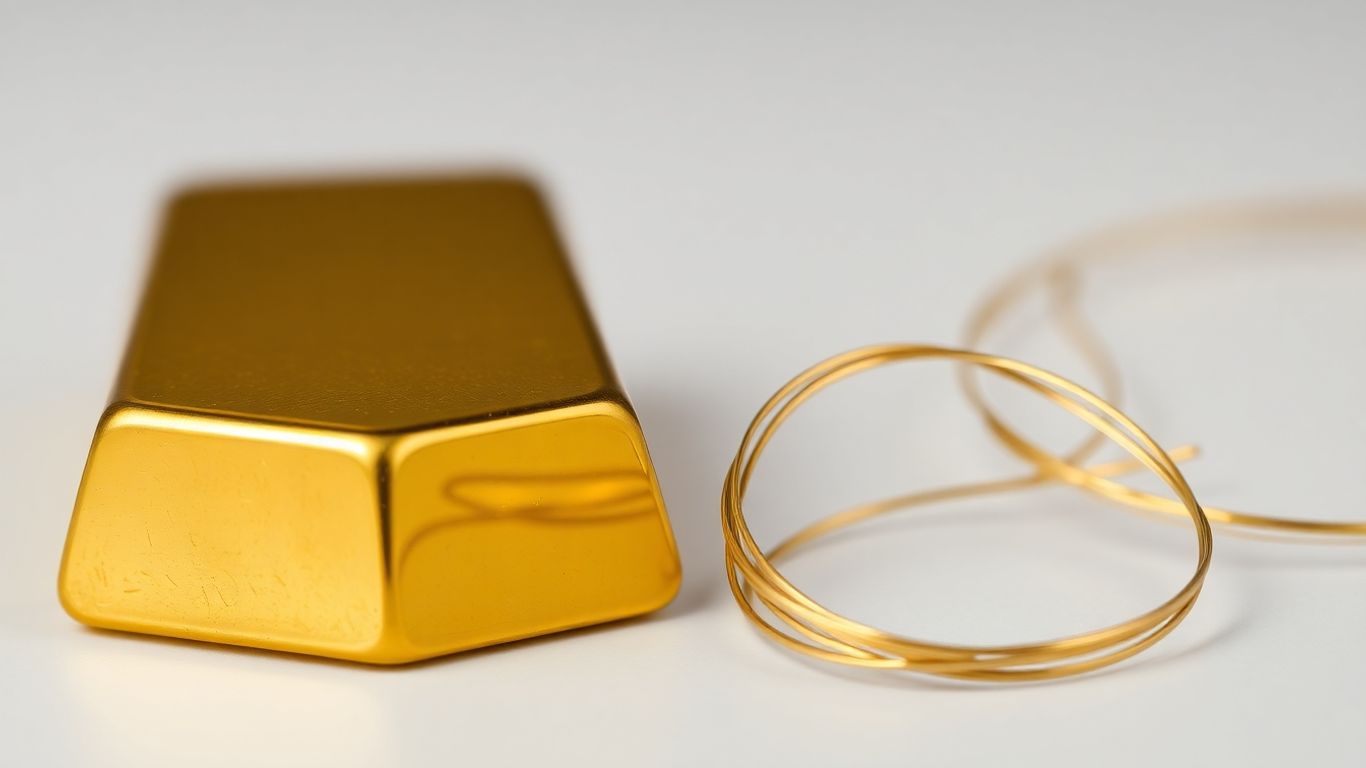
When it comes to gold, it's easy to get confused. You may have heard of the gold used to make jewelry or the gold found in our electronic devices. Well, that's not quite the same as the gold you buy to protect your savings. There are significant differences, especially when you look at prices and uses.
Gold in industry: specific properties and applications
Gold is a bit like the Swiss Army knife of precious metals in the world of technology. Its electrical conductivity is excellent, and it doesn't rust, which is quite convenient. That's why it's found in so many electronic gadgets, like computers and smartphones. Thin layers of gold ensure that everything works properly and that the connections last. It's also a metal that's easy to work with, so it's used in some dental prostheses and even in some medications. These uses require gold, but not for its investment value.
- Exceptional electrical conductivity : Ideal for contacts in electronics.
- Corrosion resistance : Ensures the durability of the components.
- Biocompatibility Used in medicine, particularly in dentistry.
Industrial gold, while valuable for its properties, is often less pure than investment gold. Its price is therefore directly linked to demand from the sectors that use it, and that can change quite rapidly.
Jewelry and goldsmithing: a historical use of gold
Ah, jewelry! That's where gold has truly proven itself over the centuries. Think of necklaces, rings, bracelets… To make them, pure gold is often mixed with other metals. Why? To make it stronger, because pure gold is quite soft. It also allows for different colors, like rose gold or white gold. The price of a piece of jewelry isn't just the gold price Inside, there is also the work of the jeweler, the design, the brand… In short, it’s a little different from the gold you buy as an investment.
Gold in medicine and electronics: cutting-edge uses
We've already touched on it briefly, but gold has truly impressive applications in cutting-edge fields. In medicine, for example, it's used for certain dental prostheses and even in treatments. In electronics, as we mentioned, its conductivity and corrosion resistance make it a material of choice for ensuring the reliability of devices. It's a bit like the unsung superhero of technology and healthcare. These uses show that gold is much more than just a safe haven asset; it's also a material with incredible properties.
Investment gold: safe haven and financial stability
Are you wondering why gold is often presented as a safe bet, especially when times are a bit complicated? It's not just a question of bling, far from it. Gold is a bit like the home port of investors when the markets are turbulent. It has this incredible ability to weather crises without losing too much of its value, or even to gain some. That's why we say it's a safe haven.
Gold as a hedge against inflation and economic crises
When inflation rises—you know, that slight general increase in prices that means your money buys less—gold tends to perform well. While currencies lose purchasing power, the price of gold can rise. It's as if gold maintains its value when other currencies weaken. It's a bit of a shield for your savings. Economic crises, geopolitical tensions, all of that can shake up the financial markets. Stocks can fall, bonds can become less attractive. In those times, many people turn to gold. Why? Because it's less tied to corporate decisions or government policies. It has an intrinsic value recognized worldwide. It's this independence that gives it its stability. Central banks around the world hold enormous quantities of gold, often more than 36,700 metric tons, which demonstrates their confidence in this metal as a store of value and for diversify their assets.
Recognized forms of investment gold
When we talk about investment gold, there are very specific formats that are recognized. Not just any jewelry will do. We're talking mainly about:
- Gold bars: They are available in a wide range of weights, from the smallest (1 gram) to the largest (1 kilogram). They are valued for their purity and their price per gram, which is often more advantageous in larger sizes.
- Investment gold coins: These are coins minted by states, legal tender in their country of origin, and meeting specific purity and weight criteria. Famous examples include the Napoleon French, the South African Krugerrand or the Canadian Maple Leaf.
These formats are preferred because they are easily identifiable, their purity is guaranteed and they are recognized on the global market, which facilitates their resale.
International investment gold standards
For a gold bar or coin to be considered investment gold, it must meet certain standards. The most important is purity. For gold bars, this generally means 999,9 parts per thousand fine gold (24 carats). Investment coins must have a fineness of at least 900 parts per thousand and have been minted after 1800. They must also have been legal tender in their country of origin. These standards guarantee that you are buying a product whose value is internationally recognized, which is extremely important when you want to sell your gold later. It's a bit like having a universal identity card for your investment.
Physical gold, whether in the form of bars or coins, offers reassuring tangibility. Unlike intangible assets, you can see it, touch it, and above all, you actually own it. This physical possession makes you independent of banking systems and stock market fluctuations, which is a major advantage in times of uncertainty.
The different formats for investing in gold
When you decide to invest in physical gold, you're faced with a choice: the format. It's not just about buying gold, but about choosing the form that best suits you, the one that aligns with your goals and your wealth management strategy. Each format has its own advantages, whether it's ease of storage, resale, or even the initial investment price. It's therefore important to understand the differences.
Gold bars: from 1g to 1kg
Gold bars are a classic investment in physical gold. They come in all sorts of sizes, from tiny 1-gram bars to larger 1-kilogram bars. Smaller sizes, like 1g or 2g, are great for beginners or for gifts. They're more affordable and allow you to buy gold gradually, much like saving money. It's a good way to build up a gold portfolio without having to spend a large sum all at once. Intermediate sizes, like 50g or 250g, offer a good compromise. They're easier to store than larger bars, and the price per gram is often more attractive. The 1kg bar, on the other hand, is for those who want to invest a larger sum and are looking for the best price per gram. They are all produced by recognized refiners and come with a certificate of authenticity, guaranteeing their purity and origin. This is important to ensure the quality of your investment.
Here's an overview of common formats:
- Ingots (1g to 50g) Ideal for beginners, as gifts, or for flexible management. The price per gram is generally a little higher.
- Intermediate ingots (100g to 500g) A good balance between cost and ease of use. The price per gram becomes more competitive.
- 1kg ingot : The most advantageous format in terms of price per gram, but requires a larger initial investment and more suitable storage.
It is essential to verify that your bullion bars come from recognized refiners and that they comply with international standards, such as those of the LBMA (London Bullion Market Association). This ensures their purity and facilitates their resale.
Investment gold coins: a recognized value
Gold coins are another very popular way to invest. Think of Napoleons, Sovereigns, or Krugerrands. These coins have a history; they even circulated as currency at one time. What's interesting about coins is that they often have numismatic value in addition to their intrinsic gold value. This means their price can also depend on their rarity, condition, or historical significance. This is somewhat different from gold bars, which are primarily valued for their weight and purity. Coins are also easier to resell in small quantities, and they are often easier to store and transport than gold bars. You just need to be careful to choose reputable investment coins, as not all gold coins are created equal in terms of liquidity and premium.
Some examples of popular investment coins:
- Napoleon (France) Historical pieces with high demand.
- Sovereign (United Kingdom) A classic piece, recognized worldwide.
- Krugerrand (South Africa) : One of the first modern investment coins.
- Maple Leaf (Canada) Known for its very high purity.
It is important to find out about the official list of coins considered investment gold, as this can have tax implications.
Choosing the format according to your objectives
So, how do you choose? It really depends on what you want to do. If you're a beginner and just want to test the waters, a small 1g ingot or a Napoleon coin could be a good idea. It's affordable and allows you to understand how it works. If you have more capital and are looking to secure part of your assets for the long term, 50g, 250g, or even 1kg ingots are more suitable. They often offer a better price per gram. For those who love history and believe numismatic value plays a role, investment coins are worth exploring. The important thing is to carefully consider your objectives: do you want to be able to easily resell a small portion of your gold? Are you looking for the lowest price per gram? Or are you drawn to the historical aspect? By answering these questions, you'll find the format that best suits you for investing in physical gold.
Factors influencing the price of gold
The price of gold fluctuates, right? It's not an exact science, and many things can make it go up or down. If you're wondering what's behind these fluctuations, let's take a look. It's not just a matter of demand for jewelry, far from it.
The role of central banks and markets
Central banks, you see, are the big players in the gold market. They hold tons of this precious metal, often to ensure the stability of their country. When they decide to buy or sell part of their reserves, it can have a fairly direct impact on the global price. If they buy a lot, demand increases, and boom, the price can climb. Conversely, if they sell, it can cause the price to fall. It's a bit like when a large company buys or sells a lot of a stock; it moves the market. Central bank gold reserves are a bit of a barometer of confidence in the global economy, and they influence the price of gold. You can track the evolution of these reserves to get an idea of what's going on.
Industrial and jewelry demand
Okay, we often talk about it, but the jewelry industry is a major consumer of gold, especially in countries like India and China. When the holidays approach or purchasing power increases in these regions, the demand for gold jewelry rises, and that drives prices up. But be aware, gold isn't just for looks. Industry uses it too, and quite extensively! Think of electronics, where gold is used for its exceptional conductive properties, or medicine for certain applications. When these industrial sectors need more gold, it creates additional demand that can also push prices up. It's this dual demand, both for pleasure and necessity, that makes the gold market so dynamic. Gold is essential in industrial applications in France because of its unique properties, such as its electrical conductivity and corrosion resistance. These cutting-edge uses create a constant demand.
Speculation and economic uncertainties
And then there's the whole speculation part. Financial markets are a bit like a game where people bet on future price movements. When there's economic uncertainty, like high inflation or geopolitical tensions, many investors turn to gold because they see it as a safe haven. They buy gold hoping its price will rise when other assets, like stocks, fall. These massive purchases, often motivated by fear or the anticipation of trouble, can drive up the price of gold, even if industrial or jewelry demand hasn't budged. It's a bit like a self-fulfilling prophecy: everyone thinks gold will rise, so everyone buys it, and as a result, it rises. You need to keep an eye on gold price forecasts to understand these movements.
The price of gold is influenced by a complex combination of factors, ranging from strategic decisions by central banks and consumer demand for jewelry to the specific needs of the industry. Global events, whether economic or geopolitical, also play a major role in directing investors toward this metal as a safe haven.
Price comparison: industrial gold versus investment gold
The distinction between intrinsic value and speculative value
You're probably wondering why the price of gold you see in jewelry or electronics isn't the same as the price you buy for investment. That's a perfectly normal question! In fact, even though it's the same metal, its price is influenced by very different factors.
Gold, as a raw material, has a base value, a kind of intrinsic value. This value comes from its unique properties: it is rare, it doesn't rust, and it conducts electricity well. That's why it's found in advanced electronics, dentistry, and even some medications. Demand for these industrial uses drives up the price of this type of gold. But be aware that this gold doesn't necessarily need to be of extreme purity, which can affect its cost.
On the other hand, investment gold, such as bars or recognized coins, is primarily valued for its stability. It is a safe haven asset. Its price is therefore much more closely tied to the confidence people place in it, especially during periods of economic uncertainty or inflation. It must meet very strict purity standards (often 999,9 per thousand), which increases its production cost and thus its value on the investment market.
The impact of purity on cost
Purity is a bit like the benchmark that determines the price. For investment gold, we're talking about very high purity, often 99,99%. This is what we call fine gold. The higher the purity, the higher the price per gram, because more advanced refining processes are required to reach that level.
For industrial gold, purity may be less critical. For example, for some electronic components, a very thin layer of gold is sufficient, and its purity doesn't need to be as perfect as for a gold bar. Similarly, gold used in jewelry is often alloyed with other metals (copper, silver) to give it color and durability. A piece of 18-karat gold jewelry (75% pure gold) will therefore be less expensive per gram than a pure gold bar.
Here is a small table to help you see things more clearly:
| Gold type | Typical purity | Price per gram (indicative) | Main pricing factors |
|---|---|---|---|
| Investment gold | 99,99% | High | Purity, demand as a safe haven asset, storage costs |
| Industrial gold | Variable | Medium | Specific properties (conductivity, etc.), sectoral demand |
| Gold in jewelry | 75% (18 carats) | Medium to High | Alloys, manufacturing costs, brand, design, purity |
Additional costs in the price of jewelry
When you buy a piece of jewelry, the price you pay isn't just the value of the gold it contains. There are many other factors involved. Think about the design costs, the craftsman's work, the brand (a luxury brand will cost more), and even the advertising costs. All of this increases the final price. That's why jewelry, even if it's made of gold, isn't always the best way to invest your money if your only goal is pure financial return. Investment gold, on the other hand, is sold with a lower markup because it doesn't have all these additional costs. The price is much closer to the intrinsic value of the pure metal.
In short, if you're looking to protect your savings and have a tangible asset that retains its value over the long term, investment gold is the best option. If you're passionate about electronics or looking for an aesthetically pleasing object, industrial gold or jewelry gold will also have their place, but with a different pricing strategy.
Gold and its historical role in global finance
From the first currencies to the gold standard
You know, gold isn't just a shiny metal we use for jewelry or investments today. Its history is incredibly long and intimately linked to how we've traded and managed wealth throughout the centuries. We've been talking about gold since the end of prehistory; it was the second metal humans learned to work, right after copper. Initially, it was mainly used to adorn the powerful and in religious ceremonies, a bit like a symbol of status and power.
But it was really in Antiquity that gold took off as a monetary currency. The Lydian kings, for example, were among the first to mint gold coins around the 8th century BC. Just imagine: gold coins in circulation! Later, in France, under Louis XIII, the famous Louis d'or became a kind of international benchmark for safe investments. It was from then on that gold truly began to shape the monetary policies of nations.
In the mid-19th century, the California Gold Rush had a tremendous impact, not only on the expansion of the American West, but also on the region's economy and demographics. Gold subsequently became the primary monetary standard, known as the gold standard. This system aimed to stabilize exchange rates by fixing a fixed value relative to gold. It lasted for quite some time, until things changed.
The abandonment of the gold-dollar parity
The gold standard system, established notably with the Bretton Woods agreements of 1944, began to show its limitations in the 1960s. The United States had significant external deficits, which weakened the system. Finally, in 1971, the United States decided to suspend the convertibility of the dollar into gold. And in 1976, with the Jamaica Accords, gold was definitively demonetized, losing its official monetary status. The price of an ounce of gold, which had remained fairly stable for years, then skyrocketed, reaching record highs in the 1970s and 1980s. It was, in a way, the end of an era for gold as official currency.
The Role of Gold in the Financial Stability of Nations
Despite the end of its official convertibility, gold has not lost all its importance; far from it. Central banks still hold enormous quantities of gold, almost as a guarantee for their country's financial stability. The United States, for example, possesses the largest monetary gold reserves in the world. In 2003, it was estimated that central banks held about a quarter of all the world's gold, or nearly 28,554 tons! That's enormous.
Gold continues to be traded on major global stock exchanges, and the transactions that take place there, especially during periods of economic crisis or uncertainty, are often seen as an important barometer of the health of the global economy. It must be said that gold has this unique ability to retain its value, even when financial markets are turbulent. This is why it remains a pillar of monetary stability for nations, even if it is no longer directly linked to currencies as it once was.
Gold, by its tangible nature and rarity, has always inspired confidence. Its monetary history shows how it served as a basis for trade, a symbol of wealth, and a guarantee of stability. Even after losing its official role as currency, it remains an essential asset for central banks and a safe haven for investors in times of uncertainty.
Gold has always played an important role in the history of money worldwide. It has been used as a medium of exchange and as a symbol of wealth for centuries. Understanding its historical journey can help us better understand today's financial markets. To learn more about how gold influences finance, visit our website.
In conclusion: which gold for which project?
So, that's it. You can see now that gold isn't just a shiny metal. Whether it's to protect your money from economic fluctuations or to be used in high-tech devices, it has many facets. Investment gold is your safety net, the one that remains solid when everything else falters. Industrial gold, on the other hand, is at the heart of innovation—perhaps a little less glamorous, but just as important. So, when you're looking at gold, think about what you want to do with it. Are you looking to secure your future? Or are you fascinated by technology? Sometimes, a bit of both can be a good idea. Weigh the pros and cons carefully before taking the plunge.
Frequently Asked Questions
What is the main difference between gold found in jewelry and gold used for investment?
The gold in jewelry is often mixed with other metals to make it more durable and give it a special color, such as yellow or rose gold. It is generally less pure than investment gold. Furthermore, the price of jewelry includes manufacturing and design costs, making it less attractive as a pure investment.
Why is gold considered a safe haven?
Gold is seen as a safe haven because it tends to retain its value even when the economy is struggling. Unlike currencies, which can lose value over time, gold remains stable and can even increase in value during times of inflation or crisis. It's a bit like insurance for your money.
What are the criteria for a gold bar or coin to be considered investment gold?
To be considered investment gold, the bars or wafers must be at least 99,5% pure (or 995 thousandths) and weigh more than one gram. For coins, they must have been minted after 1800, have been legal tender in their country of origin, and their price must not be significantly higher than the value of the gold they contain.
Is industrial gold the same as investment gold?
No, it's not the same thing. Industrial gold is used for its special properties, such as its ability to conduct electricity well and its resistance to corrosion. It's found in phones, computers, and even medicine. Its price depends mainly on demand from these industries, while investment gold is primarily purchased for its reserve value.
What are the most common formats for investing in gold?
The most common formats for investing in gold are gold bars (or ingots) and coins. Bars come in various sizes, from small grams to kilograms, and are generally very pure. Gold coins, such as the Napoleon or the Sovereign, also have recognized value and are easier to exchange in small quantities.
Why do central banks hold large amounts of gold?
Central banks buy and hold gold because it is a very safe asset that helps stabilize a country's economy. In the event of a financial crisis or high inflation, gold retains its value and strengthens confidence in the country's currency. This is a way to ensure the nation's financial soundness.