
Are you wondering whether it's better to invest in physical gold or real estate in 2025? This is a question many are asking, especially as we see gold prices rising and real estate prices stabilizing, or even declining in some areas. These two investments are often considered safe bets, but they have very different functions and objectives. So, to help you see things more clearly and make the best choice for your money, we're going to analyze the strengths and weaknesses of physical gold versus real estate.
Key Takeaways
- Physical gold is a tangible asset, widely recognized, that can protect you in the event of major economic difficulties. It doesn't offer regular income, but it's easy to resell.
- Real estate is a little different. It can bring in rent every month, and its value can increase over time. However, it requires more money to start and is less easy to sell quickly.
- To buy gold, you can start with relatively small amounts, such as coins or small bars. Real estate generally requires a larger deposit, although there are ways to start with less.
- Selling gold is generally faster than selling a house or apartment. You just have to be aware of fees and market fluctuations for gold.
- The ideal is often to have a bit of both in your assets. This allows you to spread the risks and enjoy the benefits of each type of investment. A little gold for security, a little real estate for yield, it's a good balance.
Gold and real estate: two pillars of wealth investment
Comparing gold and real estate isn't just a pipe dream. In 2025, it's a logical step if you're serious about building your wealth. These two types of assets have been found for centuries in the portfolios of those looking to secure their money. But beware, their role has changed somewhat over time, especially with the current uncertainties in the world. Gold, for example, is reaching record prices, while real estate is experiencing a correction after years of growth. This encourages you to think about how they can work together in your wealth.
Why compare gold and real estate?
This is a question many people ask themselves, and it's understandable. You're wondering whether the simplicity and liquidity of gold is better, or whether you'd rather aim for the potentially higher returns of real estate, even if it means using credit. The answer really depends on your goals, how long you want to leave your money invested, and your risk appetite. There's no magic formula, just strategies to adapt to your situation.
- Gold: It's liquid, it can be tax-efficient, but it doesn't earn you anything directly. It's mainly to preserve your capital.
- Real estate: It can bring in more money, but it requires management, or you can delegate that management. It's a more productive investment.
Two historic safe havens
Gold and real estate have always been the solid foundations of investment. They've weathered every crisis, whether economic or political. Gold is the ultimate safe haven. It's a precious metal that retains its value, no matter what happens with currencies. And since it can be easily resold anywhere, it's a bit of a universal language for money. Real estate is tangible assets. Whether it's a house or an apartment, it can bring you regular rent and also protect you against inflation. Basically, one provides security, the other generates income. That's why they're often found together in well-constructed portfolios.
Gold and real estate are often seen as safe bets, especially when the economic climate is uncertain. They attract those who want to protect their money.
Different but complementary investment intentions
Each asset has its own role in your overall strategy. Gold is there to preserve your capital. It's highly liquid, easy to store, and has proven its ability to maintain its value when markets are unstable. It's a bit of a shield. Real estate, on the other hand, is more geared toward generating income through rental income and has long-term appreciation potential. It can also protect you against inflation. In fact, they complement each other well: one provides security, the other generates growth. It's this complementarity that makes them key elements for diversifying your assets.
The advantages of gold as a safe haven
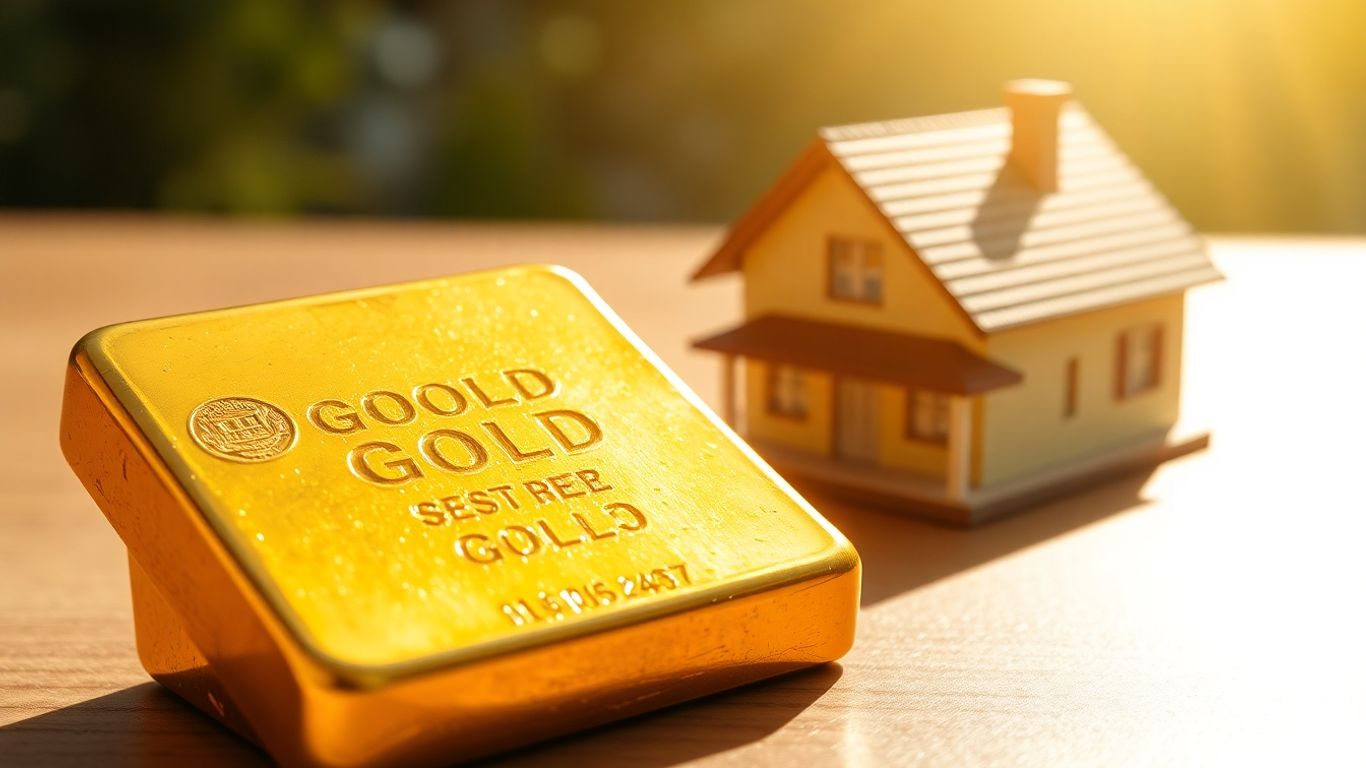
When we talk about investing, gold often comes up. And for good reason: this yellow metal has a great reputation as a safe haven. It's like a safe for your assets when times are uncertain. Wondering why it has this particular appeal? Let's take a closer look.
A tangible and universally recognized asset
Gold is something you can touch, hold in your hand. Unlike a stock, which only exists on a screen, a gold bar, or a gold coin, it's tangible. And that's reassuring. Plus, no matter where you are in the world, gold is understood. There are no language or cultural barriers when it comes to recognizing the value of gold. It's like having a universal currency in your pocket, ready to be exchanged if needed.
An essential safe haven
It's often said that gold is a shield against crises. And it's quite true. When financial markets panic, banks have problems, or the geopolitical climate becomes tense, people tend to turn to gold. Its price often tends to rise when other assets fall. That's why many financial advisors recommend having a small portion of it in your portfolio, like 5 to 10%, just for safety.
Advantageous taxation
In France, the way gold is taxed when you resell it is rather interesting. You have a choice: either a flat tax of 11,5% on the capital gain, or, if you keep your gold for more than 22 years, you can even be completely exempt from tax on this capital gain. Not bad, right? You don't have to worry about complicated declarations until you sell. It's only when you resell that you have to worry about it.
Gold is a bit like insurance for your money. It won't earn you millions in a year, but it's there to protect your capital when things go wrong elsewhere. That's its main strength: the security it provides.
Real estate: a productive and tangible investment
Real estate is a pillar of wealth for many French people, and it's easy to see why. In 2025, the real estate market continues to attract investors, thanks in part to financing options that, while evolving, remain attractive for those who know how to take advantage of them. It's an asset that doesn't just increase in value; it works for you, generating regular income.
The advantages of real estate in 2025
It's safe to say that real estate has a significant income-generating potential. Think about the rent you receive each month. This regular income, often indexed to inflation, can not only cover your expenses but also, over time, pay off your mortgage. It's a bit like having an employee who pays you.
Additionally, real estate offers the potential for capital appreciation. Properties, especially in desirable areas, tend to increase in value over the long term. It's an asset you can pass on, a value that lasts.
Rental income and credit leverage
The big advantage of real estate is that it can bring you money every month through rent. This is called rental income. And a mortgage is your best ally for multiplying your investment capacity. By contributing a portion of the capital, you can acquire a property with a much higher value. For example, with a 20% deposit, you actually control 100% of the property's value. This is called leverage, and it can really boost the profitability of your initial investment.
Tax advantages and real estate loans
Let's talk a little about tax benefits, because there are many. Schemes like the LMNP (Non-Professional Furnished Rental) status allow you to depreciate the property and furniture, which considerably reduces your income tax. There is also the land deficit or the possibility of going through a Civil Real Estate Company (SCI) to optimize your taxes. These schemes are real tools to reduce your tax burden while building your assets. Credit conditions in 2025, although fluctuating, can still offer interesting opportunities to finance your projects. It is always good to find out about the real estate rates current to properly frame your budget.
Real estate is an investment that requires careful thought, but it can truly transform your financial situation in the long run. You just need to understand the mechanisms and constraints to get the most out of it.
Accessibility and investment formats
When we talk about investing, whether in gold or real estate, the first thing that often comes to mind is the amount needed to get started. And that's normal; you need to know if it's within your reach.
Investing in physical gold: bars and coins
Physical gold is pretty simple to understand. You buy a quantity of gold, in the form of bars or coins, and you keep it. For bars, there are many different sizes. You can find tiny 1-gram bars, perfect for starting out on a small budget, or 500-gram or 1-kilo bars if you already have a larger capital. It's a bit like buying bricks, but made of precious metal. Gold coins, like Napoleons or Sovereigns, are another way to invest. They have a face value, but their price depends mainly on their weight in gold and their rarity.
- Gold bars: Ideal for beginners, with sizes like 1g, 2g, 5g, 10g. Perfect for gradually building up.
- Gold bars: Larger formats such as 50g, 100g, 250g, 500g, 1kg. They offer a better price per gram.
- Gold coins: Historical and recognized, they can have a numismatic value in addition to their intrinsic value.
The advantage is that you can start with a few dozen euros for a 1 gram ingot. It's really affordable. You can even buy gold through ETFs if you prefer a more dematerialized approach, but we are talking about physical gold here.
Investing in real estate: contribution and management
Real estate is another story. To buy a property directly, you generally need a fairly substantial personal contribution, often around 10% of the property's price, or even more, not including notary fees and other costs. It's an investment that requires more initial capital than physical gold. But there are solutions to make real estate more accessible. SCPIs (Sociétés Civiles de Placement Immobilier), for example, allow you to invest in real estate with more modest sums; a few hundred euros are enough to buy shares. It's a bit like buying a small fraction of a building.
Real estate is a bigger commitment at the outset, but it can generate regular income and long-term capital gains. You just need to choose your investment method wisely.
- Direct purchase: Requires a substantial contribution and active management (tenants, works, etc.).
- SCPI: Allows you to invest in real estate with a lower entry ticket and delegated management.
- Real estate crowdfunding: Invest in specific real estate projects with varying amounts.
Diversify your assets with varying amounts
The interesting thing is that you don't have to choose between one or the other. You can very well have a little gold and a little real estate in your assets. The idea is to build a diversified portfolio. If you have a small budget, you can start by buying a few grams of gold each month. As your capital grows, you may want to consider investing in REIT shares or, later, in real estate directly. The important thing is to start, regardless of the amount. Every euro invested, whether in gold or real estate, helps build your financial future.
Liquidity and risk management
When it comes to liquidity and risk management, you need to understand how each asset behaves when you need your money quickly or if things go wrong. It's a bit like knowing whether you can sell your car easily or if you'll have to wait months and lower the price.
Which asset is easiest to resell?
For gold, it's generally quite simple. If you have physical gold, such as recognized bars or coins, there's always a market. Professionals and even individuals are often willing to buy. If you use vehicles like ETFs or paper gold, resale is almost immediate, like selling a stock on the stock market. This is a big plus if you need cash immediately.
Real estate, on the other hand, is a different story. Selling a property takes time. You have to find a buyer, negotiate, and go through administrative procedures that can last several months. Even if you have a quality property in a good neighborhood, there's no guarantee of a quick sale. Things can get complicated if the real estate market slows down or if interest rates rise, making financing more difficult for potential buyers.
Managing Gold Risks
Gold is a safe haven, but that doesn't mean there's no risk. Its value can fluctuate a lot, sometimes quite dramatically, depending on the global economy, geopolitical tensions, or even movements in the financial markets. This is called volatility. If you buy gold at its peak and the market falls right afterward, you can lose money in the short term. There's no regular income like rent, so your only gain comes from the rising price. You also need to think about secure storage if you have physical gold, which can lead to costs or security concerns.
Anticipating real estate constraints
With real estate, the risks are different. The first is rental vacancy: your property may be empty for a while, and you continue to pay charges and taxes without receiving rent. There are also tenant-related risks, such as unpaid rent or damage. Not to mention the work required, which can be expensive and impact your profitability. Furthermore, as mentioned, reselling can be long and complicated, especially if you need to sell quickly. You also have to consider management fees, property taxes, and the fact that real estate often requires a significant initial deposit, which can limit accessibility for some.
In summary, gold offers great resale ease and protection against inflation, but its value can be volatile and it does not generate income. Real estate, on the other hand, can provide regular income and some stability, but it is much less liquid and carries management and vacancy risks.
Reconciling gold and real estate for a balanced portfolio
So, how do you make gold and real estate work together in your investment strategy? That's where diversification comes in, and frankly, it's kind of the secret to not putting all your eggs in one basket. The idea is to create a portfolio that doesn't depend solely on the performance of a single asset type. Basically, when one goes up, the other can stabilize, or even decline a little, and vice versa. This helps smooth out the bumps and allows you to sleep a little easier.
Diversification: a fundamental principle
Diversification is really the foundation. It involves spreading your money across different asset classes to reduce overall risk. If you put everything into real estate and the market takes a dip, or everything into gold and its price suddenly drops, you could be in trouble. By combining gold, which is often seen as a safe haven in times of uncertainty, and real estate, which can generate regular income and appreciate in value over the long term, you create a balance. It's a bit like having insurance against the unexpected.
- Risk reduction: By not depending on a single market, you reduce the impact of declines on your overall wealth.
- Increased stability: Real estate can provide regular rental income, while gold can serve as a shield against inflation or crises.
- Flexibility: This combination gives you more room to adjust your strategy as the economy evolves.
Example of balanced distribution
Of course, there's no magic formula that works for everyone, as your personal situation, risk tolerance, and goals are unique. But to give you an idea, a fairly typical allocation might look something like this:
| Asset class | Suggested percentage |
|---|---|
| Real Estate | 60% - 70% |
| Or | 10% - 20% |
| Cash/Other | 10% - 20% |
For a more conservative profile, you could increase the proportion of gold and cash, for example, 50% real estate, 30% gold, 20% cash. Conversely, if you are more dynamic and aim for stronger growth, you could adjust to 80% real estate and 15% gold. The important thing is that this allocation suits you and is in line with your plans.
It's important to remember that these percentages are examples. Your own strategy should be tailored to your investment horizon, your ability to tolerate fluctuations, and your income needs.
Real Estate Private Equity: a strategic alternative
If direct real estate seems too restrictive in terms of management (finding tenants, managing renovations, etc.), or if you have more capital to invest, Real Estate Private Equity can be an interesting option. Basically, you invest in funds that own and manage diversified real estate portfolios (offices, retail, logistics, etc.). It's a way to access professional real estate, often with higher entry tickets, but which delegates management to experts. This can offer good return potential, while benefiting from a certain diversification within real estate itself. It's a way to combine the advantages of real estate with more passive management, which can be combined well with an allocation to physical gold for a truly balanced portfolio.
To have a solid investment portfolio, it's a smart idea to combine gold and real estate. These two assets can complement each other to help you grow your money. Want to know how?
Discover how combining gold and real estate for a balanced portfolio on our website!
So, gold or real estate: what will your choice be?
So, that's it. You've seen that gold and real estate don't have much in common, even though both can help grow your money over the long term. Gold is more for those who want something safe, easy to resell, and who fear inflation. Real estate is more for those looking for regular income, who are willing to take care of it a little, and who have a longer-term vision. Often, it's best not to put all your eggs in one basket. Think about what suits you best, your goals, and your own situation. And if you still have doubts, don't hesitate to seek professional advice. It's always a good idea to think carefully before investing your money, right?
Frequently Asked Questions
Why compare gold and real estate for my savings?
That's a good question! We compare gold and real estate because they are two different ways to make your money grow over the long term. Gold is like a super-safe store of value that survives crises. Real estate is more tangible; it can bring in rent every month and increase in value over time. Both have their advantages in making your money work for you.
Is gold really a safe haven?
Yes, gold has been considered a safe haven for a very, very long time. When there are problems in the world, like economic crises or tensions, people tend to buy gold because it retains its value. It's a bit like a treasure that doesn't lose its shine, no matter what's going on around it.
What makes real estate interesting in 2025?
In 2025, real estate has several advantages. For example, you can buy a property with a loan, which means you don't need the entire amount at once. Plus, if you rent out your property, you receive rent that can help you pay off your loan or earn you money. There are also incentives to reduce taxes when investing in real estate.
Is it easy to buy and sell gold or real estate?
For gold, it's pretty easy to resell quickly, especially if you have reputable bars or coins. It's quite liquid. Real estate is a little different. Selling a house or apartment can take longer because you have to find the right buyer. So, gold is generally easier to resell when you need it.
How can I start investing in gold or real estate with little money?
Even with a small budget, you can get started! For gold, you can buy small coins or even fractions of ingots. For real estate, it's a little more complicated at first because you need a deposit, but you can look into fractional real estate or SCPIs (Sociétés Civiles de Placement Immobilier) which allow you to buy shares of real estate with more modest sums.
Is it a good idea to put gold and real estate in my portfolio?
Absolutely! It's actually a great idea to diversify. Basically, it means not putting all your eggs in one basket. If real estate is going through a rough patch, gold can help balance it out. And if the gold price decline, your real estate can continue to generate rent. This is a strategy that allows you to better protect your money over the long term.