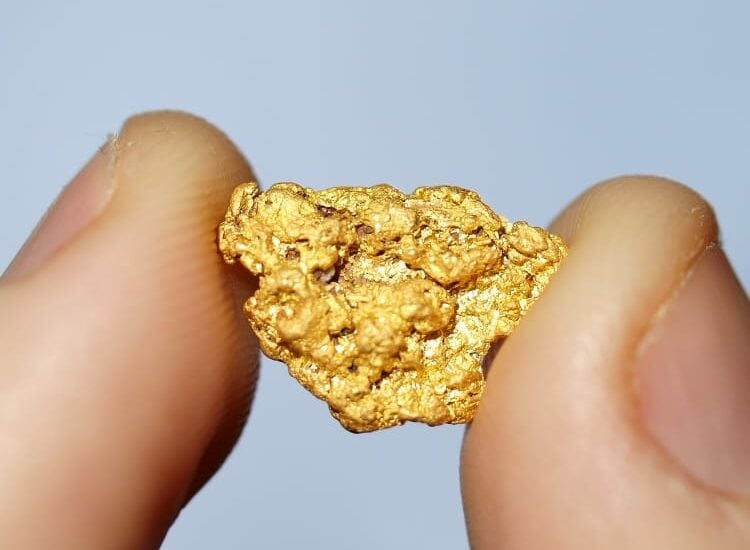
vc_row] vc_column offset=”vc_col-lg-9 vc_col-md-9″ css=”.vc_custom_1452702342137{padding-right: 45px !important;}”] stm_post_details] vc_column_text css=”.vc_custom_1662124073704{margin-bottom: 20px !important;}”]We all know that gold is a precious resource, present in its natural state almost everywhere in the world. Its most common form is flake, which is found in particular in gold-bearing sand including in France, in the Pyrenees as well as in the Alps. But can synthetic gold be made?
Where does the gold we know today come from?
Currently, the gold that we know comes mainly from gold-bearing rivers and streams, near mountain ranges. In France, for example, with a little patience, it can be found in the Pyrenees, but also in the Jura massif, the Alps or the Massif Central. Gold thus occurs naturally in the form of "flakes", which can reach very variable dimensions depending on the region. In the eastern Pyrenees, we can find flakes that can reach dimensions greater than 5 mm.
Update on technological advances
Many chemists are now looking at gold, as well as possible technological alternatives for make gold in the lab more easily. For the moment, scientists know how to make gold from mercury, whose composition is very close to that of gold at the start (80 protons and 80 electrons compared to 79 of each in gold). However, the process requires mobilizing disproportionate nuclear resources to ultimately obtain a radioactive material. The operation therefore proves to be poorly profitable for a maximum risk.
Gold… from bacteria!
However, science continues its explorations and has had some great successes. In 2012, researchers at the University of Michigan made a major breakthrough in the field of "microbial alchemy". Thus, thanks to the bacteria Cupriavidus metallidurans, it was possible to extract micro-nuggets of 24 carat gold after ingesting gold chloride to the bacteria. Unfortunately, this production method for make gold in the lab is not more profitable.
Another bacterium is giving hope to the research. Called Delftia acidovorans, it uses a defense mechanism to transform toxic gold ions into gold nanoparticles, to collect them around itself in the form of a micro-nugget. /vc_column_text] stm_post_bottom] stm_post_about_author] stm_post_comments] stm_spacing lg_spacing=”80″ md_spacing=”80″ sm_spacing=”30″ xs_spacing=”20″] /vc_column] vc_column width=”1/4″ offset=”vc_hidden-sm vc_hidden-xs”]