You might be wondering how our era's space ambitions, those that drive us to explore beyond our planet, could possibly be connected to a metal as ancient as gold. Well, think again; the connection is much stronger than you might imagine. Gold, with its unique properties, has become a key player in space technology, and consequently, the policies that guide this exploration directly influence the demand for this precious metal. How does space policy influence the demand for gold? That's what we're going to explore together.
Key Takeaways
- Gold, thanks to its conductivity, corrosion resistance and ability to reflect heat, is a material of choice for essential components of spacecraft, ensuring their proper functioning in extreme conditions.
- Gold's applications in electronic circuits, radiation protection, and communication systems are vital for the reliability and longevity of space missions, increasing its demand.
- Space policies, by stimulating research and development in this sector, create increased demand for gold, making this metal a strategic element whose value is influenced by ambitions for space exploration.
Gold, a metal with unique properties for space exploration
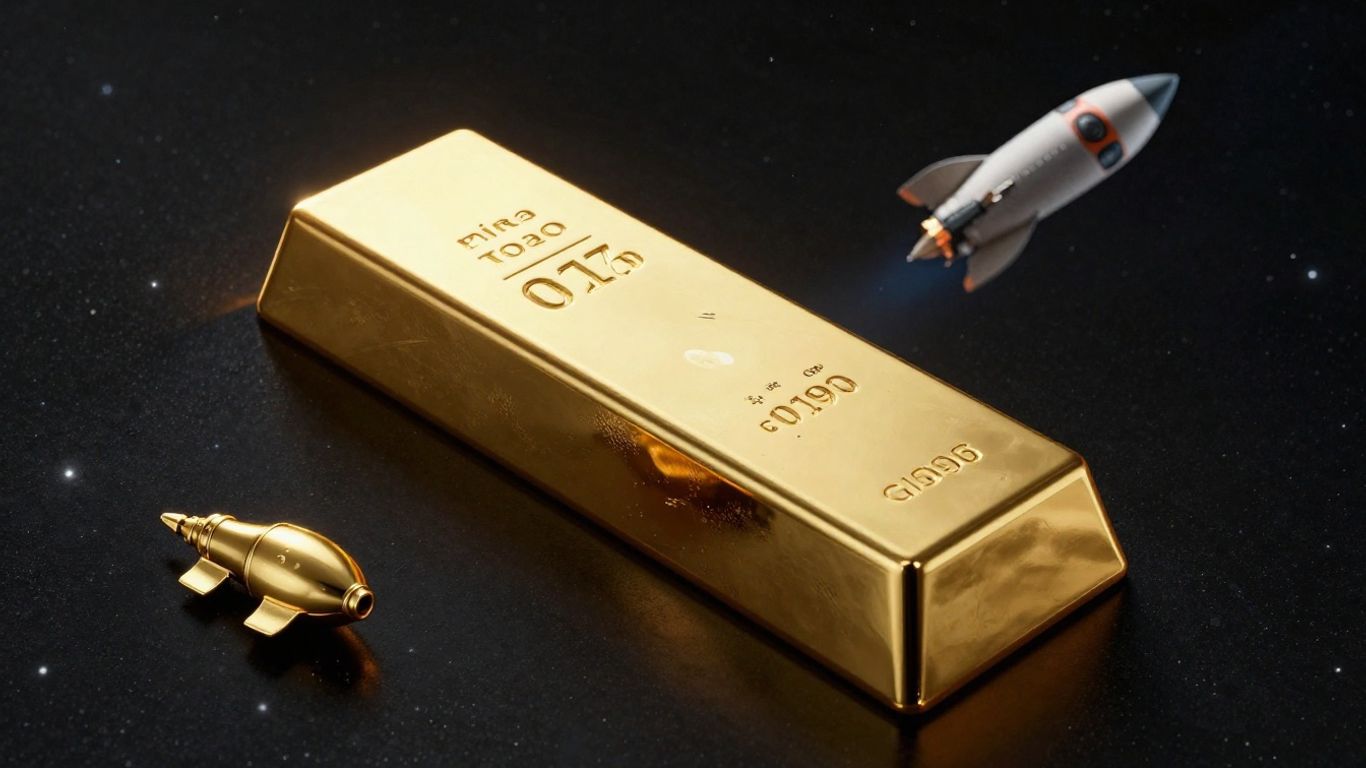
When we think of space, we often picture high-tech robots and powerful rockets. But did you know that gold, that precious metal you might know from your jewelry, plays a surprisingly important role up there? It's quite fascinating to see how such an ancient material finds its place in the most advanced technologies. You might wonder why? Well, it's a matter of properties. Gold possesses characteristics that make it almost indispensable for facing the extreme conditions of space.
Conductivity and resistance: the perfect alloy for space
Imagine a place where temperatures fluctuate dramatically, shifting from freezing cold to intense heat in the blink of an eye. This is the daily reality for a satellite or space probe. In this context, gold proves to be an invaluable asset. Its excellent electrical conductivity is crucial for all the electronic circuits that power these devices. Without good conductivity, signals could be lost or slowed down, which would be catastrophic. Furthermore, its heat resistance helps maintain a stable temperature inside the components, protecting them from thermal shock.
Stainless steel resistance to corrosive challenges
Space isn't just hot and cold; it's also full of things that can damage materials. We're talking about radiation, fine particles, and other elements that, over time, can wear down even the most robust metals. Gold, however, has a major advantage: it doesn't rust or corrode easily. It's almost as if it's immune to most of the aggressions of the space environment. This chemical inertness is crucial for the longevity of equipment. Think of probes that travel for years to reach other planets; they need components that can withstand the rigors of space, and gold plays a vital role in that.
The golden sheen serving as a heat shield
Have you ever seen those images of spacecraft covered in a sort of golden blanket? Well, it's not just for show. This thin layer of gold acts as a heat shield. Its golden color reflects a large portion of the sun's radiation. It's a bit like putting sunglasses on your space equipment to prevent it from overheating. This ability to reflect light and heat is vital for protecting sensitive instruments and electronic systems that, without this protection, could simply fry.
Gold, often associated with earthly wealth, proves to be a material with exceptional physical properties, making it indispensable for the unique challenges of space exploration. Its conductivity, corrosion resistance, and reflective capabilities make it a strategic choice for the reliability and durability of spacecraft.
Here is a brief summary of the advantages of gold in space:
- Electrical and thermal conductivity: Essential for circuits and temperature management.
- Corrosion resistance : Ensures the longevity of components in a harsh environment.
- Reflection of solar radiation: Acts as a thermal shield to prevent overheating.
Strategic applications of gold in space technology
When we think of gold, we often picture jewelry or ingots in a safe. But in the space sector, this metal takes on a whole new dimension. It's no longer about decoration, but about pure, unadulterated performance for missions that push the boundaries of what we know.
A reliable conductor for electronic circuits
Imagine a satellite in orbit, far from any possibility of repair. Every component must function perfectly, and for years. That's where gold comes in. Its ability to conduct electricity without significant energy loss is simply incredible. This means that the signals sent by the onboard instruments reach their destination without being weakened. It's a bit like having a toll-free highway for data. Furthermore, it doesn't degrade over time, which is quite handy when you're in the vacuum of space.
Unfailing protection against radiation
Space is also a very hostile environment, bombarded with radiation that can fry any sensitive electronic component. To protect cameras, sensors, and other delicate instruments, a thin layer of gold is often used. This gold coating acts as a shield, reflecting some of these harmful rays. Without this protection, the data collected could be distorted, or even the equipment rendered unusable. It's a kind of high-tech sunscreen for our spacecraft.
The assurance of seamless communication
For a satellite to send us information, or for a probe to transmit images of distant planets, stable communication is essential. Gold-plated connectors are ubiquitous in space communication systems. They guarantee a robust, interference-free connection between the antennas and the equipment that transmits data back to Earth. It is thanks to them that every message, every image, arrives intact, despite the millions of kilometers that separate us.
Gold, far from being a mere symbol of wealth, is becoming an essential technical element for the success of our space explorations. Its reliability under extreme conditions makes it a preferred choice for engineers designing the technologies of tomorrow.
Here are some key points on the use of gold in space:
- Electrical conductivity : Allows for optimal signal transmission.
- Corrosion resistance : Does not degrade in the space environment.
- Thermal reflection : Helps regulate the temperature of the equipment.
- Radiation protection : Preserves sensitive electronic components.
- Reliability of connections : Ensures stable and lossless communication.
Gold, that shining metal, isn't just for making pretty jewelry! It's also incredibly useful in space, for our rockets and satellites. It helps protect equipment from extreme temperature changes and radiation. It's a bit like a protective blanket for technology traveling far from Earth. Want to learn more about the secrets of gold? Visit our website to discover all its secrets. fascinating applications !
So what's the verdict?
So, you've seen how space projects, these adventures that make us dream, have a rather surprising connection with gold. It's not just for decoration on satellites; no, this gold has very specific functions up there. When you look at the sky, think about it: this gold is there so that our explorations can continue, so that the technologies can work. It's almost as if, by aiming for the stars, we've also found a new reason to value this ancient metal. Who would have thought that the space race would give a boost to the demand for gold, a bit like a new gold rush, but cosmic? It's fascinating to see how such different fields can intersect and influence each other, isn't it?
Frequently Asked Questions
Why is gold so important for space missions?
Gold is incredibly useful in space because it doesn't rust and it conducts electricity and heat very well. Imagine, it protects satellites from extreme temperature changes and helps onboard computers function properly. It's like armor and a super-conductor all in one for spacecraft that travel long distances!
How does gold protect astronauts and their equipment in space?
In space, there are many dangerous rays, a bit like a very powerful but invisible sun. Gold, thanks to its brilliant color, can reflect these rays. It is therefore used in a thin layer on spacecraft or instruments to prevent them from overheating and to protect sensitive equipment from radiation.
Is gold expensive for space projects?
Yes, gold is quite expensive, and it's an important factor to consider when going into space. Scientists need to be sure that using gold is truly necessary for the spacecraft to function properly or to protect it. Therefore, they strive to use just the right amount, very intelligently, so that it fits within the mission budget.