
Gold and central bank digital currencies (CBDCs) are two hot topics right now. On the one hand, we have gold, that good old precious metal that central banks have always kept in their vaults. On the other, we have CBDCs, those digital currencies that central banks are starting to take a closer look at. What does this change for us, and more importantly, how does gold fare in all this? That's what we're going to see.
Key points
- Central banks have a long history with gold, often viewing it as a safe haven and a key component of their gold reserves. Gold prices is influenced by their decisions.
- MNBCs are digital versions of national currencies, different from cryptocurrencies because they are issued and controlled by central banks.
- Gold tokenization could enable investment in gold through digital assets, changing the perception of gold in the digital economy.
- MNBCs raise security and data protection issues and can impact the banking system, with adoption challenges.
- In the face of the decline of cash, gold remains a relevant investment, with its price responding to innovations in digital payments.
Gold and Central Banks: An Ancient Relationship
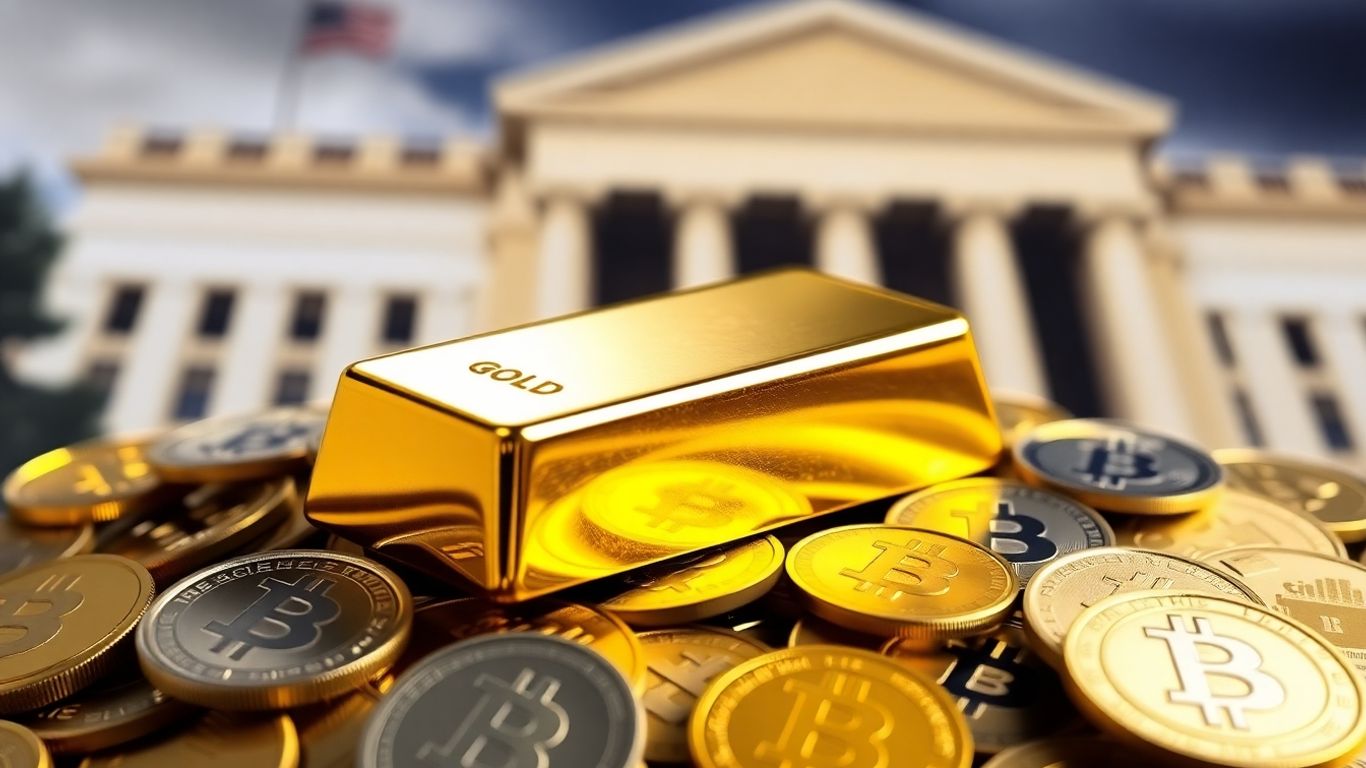
Gold has always held a prominent place in the world of finance, and central banks are no exception. Their connection to this precious metal dates back centuries, long before the advent of digital currencies. Gold has served as the backbone of many monetary systems, providing stability and confidence that few other assets can match.
Central Banks and Their Gold Reserves
Central banks hold significant amounts of gold in their vaults. These reserves aren't there by chance; they play a key role in a country's financial stability. Gold is considered the ultimate store of value, a tangible asset that retains its value even in times of economic crisis or geopolitical uncertainty. Think of it as the ultimate insurance for a nation's economy. The composition of reserves may vary, but gold remains a constant.
Gold as a Safe Haven for Central Banks
When financial markets are in turmoil and confidence is eroding, gold shines brightly. This is where it truly comes into its own as a safe haven. Central banks, as guardians of financial stability, naturally turn to gold to protect their assets and, by extension, their country's economy. It's a bit like having a golden parachute when everything else seems to be falling apart. This perception of safety keeps gold a strategic asset, even in the digital age.
The Influence of Central Banks on the Price of Gold
The actions of central banks have a direct impact on the gold priceWhen a central bank buys gold, it increases demand and can drive up prices. Conversely, if they sell some of their reserves, it can exert downward pressure. Their monetary policy, such as interest rates, also indirectly influences the price of gold. Low rates often make gold more attractive compared to interest-bearing investments. It's a constant balancing act between supply, demand, and the decisions of major financial institutions. Gold is often compared to Bitcoin as a store of value, although their natures are very different.
Central Bank Digital Currencies (CBDCs): A New Era
We're hearing more and more about Central Bank Digital Currencies, or CBDCs. It's a bit like your central bank deciding to create a digital version of the euro or the dollar. But be careful, this shouldn't be confused with Bitcoin or other cryptocurrencies.
What is a MNBC?
Basically, a CBDC is the electronic version of the money you already know, the one issued by your central bank. Think of it like a coin or a bill, but in the form of computer code. The major difference with cryptocurrencies is that a CBDC is controlled by the central bank. It decides whether to create or destroy it, as part of its monetary policy. Bitcoin, on the other hand, is created by calculations made by users, the miners. A CBDC is still official money, just in a different form.
Differences with Cryptocurrencies
The main distinction is control. Cryptocurrencies are decentralized; no one really controls them. CBDCs, on the other hand, are centralized, managed by the central bank. It's a bit like comparing a free market to a state-run store. Cryptocurrencies can be created by anyone via algorithms, while CBDCs are issued by a monetary authority. Even though some CBDCs use the technology behind cryptocurrencies, such as blockchain, their nature remains fundamentally different.
The Potential Benefits of MNBCs
Central banks are exploring CBDCs for several reasons. They could make payments faster and more secure, even outside of bank hours. Imagine being able to send money at any time, without going through regular banking systems. It's a bit like having a bank card that always works, even when everything else is closed. Moreover, they could help combat fraud and make transactions more transparent. China, for example, is already testing its digital yuan, showing that this is no longer science fiction.
Many see MNBCs as a natural evolution of payment systems, rather than a complete revolution. They aim to complement what already exists, bringing greater efficiency and security to the digital world.
Currently, many countries are still in the testing phase for their CBDCs. There are two main directions we can see: retail CBDCs, for everyone (individuals and businesses), and wholesale CBDCs, reserved for banks and financial institutions. The choice will depend on what each country wants to achieve with this new form of currency.
Digital Gold: A Possible Reality?
We're hearing more and more about central bank digital currencies (CBDCs), but what about gold in digital form? Could gold, that good old precious metal, also become a digital asset? It's an interesting question, especially given the rapid evolution of payments and the arrival of CBDCs.
The Tokenization of Gold
The idea behind gold tokenization is to represent ownership of a quantity of physical gold with a digital token on a blockchain. Essentially, each token would correspond to a fraction of an ounce of gold stored in a secure vault. This would allow you to own gold without having to deal with physical storage, insurance, or custody fees. It's a bit like having gold in your digital wallet, but with the security of knowing it's there somewhere.
- Benefits of tokenization:
- Increased accessibility: small fractions of gold can be purchased.
- Improved liquidity: Tokens can be traded more easily than physical gold.
- Security: Blockchain provides a transparent and immutable ledger.
- Reduced costs: less storage and management costs.
Investing in Gold via Digital Assets
Thanks to tokenization, investing in gold is becoming easier for many. No more hassle with buying and storing bars or coins. These 'gold tokens' can be purchased directly online, often with reduced fees. It's a modern way to diversify your portfolio, combining the stability of gold with the flexibility of digital technology. This opens the door to a new type of investor, younger and more comfortable with digital technologies.
The Perception of Gold in the Digital Economy
In a world where transactions are increasingly online and digital currencies are gaining momentum, gold retains its place. It remains a safe haven, a tangible asset that provides reassurance during turbulent markets. Tokenization only makes this asset more accessible and more practical to use in the digital economy. It's as if gold is adapting to the times, without losing its essence. It could even serve as collateral or reference in certain digital payment systems, thus reinforcing its traditional role.
The Challenges and Risks of MNBCs
Central bank digital currencies (CBDCs) are generating a lot of buzz, and rightly so. They promise to revolutionize the way we pay, but like any new development, they also raise questions and concerns. We shouldn't rush into them without considering the potential obstacles.
Security and Data Protection
When we talk about digital currency, the first thing that comes to mind is security. How will our personal information and transactions be protected? Central banks will have to implement ultra-secure systems to prevent hacks and data leaks. It's a bit like building an impenetrable fortress for our digital money. We're talking about advanced technologies, but also about access management and confidentiality. Who will have access to our data? How will it be used? These questions are far from trivial.
The Impact on the Banking System
The arrival of CBDCs could be a game-changer for commercial banks. If everyone can hold central bank money directly, it could reduce deposits in private banks. Imagine: instead of keeping your money at home or in your bank account, you could store it directly in digital form with the central bank. This could change the way banks finance the economy. A balance will need to be struck to keep the financial system stable.
Obstacles to the Adoption of MNBCs
Despite the potential benefits, getting the general public to adopt CBDCs will be no easy feat. First, there's the issue of trust. People are used to their banknotes and cards. Switching to a fully digital currency requires a change in habits. Then there's the digital divide: not everyone necessarily has access to a smartphone or a reliable internet connection. We'll also have to consider those who still prefer cash. Finally, the technological complexity may scare off some of the population. It will take a lot of education and training to ensure CBDCs are understood and accepted by everyone. It's questionable whether people will be willing to abandon their habits for a technology they don't necessarily understand. It's a bit like wanting to replace books with e-readers: it has advantages, but it doesn't appeal to everyone.
The deployment of MNBCs raises major questions about privacy and the potential surveillance of transactions. The centralization of this data could offer unprecedented control capabilities, which worries some members of the public and experts.
Gold and the Evolution of Payments
The Decline of Species and the Rise of Digital Technology
We see it every day: cash is becoming less and less present in our wallets. Whether it's to buy a coffee or pay rent, electronic transactions are taking over. It's quite striking to see how ubiquitous payment terminals are, and some merchants even seem a little confused when you hand them bills!
This trend isn't new, and it doesn't affect just one country. Across the world, there's a decline in the use of cash. Online purchases, by their very nature, cannot be made with cash, which is further accelerating this trend. New payment platforms are constantly emerging, offering speed and simplicity, and they're directly competing with good old-fashioned bills and coins.
It must be said that habits are changing, especially among younger generations. Those under 45 use cash much less often than their elders. They prefer credit cards, debit cards, or even mobile payment apps. This is a fairly significant change in behavior.
| Payment Method | Less than 45 years | 55 years and older |
|---|---|---|
| Cash | Up to 10% | Up to 20% |
| Debit card | Up to 30% | Up to 25% |
| Debit card | Up to 40% | Up to 35% |
| Mobile payment | Up to 15% | Up to 5% |
Cash, although always considered a safe bet, especially in times of financial uncertainty such as 2008, is seeing its role diminish in the face of the convenience and perceived security of electronic payments.
How the Price of Gold Reacts to Innovations
Faced with this payments revolution, one might wonder what's happening to the price of gold. Historically, gold has always been a safe haven. When traditional financial systems tremble, gold often shines. But how is it reacting to these digital innovations that promise speed and efficiency?
Physical gold is one thing, but we're seeing the emergence of concepts like digital gold or gold tokenization. The idea is to represent ownership of gold as digital tokens on a blockchain. This could make investing in gold more accessible, easier to trade, and potentially more liquid.
However, caution is warranted. The value of gold is often tied to confidence in traditional monetary systems and inflation. If central bank digital currencies (CBDCs) succeed in providing sufficient stability and trust, this could, in theory, reduce gold's appeal as the ultimate safe haven. But for now, gold remains a tangible asset, independent of computer systems, which gives it a special level of security.
Gold: Still a Relevant Investment?
Despite the rise of digital payments and the emergence of CBDCs, the question of gold's relevance as an investment remains unanswered. People tend to turn to gold when they doubt the stability of fiat currencies or the economy in general. It's a bit like insurance.
Younger generations, who are massively adopting electronic payments, are not abandoning gold. Many see gold as a way to diversify their portfolio, an asset that isn't dependent on the decisions of a central bank or a technology company. The ability to invest in gold through digital assets, such as gold-backed ETFs or gold tokens, makes this investment more accessible than ever.
Ultimately, gold still holds its place. It represents a tangible and universal form of wealth. Even as our payment methods evolve rapidly, gold's intrinsic value, rarity, and history make it a pillar of investment, especially in a world where economic uncertainty seems to be the new normal.
Future Perspectives: Gold and Digital Currencies
As the financial world continues to evolve at breakneck speed, the question of gold's place alongside central bank digital currencies (CBDCs) is becoming increasingly pressing. It's clear that cash is becoming less and less present in our lives. Electronic payments, on the other hand, are becoming increasingly important. As a result, many countries are considering the idea of creating their own digital currencies.
The Coexistence of Physical Gold and MNBCs
Physical gold is a bit like the reassuring grandfather of the money world. It's been around forever, solid, tangible. But let's be honest, storing and reselling it isn't always easy. CBDCs, on the other hand, arrive with the promise of faster, cheaper payments and financial inclusion for those who are a little outside the traditional banking system. There's also talk of smoother international transactions. Sounds like a dream, right? But beware, there are some downsides, like data security and privacy protection. It is likely that physical gold and CBDCs will not oppose each other, but rather find ways to coexist. One could serve as a stable safe haven, while the other offers flexibility and efficiency in everyday life. Think of it like two different tools in a toolbox: you use the one that best suits the task. Physical gold is the safe, CBDCs are the digital bank card. Both have their uses. In fact, gold tokenization—representing gold as digital tokens on the blockchain—could be the bridge between these two worlds, making gold investing more accessible and transparent, much like buy gold online.
Gold as a Strategic Asset for Central Banks
Central banks don't view gold as a mere collectible. They see it as a strategic asset. Why? Because gold has this unique ability to retain its value, even when everything else collapses. In a world where fiat currencies can be devalued by inflation or risky monetary policies, gold remains a safe bet. CBDCs, while promising, introduce new variables. Central banks will have to juggle these new technologies while maintaining financial stability. Gold could therefore play a stabilizing role, an anchor in an increasingly digital and potentially volatile monetary landscape. It's a bit like having a lifeline when navigating uncharted waters.
Investing in Gold in the Digital Age
So, for us mere mortals who want to make our savings grow, how do we go about it? The digital age doesn't mean that gold is losing its appeal. On the contrary. Investing in gold is now more flexible. Online platforms and gold-related financial products, such as ETFs backed by physical gold or the famous gold tokens, make access easier than ever. It's no longer just about buying bars or coins. You can diversify your portfolio with gold-backed digital assets, which combine the security of gold with the ease of digital transactions. It's a modern way to keep part of your wealth safe from economic ups and downs, while still enjoying the benefits of technology. Gold remains a safe haven, and the tools to access it have never been more varied.
Gold and new digital currencies, like Bitcoin, are hot topics. How will these two worlds intersect? Will gold remain a safe bet in the face of these new forms of money? Explore with us the avenues for understanding the future of finance. Learn more about investing in gold, visit our website today!
So, what do we take away from this?
Well, we've covered the whole issue of central bank digital currencies, and frankly, it's not exactly simple. Between the promises of faster payments, the idea of including everyone in the financial system, and the big question marks over privacy and security, it's food for thought. It seems like central banks are walking a bit of a tightrope, trying to modernize without breaking everything. For now, it looks more like a long exploration than an imminent revolution. We'll keep an eye on it, but for now, your good old wallet and bank card still have a bright future ahead of them. We're not going to see the digital dollar replace our banknotes any time soon, let's be honest.