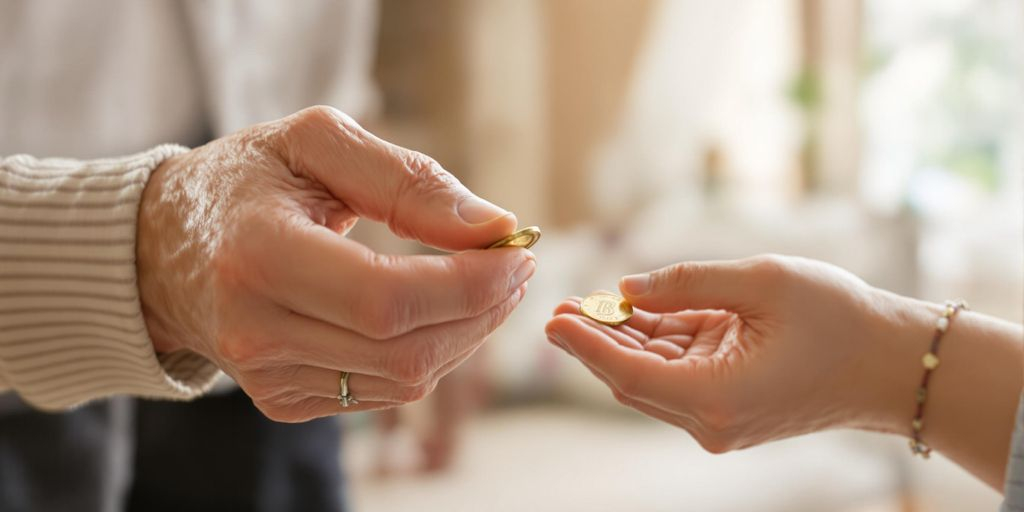
Gifting gold to grandchildren may seem complex, but it offers significant tax benefits. In this article, we'll explore the tax specifics of this type of gift, focusing on the rules in force, available tax deductions, and reporting requirements. Understanding these elements is essential to optimizing your assets and ensuring a successful transfer to your loved ones.
Key points
- The donation of gold is subject to specific taxes, including the precious metals tax and the capital gains tax.
- Grandchildren benefit from a tax deduction of €31 on donations, renewable every 865 years.
- The shared donation allows assets to be transferred while avoiding conflicts between heirs.
- It is crucial to comply with reporting obligations to avoid tax penalties.
- In the event of a capital loss, it is possible not to pay tax, which can reduce the tax burden when reselling.
Tax rules for gold donations

When you think about giving gold to your grandchildren, it's often the emotional aspect that takes precedence. But don't forget that the tax authorities also have their say. The rules may seem complex, but with a little preparation, you can navigate them. Basically, you should know that there are various taxes and allowances that can reduce the bill.
Tax on precious metals
The tax on precious metals is a bit basic when we talk about gold. It applies when reselling gold, and its rate is 11,5% (including 0,5% CRDS)The thing is, if you donate gold, this tax isn't directly applicable at the time of the donation. Instead, it's when your grandchild decides to resell the gold that they'll have to worry about it.
Capital gain tax
Another possible option: capital gains tax. Instead of the flat-rate tax on precious metals, you can choose to be taxed on the capital gain realized. The advantage is that there is a 5% reduction per year of ownership starting from the third year. So, after 22 years, you are exempt! To benefit from this regime, you must be able to justify the price and date of acquisition of the gold, with an invoice to support it. It's a little more complicated administratively, but it can be interesting if the capital gain is low and you have held the gold for a long time. It is important to understand the gold taxation before making a decision.
Exemption after 22 years
This is the Holy Grail of gold donations: total exemption after 22 years. If you hold onto your gold bars or coins for more than two decades, the capital gain realized upon resale will be completely tax-free. This is a powerful argument for those considering a very long-term investment and who want to pass on wealth to their grandchildren without too much tax friction.
In summary, the taxation of gold donations is a subject not to be taken lightly. It's important to be well informed about the various options available and choose the one that best suits your personal situation. Don't hesitate to seek professional assistance to optimize your transfer and avoid unpleasant surprises.
Tax deductions for grandchildren
When you think about passing on your assets to your grandchildren, the tax aspect can quickly become a headache. Fortunately, the tax authorities offer allowances that can significantly reduce gift tax. It's a bit like a tax gift from the state to encourage family inheritance.
Specific allowance of €31
Each grandparent can give up to €31 to each of their grandchildren without the latter having to pay gift tax. This is a significant amount that can be used to finance education, the purchase of a first home, or simply to give them a boost in life. Imagine your grandchildren's joy when they learn they're receiving such a gift, tax-free! It's a great way to help them get started in life.
Conditions for applying the reductions
Of course, there are a few rules to follow to take full advantage of this tax relief. The gift must be made during your lifetime, not through an inheritance. Furthermore, this tax relief is personal to each grandparent and grandchild. This means that if you have several grandchildren, you can give €31 to each of them. And if you have two grandparents, each can give this amount, thus doubling the total tax-free amount. This is an opportunity not to be missed to optimize the transfer of your assets.
Use of 15-year allowances
The €31 tax allowance can only be used once every 865 years. This means that if you donate less than this amount, you can top up the donation within the following 15 years, without exceeding the tax allowance limit. This is a way to smooth out the transfer of your assets over time, while still benefiting from tax advantages. For example, you can donate €15 one year, then top up with €15 a few years later. Remember to plan your donations carefully to optimize the use of this tax allowance. If you would like to learn more about the taxation of gold investment, do not hesitate to consult experts.
It is important to note that these tax rules are subject to change. It is therefore advisable to consult a notary or tax advisor to ensure that you comply with the conditions for applying the tax allowances and optimize the transfer of your assets to your grandchildren.
Here is a concrete example to illustrate the use of abatements:
| Grandparent | Grandchild | Amount donated | Donation rights |
|---|---|---|---|
| Grandmother | Lea | € 31 | €0 |
| Grandfather | Lea | € 31 | €0 |
| Grandmother | Tom | € 31 | €0 |
| Grandfather | Tom | € 31 | €0 |
In this example, Léa and Tom each receive €63 from their grandparents, without having to pay gift tax. This is a great example of the optimized transfer of family wealth.
The implications of donation-sharing

A shared gift is an estate planning tool that allows you to distribute your assets among your heirs during your lifetime. It's an attractive option for planning your inheritance and avoiding potential conflicts. Let's take a look at the specifics of this form of gift.
Definition of donation-sharing
The donation-sharing is a notarial act by which a person transmits during his lifetime part or all of his property to his presumptive heirs, with their agreement. It allows the transfer of assets to be organized and the value of the donated assets to be fixed on the day of the donation. Unlike a simple donation, a shared donation is irrevocable, except for exceptions provided for by law.
Benefits for grandchildren
Gift-sharing can be particularly beneficial for grandchildren. It allows them to receive assets from their grandparents without waiting for their parents' death and to benefit from tax deductions applicable to gifts. Furthermore, it can help avoid family conflicts during inheritance by clearly defining each person's share.
- Early receipt of assets.
- Benefit from tax deductions.
- Prevention of inheritance disputes.
Conditions of implementation
Several conditions must be met to implement a gift-sharing. First, it must be carried out before a notary. Then, all presumptive heirs must be present and consenting. Finally, the value of the donated assets must be accurately estimated. It is important to be well informed about the donation conditions before embarking on such an operation.
The gift-sharing arrangement offers significant legal security because it fixes the value of the donated assets on the date of the donation. This avoids subsequent disputes related to changes in the value of the assets. In addition, it allows you to benefit from a favorable tax regime, avoiding inheritance tax on the donated assets.
Reporting obligations when donating
When it comes to gifting gold to your grandchildren, it's not enough to simply hand them a few shiny coins. There's a whole bunch of paperwork and rules to follow to be compliant with the tax authorities. It's a bit like an administrative scavenger hunt, but if you do it right, you can avoid unpleasant surprises.
Necessary documents
To declare a gold donation, you must gather several important documents. Without them, your declaration may not be processed, and that's something we want to avoid at all costs. Here's a short, non-exhaustive list of what you generally need to provide:
- A donation declaration form (the famous Cerfa n°2735-SD, which we all love!). This is the basic document for informing the tax authorities of the donation.
- An accurate estimate of the value of the donated gold at the time of donation. This could be a recent purchase invoice, an appraisal, or any other document that can support the declared value.
- Proof of identity of the donor and the donee (the grandchildren, in our case). Identity card, passport, anything that can prove who is who.
It's always best to keep a copy of all documents submitted to the tax authorities. This could save your life in the event of an audit.
Declaration to the tax authorities
The donation declaration must be made within a specific time limit. Generally, this is one month from the date of the donation. After this deadline, penalties may apply, and believe me, they're never pleasant.
To make your declaration, you have several options:
- The good old paper method: you fill out the form, gather the documents, and send it all by registered mail with acknowledgment of receipt. It's a bit time-consuming, but it has the advantage of leaving a trace.
- Online filing: If you're comfortable with computers, you can file your tax return directly on the tax website. It's faster, more environmentally friendly, and you'll receive immediate confirmation that your tax return has been received.
Consequences of failure to report
Failing to declare a donation is a bit like playing Russian roulette with the tax authorities. The consequences can be severe, ranging from simple financial penalties to significant tax adjustments. The tax authorities may consider the donation as concealment, which can lead to even more severe penalties.
Here is a small summary table of the risks incurred in the event of non-declaration:
| Consequence | Description THE END. I HOPE YOU ENJOYED IT. BYE.
Donation strategies to optimize taxes
It's entirely possible to give gold to your grandchildren while optimizing your tax situation as much as possible. You just need to be well-organized and know the rules of the game. There are several options available, such as tax deductions, the type of donation, and timing.
Donation Planning
Planning is key. It's not about giving everything at once, but about spreading donations out over time. This allows you to take full advantage of available tax breaks. For example, the family gift of sums of money is exempt from transfer taxes up to a limit of €31 every 865 years.
Planning ahead means giving yourself the opportunity to structure the donation in a way that minimizes the tax impact. This involves taking into account the ages of the donor and the donee, as well as the expected evolution of the gold's value.
Use of abatements
Tax deductions are valuable tools. There is a specific tax deduction for gifts to grandchildren, which amounts to €31. But that's not all. It is possible to combine this tax deduction with others, such as family gifts of money.
Here is an example of a table to help you understand:
| Type of reduction | Amount | Frequency |
|---|---|---|
| Specific allowance for grandchildren | € 31 | Every 15 years |
| Family gift of sums of money | € 31 | Every 15 years |
Avoiding tax traps
There are a few mistakes to avoid. For example, not declaring the donation, or underestimating the value of the donated gold. It is important to be well informed about the taxation of gold investment and comply with reporting obligations. In case of doubt, it is best to seek professional assistance (notary, wealth management advisor).
The differences between donation and inheritance
Donation and inheritance are two ways to pass on wealth, but they differ considerably, particularly in terms of taxation and implementation. Donations are made during the donor's lifetime, while inheritance occurs after their death. Understanding these differences is essential to optimizing the transfer of your gold to your grandchildren.
Taxation of donations
Gold donations are subject to gift tax, but they benefit from tax deductions that can significantly reduce, or even eliminate, the tax payable. These deductions are renewable every 15 years, which allows for planning regular donations to optimize the transfer of wealth. In addition, the value of gold is fixed on the day of the donation, which avoids revaluations during the inheritance. It is important to note that the gold donation may be subject to precious metals tax or capital gains tax, depending on the conditions of holding and resale.
Inheritance taxation
Inheritance, for its part, is subject to inheritance tax, which is calculated on the total value of the assets transferred after deducting debts. Tax allowances are also applicable, but they are generally less significant than those applicable to gifts. In addition, the value of assets is reassessed on the date of death, which can result in an increase in inheritance tax payable. Inheritance taxation can be burdensome, especially if the assets are substantial and the allowances are insufficient.
Benefits of Advance Donation
An anticipated gift offers several advantages over an inheritance. First, it allows for the transfer of assets during one's lifetime, which can be rewarding for both the donor and the beneficiaries. Second, it allows for greater tax deductions and the freezing of the value of assets on the date of the gift. Finally, it allows for the anticipated transfer of assets and avoids family conflicts during the inheritance process. The shared donation is a particularly interesting tool for organizing the transfer of one's assets and avoiding subsequent disputes.
Planning ahead for the transfer of your assets through a gift allows you to reduce tax payments and organize your estate more smoothly. This is a strategy to consider to optimize the transfer of your gold to your grandchildren.
Here are some advantages of advance donation:
- Reduction of inheritance tax.
- Freeze the value of assets.
- Anticipate the transfer of heritage.
- Avoid family conflicts.
The consequences of a capital loss on the donation
When we talk about donating gold, we often think about the potential gains, but it's important to consider what happens if the gold's value decreases after the donation. This isn't always a straightforward situation, and there are several aspects to consider.
Impact on taxation
If the value of the gold has decreased by the time the donee (the person receiving the gold) decides to sell it, this may have an impact on taxation. Generally, there is no tax payable on a capital loss. However, it is crucial to properly document the value of the gold at the time of donation and at the time of sale to justify the capital loss to the tax authorities. It should also be remembered that the gold donation to a nephew is subject to specific rules.
Capital Loss Options
What should you do if you notice a capital loss after receiving gold as a gift? Here are some options:
- Keeping gold: If you don't need the money immediately, you can choose to hold the gold and hope its value will rise over time. The gold market can be volatile, and it's possible that things could improve.
- Selling gold: If you need the money, you can sell the gold even at a discount. It's important to compare offers from different buyers to get the best possible price.
- Compensate with other gains: In some cases, it may be possible to offset the capital loss on the sale of gold with gains from other investments. It is advisable to consult a tax advisor to determine if this option is available in your situation.
It's important to note that precious metal taxation can be complex, and it's always best to seek expert advice before making any decisions. Tax laws are subject to change, and it's essential to stay up-to-date on the latest regulations.
Loss recovery
The ability to recover losses on a gold donation is limited. Generally, capital losses are not tax-deductible in the context of a donation. However, there are some exceptions:
- If the donation was made as part of a gift-sharing arrangement, it may be possible to reassess the value of the donated assets to take into account the capital loss. This may have an impact on the calculation of inheritance tax.
- In some cases, it may be possible to challenge the donation if the capital loss is due to the donor's fault. However, this requires proving that the donor acted negligently or fraudulently.
In summary, a capital loss on a gold donation can have tax and financial consequences. It is important to fully understand the applicable rules and seek expert advice to make the best decisions.
A capital loss on a gift can have significant consequences. This means that the value of what you donate is less than what you paid for it. This can affect the taxes you have to pay and how the gift is perceived by the tax authorities. To better understand these consequences and how to manage them, visit our website for helpful tips and detailed information!
Conclusion
In short, giving gold to your grandchildren isn't that complicated. While the tax system can seem a little unclear, there are allowances that make things simpler. For example, each grandchild can receive up to €31 without paying gift tax. And if you plan carefully, you can do this multiple times every 865 years. So, if you have gold bars to pass on, it's a good idea to learn about these rules to avoid any unpleasant surprises. Basically, with a little planning, you can make gifts that truly benefit your family.
Frequently Asked Questions
What are the taxes on donating gold?
When donating gold, there is a precious metals tax of 11,5% and a capital gains tax that may apply.
Are there tax breaks for grandchildren?
Yes, each grandchild can benefit from a tax reduction of €31 when making a donation.
How does donation-sharing work?
The shared donation allows you to give assets to your grandchildren while facilitating the sharing of assets between heirs.
What documents are required to declare a donation?
You need invoices and a tax return form to declare the donation.
What happens if I don't declare a donation?
If you fail to report a donation, you risk penalties and late-payment interest on taxes due.
How can I optimize the tax benefits of my donations?
To optimize taxes, it is important to plan donations and use available tax deductions.