

Wondering what role craftsmanship plays in the creation of high-quality gold jewelry? That's an excellent question! Far from mass production, the work of the artisan jeweler is what gives a piece of jewelry its soul and value. It's a blend of passion, expertise, and a personal touch that makes each piece truly special. You'll discover how this ancestral art shapes fine jewelry.
Key Takeaways
- Craftsmanship is essential to guarantee the quality and authenticity of gold jewelry, thanks to a rigorous selection of materials and techniques passed down from generation to generation.
- Traditional techniques, such as lost wax casting or hammering, are mastered by artisans to create unique and authentic pieces.
- Beyond the simple object, a handcrafted piece of jewelry is a work of art that expresses the creativity and passion of the artisan, and can be personalized to tell a story.
- Crafts play a vital role in preserving cultural and artistic heritage, resisting standardization and passing on valuable know-how.
- Artisan jewelers are committed to ethical and sustainable practices, supporting the local economy and promoting responsible consumption.
Craftsmanship, guaranteeing the quality and authenticity of gold jewelry
When you choose a piece of gold jewelry made by an artisan, you're not just choosing an object. You're choosing something that has real value, that's made to last, and that has a story. This is where the work of the artisan takes on its full meaning, because they are the guardians of quality and authenticity.
The meticulous selection of noble materials
The craftsman begins by choosing the finest materials. This isn't just a matter of taste; it's a fundamental step. He selects precious metals like gold, ensuring their purity and provenance. He does the same for stones, whether precious or semi-precious. Each element is carefully chosen, not only for its beauty, but also for its durability and integrity. It's this attention to detail from the start that makes the difference.
Ancestral know-how passed down from generation to generation
Many artisan jewelers work with techniques that have existed for centuries. It's not just old-fashioned; it's a legacy. They learn these skills from masters, who themselves learned them from their predecessors. This expertise is what allows them to create unique pieces with a finish that machines can't replicate. It's a bit like a secret recipe that's passed down, giving each piece its own special character.
The uniqueness of each creation
You know, when a piece of jewelry is handmade, it can't be identical to another. Even if the craftsman tries to make the same thing twice, there will always be small differences. That's what's beautiful. Every hammer blow, every solder, every setting is done by a person, with their hands. That makes each piece truly unique. You're wearing something that only exists one of a kind in the world, and that's priceless.
Traditional techniques in the service of fine jewelry
In the world of fine jewelry, traditional techniques are not simply manufacturing methods; they are the beating heart of each exceptional piece. This is where craftsmanship takes on its full meaning, transforming precious metal into works of art.
Mastery of precise and meticulous gestures
You know, artisanal jewelry is a bit like learning an ancient language. It takes years to master the subtleties, the gestures that seem so simple but require constant concentration. Every movement of the file, every blow of the hammer, every solder is executed with millimeter precision. It's this attention to detail that makes all the difference between an ordinary piece of jewelry and a piece of fine jewelry. Artisans spend hours, days, perfecting these gestures, because it's in repetition and patience that true mastery lies.
Processes such as lost wax casting and hammering
Imagine the process: lost-wax casting, for example. It's a technique that dates back to antiquity. A wax model is created, covered with a refractory material to make a mold, and then the wax is melted to remove it. It's this imprint left by the wax that allows the molten metal to be poured. It's a bit like leaving a trace of one's passage, but to create something beautiful and durable. Hammering, on the other hand, involves shaping the metal with hammer blows, often on specific anvils. This creates texture, shape, and even strengthens the metal. Each blow is designed to sculpt the material, bringing it to life.
Preserving authenticity in every piece
What's fascinating about these methods is that they allow each piece of jewelry to retain its soul. Unlike mass production, where everything is standardized, each handcrafted piece bears the mark of its creator. You can almost feel the story behind every curve, every detail. It's this authenticity that makes handcrafted jewelry so precious. They're not just objects; they're creations with a story to tell, a story made up of precise gestures, ancestral techniques, and an undeniable passion for beautiful work.
True luxury lies not in quantity, but in the quality and story that each object carries.
The added value of craftsmanship: more than a jewel, a work of art
When you choose a piece of jewelry made by an artisan, you're not just choosing an object to decorate. It's much more than that. Each piece tells a story, that of the artisan who created it, of their hands, of their heart. It's a personal connection that you don't find in mass production.
The expression of the artisan's creativity and passion
What makes a piece of handcrafted jewelry so special is the soul the artisan puts into it. They don't just follow a plan; they inject their vision, their emotions, and sometimes even years of practice. It's this personal touch that transforms a simple object into something unique. You can see the passion in every detail, in the way the metals are worked, the stones chosen. It's almost as if the artisan is sharing a part of themselves with you.
Jewelry that tells a story and reflects emotions
Every piece of handcrafted jewelry carries a narrative. It might be inspiration drawn from nature, a childhood memory, or even a special commission that requires translating a particular emotion into metal and stones. When you wear this piece of jewelry, you also carry that story, that emotion. It's like having a little piece of someone's story, or even your own, close to you.
Personalization for a unique and tailor-made piece of jewelry
One of the great things about craftsmanship is the ability to create something that truly reflects your personality. You can talk to the craftsman, choose the materials, shapes, and stones. They can even work with items you already own, like family jewelry, to give them a new life. The result is a piece that belongs only to you, designed especially for you. That's the real added value: an object that has meaning and is made for you, and you alone.
Craftsmanship is the art of transforming materials with purpose, history, and an inimitable human touch. This is what separates a mass-produced object from a truly personal work of art.
The importance of craftsmanship for heritage preservation
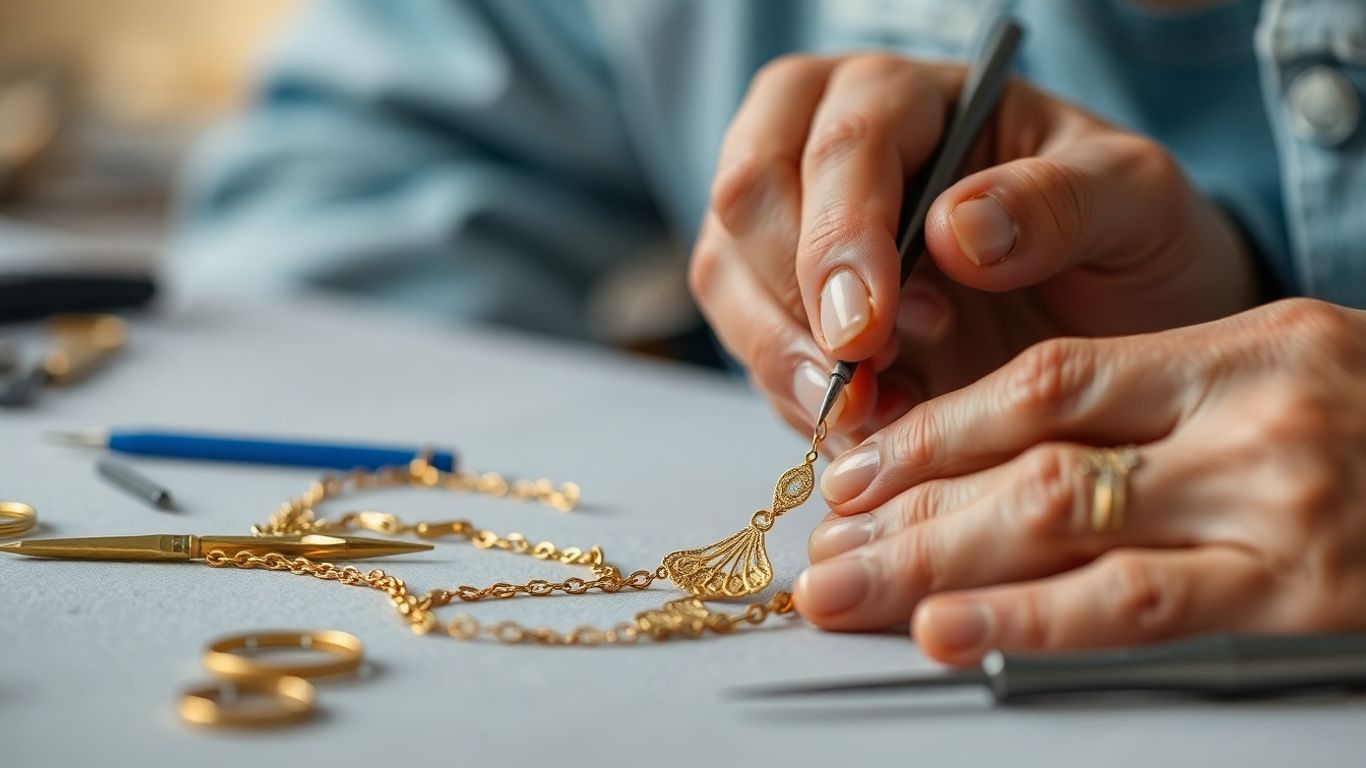
In an increasingly fast-paced world where mass production standardizes everything, craftsmanship plays a truly important role. It's like a thread that connects our past to our present. When you choose a piece of jewelry made by a craftsman, you're not just choosing a pretty object; you're helping to preserve a skill that has existed for centuries. It's a bit like keeping a part of our cultural and artistic history alive.
A cultural and artistic heritage to be promoted
The techniques used by artisan jewelers weren't born yesterday. They've been refined, passed down, and improved over the generations. Think about how gold is worked, the precision required to set a stone, or even the patterns that tell a story. All of this is part of a precious intangible heritage. By promoting these creations, you're helping to ensure this legacy doesn't disappear, and that it continues to exist and inspire.
Passing on ancestral techniques to future generations
The true treasure of craftsmanship is the hands that shape it and the knowledge they carry. Today's artisans are the guardians of these ancestral gestures. They learn, they practice, and above all, they pass them on. Whether through training, apprenticeships, or simply by sharing their passion, they ensure that these techniques are not forgotten. It is a vital chain of transmission for the art of jewelry making to continue to evolve.
Resistance to mass production and standardization
In the face of industrial production that strives for uniformity, handcrafted jewelry stands out for its uniqueness. Each piece bears the mark of its creator, its small imperfections that give it its charm, its soul. It's an antidote to standardization. By choosing craftsmanship, you opt for authenticity, for a piece that has a story to tell, and which, through its singularity, resists the prevailing standardization. It's a choice that makes sense, that values human work and creativity.
The ethical and sustainable commitment of the artisan jeweler
Support for the local economy and traditions
By choosing jewelry created by artisans, you're doing much more than acquiring a beautiful object. You're directly supporting local know-how, perpetuated traditions, and communities. It's a bit like planting a tree: it nourishes the soil of our culture. These artisans, often based in our towns and villages, keep alive crafts that are at risk of disappearing in the face of mass production. They preserve ancestral techniques, passed down from generation to generation, and their work contributes to the cultural identity of our region. It's a concrete commitment to maintaining a diverse and human economic fabric.
Environmentally friendly manufacturing practices
You may be wondering how a piece of jewelry can be eco-friendly? Well, artisan jewelry makers are paying more and more attention to this. They often favor the use of recycled gold, which avoids mining, which is often harmful to the environment. In addition, they pay attention to the provenance of the stones, seeking suppliers who respect ethical and environmental standards. The manufacturing methods themselves are designed to minimize waste and the use of harmful chemicals. It's a more thoughtful approach, taking into account the impact of each step, from design to finishing. It's a way to create beauty without sacrificing the planet.
Responsible consumption for a culturally richer world
Opting for craftsmanship is making a responsible consumer choice. Instead of following the ephemeral trends of fast fashion, you invest in unique pieces, full of history and meaning. These jewels have a soul, that of the artisan who crafted them with passion. They tell a story: yours, the artisan's, and the material's. It's a way to stand out, to wear something that has real value, not just material, but also human and cultural. By supporting these creators, you contribute to a world where diversity and authenticity still have their place. It's a simple gesture, but one that has a real impact on preserving our heritage and promoting a fairer and more beautiful economy. Think about how a personalized piece of jewelry can really reflect your story.
The role of the craftsman in creating high-quality gold jewelry
When you think of luxury gold jewelry, it's easy to imagine shiny chains or diamond-studded rings. But behind every piece that leaves a fine jewelry workshop, there's a craftsman. They're the ones who bring the gold to life, patiently shaping it, and transforming it into something truly special. You might be wondering how they do it? Well, it's a blend of craftsmanship, passion, and attention to detail that makes all the difference.
Custom design and manufacturing
The artisan is a bit like an architect for your jewelry. They don't just follow a plan; they create it. You arrive with an idea, a desire, maybe even just an emotion to translate into precious metal. The artisan will then discuss with you, understand what you're looking for, and begin drawing. They can offer adjustments, suggest stones or finishes that you hadn't considered. It's a real team effort to achieve a result that's 100% you. Then comes the manufacturing. There, you see the true work of the artisan: the melting of the gold, the hand-shaping, the meticulous setting of the stones. Every gesture is thought out and precise. This is what makes each piece of jewelry unique, because even if there is a design, the human hand adds an irreplaceable touch. It's a bit like comparing a mass-printed photo and a hand-painted painting; there is a soul in the latter.
The use of specific alloys for unique colors
Pure gold is great, but it's not always the most practical for making jewelry. To achieve these different shades—classic yellow gold, softer rose gold, or even more modern white gold—the artisan mixes gold with other metals. These are called alloys. These mixtures must be precisely measured to achieve the desired color, but also the right strength. A poorly made alloy, and your jewelry risks warping or losing its shine. The artisan masters these secret recipes, often passed down from generation to generation. They know what percentage of copper or silver to add to achieve perfect rose gold, or how to use palladium for a brilliant white. It's a science as much as an art, and it's what allows them to create jewelry with truly distinctive color nuances.
Hallmarks, guarantees of origin and quality
You may have already noticed these small marks engraved on your gold jewelry. These are hallmarks, and they are super important. For the artisan jeweler, it's a bit like their signature, but above all, it's a guarantee for you. First, there's the maker's mark, which identifies the craftsman or workshop that made the jewelry. It's like a business card engraved in the metal. Then there's the title hallmark, which certifies the purity of the gold used. For example, a hallmark might indicate that the jewelry is made of 18-karat gold, which means it's made of 75% pure gold. These marks are essential because they attest to the jewelry's quality and compliance with current standards. It's tangible proof of work well done and the use of noble materials, as confirmed by the rigorous selection of precious materials.
In short, an artisan isn't just someone who makes jewelry. They're creators, technicians, and artists who put their heart and soul into each piece. This is what gives a piece of handcrafted jewelry its value, its history, and its soul, far beyond the simple precious material it's made of.
When you make fine gold jewelry, it's a craftsman who takes care of it. He uses his expertise to create unique and magnificent pieces. Every detail counts to make a piece of jewelry that truly shines. If you're looking for carefully crafted gold jewelry, come to discover our collection on our website !
Craftsmanship: the touch that makes all the difference
So there you have it, when we talk about quality gold jewelry, we often see magnificent pieces, but we think less about the work behind them. That's where the craftsman comes in. He doesn't just work the gold, he gives it a soul. Every hammer blow, every precise gesture, it tells a story. You may be wondering why choose a piece of jewelry made by one craftsman over another? Well, it's simple: you have a unique piece, which has character, and which is made to last. It's a bit like choosing a good wine or a homemade dish, they don't have the same taste. Plus, you're supporting a skill, a tradition. So the next time you're looking for a beautiful piece of gold jewelry, think of these craftsmen who put their heart and soul into their work. You won't be disappointed.
Frequently Asked Questions
Why is craftsmanship so important for luxury gold jewelry?
Craftsmanship is like the secret of great chefs to making a delicious dish! It's the same for gold jewelry. The artisan uses special techniques, passed down by his parents and grandparents, to work with gold. He chooses the best materials and makes each piece of jewelry by hand, which makes it unique and of very high quality. It is this know-how that makes all the difference compared to jewelry produced in large quantities.
What techniques do artisans use to make gold jewelry?
Imagine an artist sculpting a statue! Jewelry artisans use very precise and meticulous techniques. For example, they may use the 'lost wax' technique, where they create a model in wax and then transform it into gold. They also practice hammering, which involves working the metal with a hammer to give it shape. These ancient methods allow them to create beautiful and authentic jewelry.
How is a handcrafted piece of jewelry different from an industrial piece of jewelry?
Handcrafted jewelry is a bit like a unique work of art. The craftsman puts all their passion and creativity into it. Each piece tells a story, that of the creator and sometimes even yours if you personalize it! Industrial jewelry is all the same, produced in large quantities. Artisanal jewelry is originality and emotion in every detail.
Why is it important to support craftsmanship in jewelry?
Supporting craftsmanship is like helping to keep precious traditions alive. Artisan jewelry makers pass down their skills from generation to generation. If we don't support them, these techniques could disappear. It's a bit like preserving a cultural treasure. By purchasing a piece of handcrafted jewelry, you're helping to preserve this heritage.
How does the artisan jeweler ensure that their jewelry is ethical and sustainable?
Artisans care deeply about the planet and people. They try to use recycled materials whenever possible, and their manufacturing methods don't pollute too much. They also support the local economy by working with suppliers in their region. It's a way to create beautiful jewelry while respecting the environment and communities.
What guarantees the quality and origin of a handcrafted gold jewel?
To be sure of quality, you need to look for the 'hallmarks'. These are small marks engraved on the jewelry that indicate its purity and who made it. The artisan uses special gold alloys to create unique colors, such as rose gold or white gold. These hallmarks are like an identity card for the jewelry, guaranteeing that it comes from a craftsman and is of good quality.
