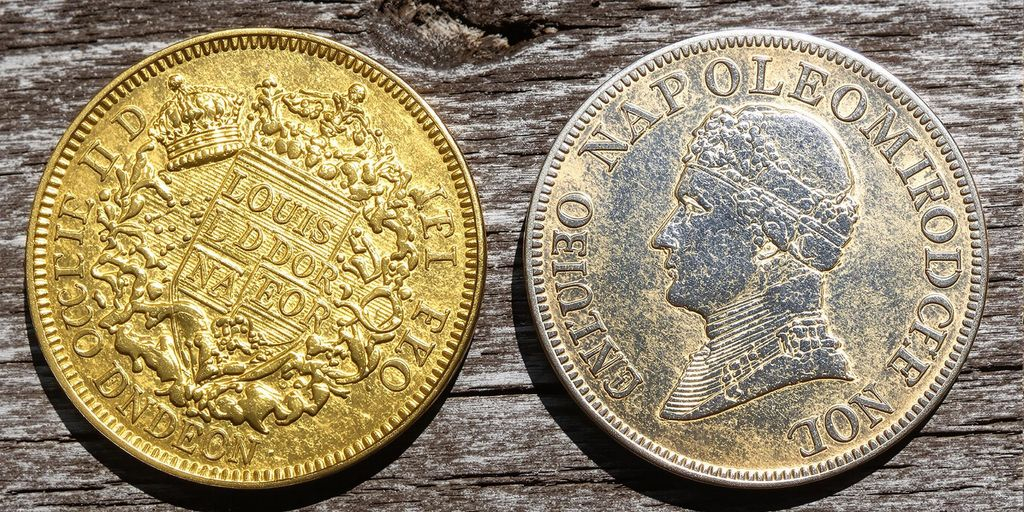
In the world of numismatics, the Louis d'Or and the Napoleon are two iconic coins that often raise questions. Although they are both gold coins, their origins, characteristics, and values differ considerably. This article explores the key distinctions between these two coins to better understand their place in gold history and the market.
Key points
- The Louis d'Or was minted between 1640 and 1792, while the Napoleon was produced from 1803 until 1914.
- Weight and purity differ: the Louis d'Or weighs approximately 7,65 g with a purity of 917/1000, while the Napoleon weighs 6,45 g with a purity of 900/1000.
- The Louis d'Or is often rarer and sought after by collectors due to its history and limited production.
- The motifs and iconography of the two coins vary: the Louis d'Or features royal portraits, while the Napoleon bears the effigy of Napoleon I and other republican symbols.
- The value of these coins is influenced by their state of preservation, their rarity and the Gold prices on the market.
The origins of the Louis d'Or and the Napoleon
History of the Louis d'Or
The Louis d'Or, an iconic coin in French monetary history, was created during the reign of Louis XIII in 1640. Its primary objective was to compete with the powerful economies of the Spanish and British monarchies, which had already begun minting their own gold coins, such as pistoles. The Louis d'Or was therefore created for economic and prestige reasons, replacing the old gold écu.
The design of the Louis d'Or was entrusted to Jean Warin, a renowned engraver at the time. Claude de Bullion, Minister of Finance, commissioned him to adorn the new coins with the symbols of financial reform. Warin used modern technology of the time to mechanically strike the coins, unlike the manual methods previously used. This is how the three types of Louis d'Or were born: the half-Louis d'Or, the Louis d'Or, and the double Louis d'Or.
The Louis d'Or continued to be used during the reigns of Louis XIV, Louis XV, and Louis XVI, using the same techniques established by Jean Warin. However, the French Revolution and the advent of the National Convention ended production of the Louis d'Or in 1792. It is important to note that the real Louis d'Or is different from the Napoleon, although the two are often confused.
Emergence of the Napoleon
The end of the Louis d'Or did not mean the end of gold coins in France. With the proclamation of the First Empire by Napoleon Bonaparte in 1804, new economic and financial reforms were implemented. Napoleon launched the production of a new gold coin: the Napoleon. This coin had the same value as the Louis d'Or and was minted until the eve of the First World War. The Napoleon has had several effigies, including those of Napoleon I, Napoleon III, and Marianne, giving rise to the 20 Franc Marianne Coq coins.
Economic context of the two pieces
Both the Louis d'Or and the Napoleon played a crucial role in the French economy during their respective eras. The Louis d'Or allowed France to compete with other European powers, while the Napoleon consolidated the French monetary system under the Empire and subsequent regimes. These coins demonstrate the importance of gold in the economy and the desire of leaders to mark their era with symbols of power and prosperity. French numismatics is rich in history thanks to these pieces.
Physical characteristics of the parts
Dimensions and weight of the Louis d'Or
The Louis d'Or, minted under different reigns, presents notable variations in terms of dimensions and weight. Generally, its diameter fluctuates around 22 mm, but this can vary slightly depending on the period of minting. Weight, too, is subject to fluctuations, but is often around 6,75 grams for the most common pieces. It is important to note that wear due to circulation may affect the actual weight of the coin.
Dimensions and weight of the Napoleon
The Napoleon, often called the 20-franc gold coin, has well-defined physical characteristics. Its diameter is generally 21 mm, making it slightly smaller than some Louis d'Or coins. The theoretical weight is 6,45 grams, with a minimal tolerance. This standardization facilitates its identification and evaluation. current value of these coins is a subject of constant interest for investors.
Differences in purity between the two
Purity is a key factor in determining the intrinsic value of a gold coin. Both the Louis d'Or and the Napoleon are made of gold, but their fine gold content can vary.
- Louis d'Or generally displays a purity of approximately 91,7% fine gold (22 carats).
- The Napoleon exhibits similar purity, also around 90% fine gold.
- The difference, although minimal, may slightly influence their market value.
It's crucial to understand that purity, combined with weight, determines the actual amount of fine gold contained in each coin. This information is critical for investors and collectors because it directly impacts the coin's value based on the price of gold.
Here is a simplified comparison table:
| Characteristic | Louis d'Or (approx.) | Napoleon (20 francs) |
|---|---|---|
| Diameter | 22 mm | 21 mm |
| Weight | 6.75 gr | 6.45 gr |
| Purity | Up to 91.7% | Up to 90% |
Market value and price
The Louis d'Or and the Napoléon, while both historical French gold coins, exhibit distinct value dynamics in today's market. The value of these coins is influenced by a combination of factors, ranging from the price of gold to their rarity and condition. Understanding these elements is essential for collectors and investors.
Evaluation of the Louis d'Or
The value of the Louis d'Or is determined by several key factors. First, the current gold price plays a major role, as the coin contains a significant amount of precious metal. Second, the rarity of certain mintage years or variants can significantly increase its value. The condition of the coin is also crucial: a coin in perfect condition will sell for much more than a worn one. Finally, demand from collectors and investors also influences the price.
Here are some elements that influence the price of Louis d'Or:
- The price of gold
- The rarity of the year of minting
- The state of conservation
- Market demand
Napoleon Assessment
The Napoleon is valued along similar lines to the Louis d'Or, but with some nuances. The price of gold is, of course, a determining factor. However, the Napoleon, being a more recent coin and having been minted in greater quantities, is generally less rare than the Louis d'Or. However, some versions, such as the Napoleon in gold with specific effigies or particular years of minting, can achieve high prices. The state of preservation remains an essential element, and the demand of investors, often more interested in the Napoleon due to its liquidity, plays an important role.
Factors influencing value
Several factors can influence the value of the Louis d'Or and the Napoleon. The price of gold is the most obvious factor, but it is far from the only one. The general state of the global economy, inflation, interest rates, and geopolitical events can all impact the demand for gold and, consequently, the value of these coins. Additionally, trends in the numismatic market and collector preferences can also play a role. It is therefore important to follow economic and numismatic news to anticipate fluctuations in value.
It's important to note that the value of a gold coin can vary considerably depending on the seller and buyer. Therefore, it's advisable to compare prices from multiple sources before making a transaction. Additionally, it's essential to have the coin authenticated by an expert to avoid counterfeits.
Here is a comparative table of the average prices observed in March 2025:
| Piece | Average purchase price | Average selling price |
|---|---|---|
| Louis d'Or | €350 | €320 |
| Napoleon 20F | €345 | €315 |
These prices are given as an indication and may vary depending on the factors mentioned above.
Symbolism and iconography
Portraits on the Louis d'Or
The Louis d'Or, as its name suggests, proudly displays the portrait of King Louis who reigned at the time of its minting. Each monarch has left their mark, and These portraits are a fascinating window into the history of the French monarchy. You can observe the evolution of hairstyles, costumes, and facial expressions over the reigns. It's a bit like having a miniature royal portrait gallery at your fingertips.
Symbols on the Napoleon
The Napoleon, on the other hand, is a little more republican in its approach. Of course, it features the portrait of Napoleon Bonaparte, but also a plethora of imperial and republican symbols. The imperial eagle, a symbol of power and victory, sometimes sits alongside more discreet symbols such as the laurel wreath, a symbol of glory. On the 20 franc gold rooster and Marianne French coin, we even find the Gallic rooster, Marianne and the motto “Liberty Equality Fraternity”, a true concentration of French identity.
Historical significance of the motifs
These motifs are not there by chance. They were carefully chosen to convey a message, assert power, or recall important values. The Louis d'Or, with its king, embodies monarchical stability and divine right. The Napoleon, for his part, symbolizes imperial ambition and the grandeur of France. Understanding these symbols is like deciphering a part of French history. It's a bit like reading a history book while looking at a coin.
The iconography of coins is a valuable testament to the eras they span. They reflect the ideologies, ambitions, and values of the societies that produced them. By carefully studying these motifs, we can better understand the issues and mentalities of these eras.
Manufacturing methods
Manual production of Louis d'Or
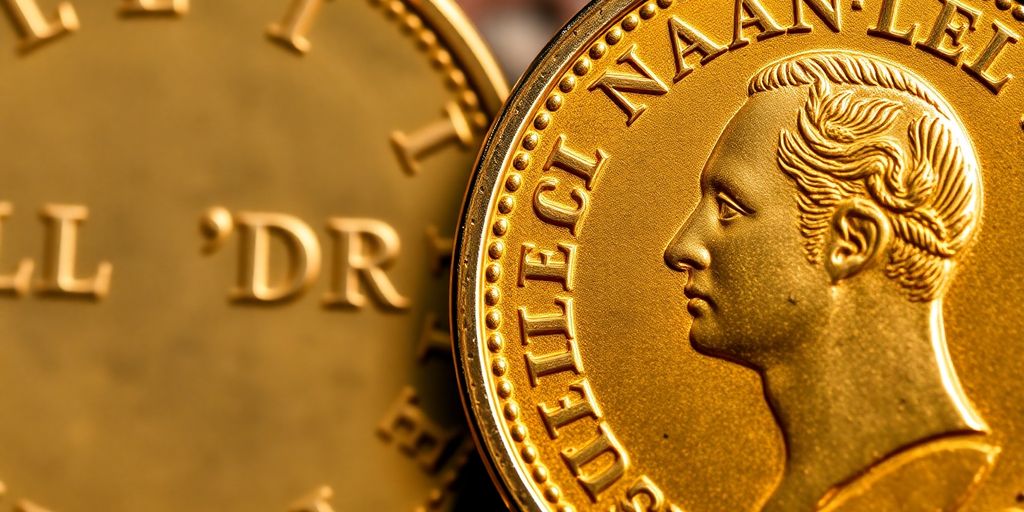
The production of the Louis d'Or was a meticulous artisanal process. Each coin was struck by hand, which involved several key steps. First, the gold was melted and formed into ingots. These ingots were then rolled to obtain gold sheets of the desired thickness. Blanks were cut from these sheets and then individually weighed to ensure they met the required standards. The next step was to strike each flan manually using engraved dies, thus imprinting the designs and inscriptions onto the coin. This artisanal process made each Louis d'Or unique, with slight variations in minting and appearance.
Mechanized production of the Napoleon
The advent of the Napoleon coin coincided with the rise of industrial mechanization. Unlike the Louis d'Or, the Napoleon was produced using machines. This change allowed for much faster and more uniform production. The flans were still prepared from gold bars, but steam-powered engines powered presses that struck the coins with greater precision. This mechanization not only increased production volume but also reduced costs and standardized the appearance of the coins. This meant that more coins could be produced more quickly and with more consistent quality. This was a major change from the artisanal production of the Louis d'Or.
Impact on rarity and value
The difference in manufacturing methods had a significant impact on the rarity and value of both coins. The manual production of the Louis d'Or, while meticulous, was limited in volume. The variations inherent in hand-minting make each coin unique, adding to its appeal to collectors. In contrast, the mechanized production of the Napoleon allowed for a much wider distribution, reducing its relative rarity. However, some Napoleons, particularly those with rare vintages or minting defects, can also achieve high values on the numismatic market. It is important to note that the value of a coin depends not only on its rarity, but also on its condition, market demand, and historical significance. sell a gold Napoleon, it is important to understand these factors well.
Use and circulation
Use of Louis d'Or in history
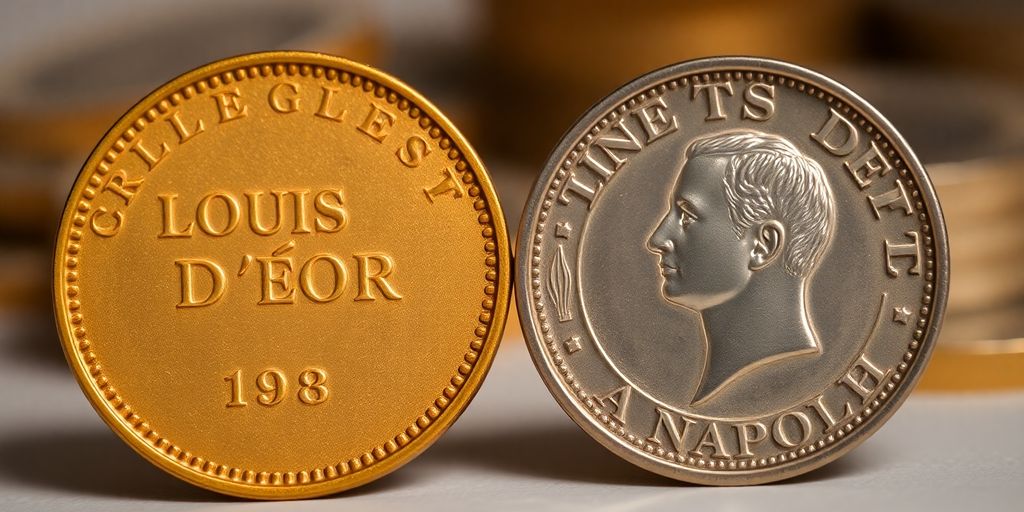
The Louis d'Or, minted during the reign of Louis XIII, quickly gained popularity and became a standard currency in France. Its use extended over several reigns, serving as a common means of exchange for important transactions. It symbolized the power and financial stability of the kingdom.
- It was used for international trade.
- It was used to pay the armies.
- It was hoarded by noble and bourgeois families.
The Louis d'Or has survived through the ages, bearing witness to France's economic and political ups and downs. Its presence in archives and private collections attests to its central role in French monetary history.
Circulation of the Napoleon
The Napoleon, introduced by Napoleon Bonaparte, was designed to stabilize French currency after the Revolution. Its widespread circulation facilitated trade and strengthened confidence in the monetary system. It circulated not only in France but also in other European countries, contributing to France's economic influence.
| Period | Significant event | Impact on traffic |
|---|---|---|
| Early 19th century | Introduction to Napoleon | Increased traffic in France and Europe |
| Mid-19th century | Economic expansion | Increased traffic through trade |
| Late XNUMXth century | Monetary stability | Maintaining significant circulation |
Comparison of modern usage
Today, neither the Louis d'Or nor the Napoléon are used as currency. They primarily have numismatic and investment value. Collectors seek these coins for their rarity and historical interest, while investors consider them a safe haven, especially in times of economic uncertainty. value of a coin is therefore very different from its original face value.
- Collectors: looking for rare and good condition pieces.
- Investors: Portfolio diversification and protection against inflation.
- History lovers: interest in heritage and monetary history.
The modern use of these coins is therefore very different from their original function, but they retain an important place in heritage and the economy.
Collection and investment
Attractiveness for collectors
The Louis d'Or and the Napoleon, beyond their intrinsic gold value, exert a particular fascination on collectors. This attractiveness stems from their rich history, their symbolism and their rarity which varies depending on the year of minting and their state of preservation. For numismatists, owning a Louis d'Or coin minted under Louis XIII or a rare Napoleon is more than just an investment; it's owning a piece of French history. Searching for specific coins with distinctive features or minting defects adds a treasure-hunting dimension to this passion.
Investment in the Louis d'Or
Investing in Louis d'Or can be an interesting strategy, but it requires a good understanding of the market. Here are some points to consider:
- High premium: As a collector's item, the Louis d'Or often commands a higher premium than the Napoleon. This means that its price significantly exceeds its pure gold value.
- Scarcity : Some mintage years are rarer than others, which significantly influences their value. It is important to research the rarity of a coin before purchasing it.
- Conservation state : The condition of the coin is crucial. A coin in perfect condition (Fleur de Coin) will have a much higher value than a worn coin.
- Authentication: It is imperative to ensure the authenticity of the coin. Consulting a numismatic expert is strongly recommended.
Investing in Louis d'Or coins is often viewed as a long-term investment. Their value can fluctuate based on the price of gold, but also on collector interest. It is therefore important to monitor developments in the numismatic market.
Investment in the Napoleon
The Napoleon is often considered a more accessible and liquid investment than the Louis d'Or. Here's why:
- Liquidity: The Napoleon is a very common piece, which makes it easy to buy and resell. Selling a Napoleon is usually simpler than selling a rare Louis d'Or.
- Lower premium: Generally, the premium on the Napoleon is lower than that on the Louis d'Or, meaning you pay less above its gold value.
- Safe haven: Like any gold investment, the Napoleon can serve as a safe haven in times of economic uncertainty.
Here is a simplified comparison table:
| Characteristic | Louis d'Or | Napoleon |
|---|---|---|
| Prime | Generally higher | Generally weaker |
| Liquidity | Less liquid | More liquid |
| Scarcity | Potentially rarer | Less rare |
| Target audience | Collectors and investors | Mainly investors |
In conclusion, the choice between the Louis d'Or and the Napoleon depends on your goals. If you're passionate about history and numismatics, and are looking for a rare coin, the Louis d'Or may be a good choice. If you're looking for liquidity and a more direct investment in gold, the Napoleon is probably a better choice.
In the world of collecting and investing, gold is a safe bet. Whether you're an avid collector or a savvy investor, choosing your coins wisely is essential. Discover our selection of gold coins and other precious objects on our website. Don't wait any longer, visit us now to make the best choice!
Conclusion
In summary, while both the Louis d'Or and the Napoleon are iconic gold coins in French history, they differ in several ways. The older Louis d'Or is often considered a collectible due to its rarity and history. In contrast, the Napoleon, which was minted more recently, is more accessible and widely used as an investment. Each of these coins has its own value, influenced by factors such as condition, demand, and history. Whether you're a collector or an investor, understanding these differences can help you make an informed choice.
Frequently Asked Questions
What is the difference between a Louis d'Or and a Napoleon?
The Louis d'Or is a gold coin minted between 1640 and 1792, while the Napoleon is a gold coin issued from 1803. They have different designs and weights.
How to recognize a Louis d'Or?
A Louis d'Or is recognizable by its weight of approximately 7,65 grams and its diameter of 24 mm. It also bears the effigy of the king of the time.
How much does a Napoleon weigh?
A Napoleon weighs approximately 6,45 grams and measures 21 mm in diameter. It is made of 900 thousandths of gold.
Why is the price of a Louis d'Or higher?
The price of a Louis d'Or is often higher due to its rarity and history, as it was minted several centuries ago.
Do both coins have the same value?
No, their value varies. The Louis d'Or is generally more expensive due to its rarity, while the Napoleon has a more stable value.
Where can you buy Louis d'Or and Napoleons?
These coins can be purchased from numismatists, specialist jewelers or online, but it is important to verify authenticity.