Wondering what the main types of gold mines are? That's an excellent question! Gold, this precious metal that has always fascinated us, is found in different forms and in various types of deposits. Whether for its brilliance in jewelry, its role in the economy, or simply its intrinsic value, understanding where gold comes from is essential. So, let's delve into the world of gold mining together to discover the deposits and methods that allow us to get our hands on this treasure.
Key Takeaways
- Gold-quartz veins represent a major source of gold, where the precious metal is embedded in quartz rock formations.
- Gold sulfide ores, often associated with other metals such as arsenic, constitute another important category of deposits.
- Gossan-type deposits, resulting from the oxidation of sulfides, act as indicators of the presence of primary ore and can have intrinsic value.
- The deposits of golden quartz veins, formed by hydrothermal processes, are rock gold deposits of major industrial importance.
- Gold is not always the main product of mines; it is often extracted at the same time as other metals such as copper, lead or silver, making the latter the main product and gold a by-product.
The different types of gold deposits
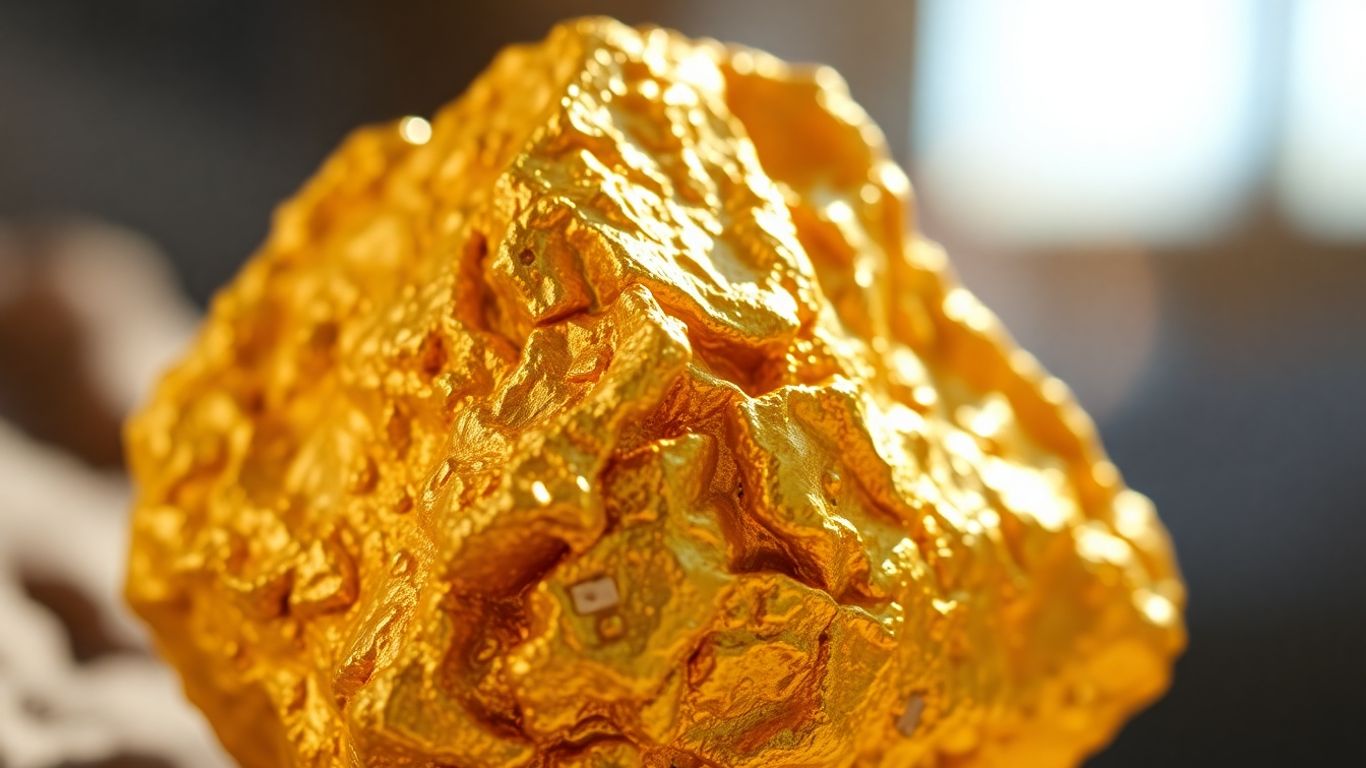
When we talk about gold, we often think of shiny nuggets or heavy ingots. But where does all this gold come from? It doesn't grow on trees, of course! It's found in the earth, in places called deposits. There are several types, and each has its own unique characteristics.
Gold-quartz veins
Imagine veins in the rock, a bit like the veins in your body. Well, in the Earth's crust, there are similar veins, but filled with quartz. Sometimes, gold has found its way inside these quartz veins. This is called a vein deposit. These veins often form when hot, mineral-rich fluids flow through cracks in the rock. The gold, which was dissolved in these fluids, then deposits in the quartz as the fluid cools or its composition changes. It's a bit like when sugar crystallizes in overly concentrated syrup.
- Training related to hydrothermal activities.
- Gold is often visible as small flakes or grains in quartz.
- These deposits are among the most exploited and have major industrial importance.
These veins can be very irregular, sometimes very rich over a short distance, then thinning out. It's a bit of a lottery for miners.
Gold sulfide ores
Here, gold isn't found alone or simply with quartz. It's often mixed with other minerals, especially sulfides. The most common is pyrite, sometimes called "fool's gold" because of its resemblance to real gold. In these deposits, gold is often in the form of particles so fine they're invisible to the naked eye. It's either embedded within the pyrite crystals or found on their surface. Extracting gold from these ores requires slightly more complex techniques than for native gold, as it's necessary to separate the gold from these other minerals.
- Gold is often microscopic and associated with sulfides such as pyrite or arsenopyrite.
- The processing of these ores requires specific processes to release the gold.
- These deposits may contain other precious or base metals, such as silver or copper.
Gossan-type gold deposits
Imagine a layer of rust on the Earth's surface. That's a bit like a gossan. These deposits form when rocks containing sulfides (like the ones we were just talking about) are exposed to air and water for a very long time. The sulfides oxidize, transforming into iron oxides (rust, basically!) and other minerals. During this process, the gold that was trapped in the sulfides can be released and then concentrate again in this oxidized layer. It's a bit like rain washing the rock away, leaving behind concentrated gold. Gossans are often indicators of a larger deposit deeper underground.
- These are surface oxidation zones of primary sulfide deposits.
- They are recognizable by their rust color due to iron oxides.
- Gold is often enriched there through secondary processes.
Golden quartz vein deposits
It's somewhat similar to gold-quartz veins, but the term "golden quartz vein" emphasizes the presence of quartz as the primary matrix (the rock surrounding the ore) and the shape of these deposits, which are often well-defined veins. These deposits are the result of intense geological activity, often linked to tectonic plate movements. Gold-rich hydrothermal fluids seep into fissures in the rock and deposit quartz and gold. Gold can sometimes be seen with the naked eye in these veins, in the form of flakes or threads. This is the type of deposit that has captivated prospectors for centuries.
- These are classic hydrothermal deposits, often associated with fault zones.
- Quartz is the dominant mineral, forming veins of varying thickness.
- Gold can be visible, but also microscopic, included in quartz or other associated minerals.
These different types of deposits clearly demonstrate that gold isn't found just anywhere. Its formation depends on complex geological processes that unfold over millions of years. Understanding these types of deposits is a bit like understanding where to look for treasure!
Gold in industry and medicine
Gold as a thermal and electrical conductor
You know, gold isn't just for jewelry or treasures. It's also a great material for all sorts of technical things. It conducts heat and electricity really well, even if it's a bit behind silver and copper in that respect. But its main strength is that it doesn't rust, even under normal conditions. That's why it's found in so many electronic components, often as a thin plating. This ensures that the connections won't degrade over time, which is pretty handy when you think about the lifespan of our devices.
Gold in dentistry and medicines
Gold also has its place in the healthcare field. For example, in dentistry, it's used for crowns and bridges. It's well-tolerated by the body and highly resistant to corrosion in the mouth. It's not cheap, but it lasts a long time! And that's not all; gold can also be found in some medications. Sometimes, it's used to coat pills, which can help control the drug's release into the body. It's quite fascinating to see how such a precious metal can have such useful and significant applications in our daily lives, even if we don't necessarily think about them.
The physical forms of gold
Native gold and its variations
Gold, the metal that makes us dream, isn't always found in the form of polished ingots or sparkling jewelry. In nature, it appears in various forms, often quite different from the image we have of it. The purest form is native gold. Imagine it as almost 100% gold, with very few other metals mixed in. It's often found embedded in rocks or in deposits of sand and gravel, as if the Earth had decided to hide its treasures. Sometimes, gold is even alloyed with other elements, like silver, which gives it a slightly different hue. There are also more complex minerals where gold is bound to tellurium, for example. These forms are fascinating because they show us how nature works, mixing and transforming elements over millions of years.
Native gold is the rawest and purest form of the metal, often found in its natural environment, bearing witness to the geological processes that formed it.
Gold in the form of nuggets, powder or flakes
When we talk about native gold, we often think of nuggets. These are the pieces of gold, some quite large, others rather impressive, that can be found in rivers or in the ground. They're practically the holy grail for gold prospectors! But gold isn't limited to nuggets. Erosion, the simple passage of time, and the action of water can reduce gold to much finer particles. It can therefore be found as a powder, almost invisible to the naked eye, or as tiny flakes that sparkle when light strikes them. These finer forms are often found in river sediments, where they are concentrated by the current. It's as if nature has already done an initial sorting for us. These different forms clearly show that gold is a natural element with a history, a transformation, even before it reaches our hands.
Here's a brief overview of the shapes you might encounter:
- Nuggets: Pieces of native gold of varying sizes, often found in alluvial deposits.
- Powder: Very fine gold particles, resulting from erosion, difficult to see without assistance.
- Sequins: Small flakes of gold that sparkle, often found in gold-bearing sands.
These different forms remind us that gold is first and foremost a treasure of nature, shaped by incredible forces.
Gold mining
Open-pit and underground mines
When we think of gold mining, we often picture dark, deep tunnels, and it's true that underground mines do exist. They are used when the gold deposit is located far below the surface. Tunnels are dug to reach the ore. It's a fairly complex job that requires many precautions for the miners' safety. Gold veins are often found in these mines.
But there are also open-pit mines. It's a bit like removing a mountain layer by layer to access the gold. These mines are used when the deposit is closer to the surface, sometimes even just below the topsoil. Enormous machines are used to dig and move tons of rock. This is often where you find the largest operations, like the Grasberg mine in Indonesia, which is primarily a copper mine.
Modern extraction techniques
Gold mining has changed dramatically. Gone are the days of using just shovels and hammers. Today, we have much more sophisticated methods. For example, heap leaching is a technique that allows us to recover gold even when it's present in very small quantities in the rock. The ore is piled up and passed through a chemical solution that dissolves the gold. This method has made previously unexploitable deposits accessible.
There is also autoclave treatment, used for so-called ores
Gold as a safe haven and financial asset
You might be wondering why gold is so fascinating, beyond its brilliance. Well, much of its magic lies in its role as a safe haven asset. When times are uncertain, whether due to economic crises or geopolitical tensions, gold tends to hold its own, or even appreciate in value. It's a bit like a safe harbor for your money when the financial seas are rough.
The role of gold in central bank reserves
You know, central banks, the ones that manage each country's currency, don't just hold banknotes. Gold occupies a prominent place in their vaults. It's a bit like insurance for a country's financial stability. Central bank gold reserves are an indicator of a nation's economic strength. For example, the United States has the largest gold reserves in the world. These reserves, often in the form of bullion, play a key role in the confidence other countries place in a nation's currency.
Here is a brief overview of what these reserves represent:
- Global gold reserves held by central banks: Approximately 28,554 tonnes (as of December 2003).
- Approximate volume: This represents a cube with an edge of approximately 12 meters.
- Share of global stock: Central banks hold about a quarter of all existing gold.
The evolution of the price of gold
Le gold priceIt's dynamic. It's not a straight line, far from it. It's influenced by many things: what central banks do with their reserves, the demand from jewelers (especially in India and China, for example), the needs of industry, and of course, the speculation of investors anticipating crises. That's why we say that the price of gold is a bit of a barometer of the global economy. There have been periods when it skyrocketed, like in the early 80s, and then others when it fell. Following its evolution is a bit like taking the pulse of international finance. Gold is a strategic asset for French industry and its share price is listed on major global stock exchanges.
Gold has a fascinating monetary history, having served as a standard and symbol of wealth for centuries. Even after the end of the gold standard, it retains an important place in investment strategies and national reserves.
Investment gold bars and coins
When we talk about investing in gold, we often think of bars and coins. You can find bars in all sizes, from small 1-gram bars to large 1-kilo bars. Sizes like the 250g or 500g bar are quite popular because they offer a good balance between affordability and price per gram. Gold coins, like the Napoleon 20-franc coins or Krugerrands also have their charm. They are often easier to resell and can have numismatic value in addition to their intrinsic gold value. It's a tangible way to hold a part of your wealth, independent of stock market fluctuations or banking decisions. It's a bit like owning a small piece of history that retains its value.
Gold in jewelry and goldsmithing
Ah, gold! That shining metal that has always captivated our dreams. When we think of gold, we often imagine sparkling jewelry, ancient coins, or precious works of art. And that's exactly it! Gold has reigned supreme in jewelry and goldsmithing for millennia.
The use of pure and alloyed gold
Pure gold is that brilliant yellow metal that doesn't tarnish. It's incredibly malleable, meaning it can be worked with great precision. In some cultures, particularly in Asia, nearly pure gold is still used to make jewelry. But be careful, because it's so soft, it deforms easily. Therefore, for everyday jewelry, it's often preferred to alloy it with other metals. These are called alloys.
- For yellow goldIt is usually mixed with silver and copper. This gives it its beautiful warm color and makes it more durable.
- Rose gold, very fashionable, gets its color thanks to a higher proportion of copper in the alloy.
- White goldThis one, however, is obtained by mixing gold with metals such as palladium or nickel. It has a very elegant silvery appearance.
These alloys not only allow for different colors, but more importantly, they make gold stronger, making it more resistant to shocks and the wear and tear of time. It's a bit like giving gold a boost to make it more robust!
The creation of jewelry, medals and luxury items
When we talk about jewelry, we immediately think of rings, necklaces, bracelets, and earrings. Gold is the preferred material for these pieces, which are often passed down from generation to generation. But that's not all! Gold is also used to make medals, whether for sporting competitions or honorary awards. And then there are all those luxury items that inspire dreams: high-end watches with gold cases, collectible pens, phone cases… In short, anything related to elegance and prestige can often be adorned with gold.
Gold, by virtue of its rarity and intrinsic beauty, has always been associated with wealth, power, and divinity. Its use in the creation of precious objects is therefore not merely a matter of aesthetics, but also of profound symbolism.
Goldsmithing and vermeil
Goldsmithing is the art of working with precious metals to create tableware, decorative objects, or liturgical pieces. Gold is, of course, a key metal, but so is silver. And when discussing goldsmithing, there's one term you should know: vermeil. Vermeil is simply sterling silver that has been coated with a layer of gold. This gives a very elegant, golden appearance to objects that would otherwise be made of silver. It's a way to achieve the look of gold without necessarily the cost of solid gold, while still benefiting from the prestige of silver.
Gold, this precious metal, has always shone in our jewelry and art objects. It is used to create magnificent pieces that stand the test of time. Whether for a special gift or to add a touch of elegance to your everyday life, gold has a unique value. Are you looking to buy or sell gold ? Find out how we can help you on our website.
So, ready to explore the world of gold?
There you have it, you now have a clearer idea of the different types of gold mines that exist. Whether for industry, jewelry, or even medicine, gold has always held a special place. It's fascinating to think about all the work and technology behind each nugget or ingot we see. I hope this article has inspired you to learn more about this precious metal and its extraction. Who knows, maybe the next time you see a piece of gold jewelry, you'll think about the journey it's taken!
Frequently Asked Questions
What are the main types of rocks where gold is found?
Gold is often hidden in a variety of places. You can find it in quartz veins, which are like cracks in the rock filled with this mineral. There are also sulfide ores, which contain gold mixed with other elements like sulfur. Sometimes, gold is also found in oxidized zones, where rocks have been transformed by air and water over a long period, forming what are called gossan-type deposits.
How do you know where to look for gold?
To find gold, prospectors look in many different types of places. Gold mines are the obvious choice, but it can also be found in riverbeds and streams, as erosion can deposit gold there. Sometimes it's found in veins of rock, or even in old mining areas where it might have been forgotten. It's even possible to find it in some deserts or on beaches.
Is gold always found alone?
No, gold is almost never found alone in nature. When gold is mined, other precious or useful metals are often found with it, such as copper, silver, lead, or zinc. Sometimes, gold is even considered a 'by-product' of a mine that primarily extracts another metal, such as copper. This is the case in some of the world's largest mines.
What is native gold?
Native gold is simply gold as it occurs naturally in the earth. It hasn't been processed by humans. It can be found as small nuggets, powder, or even fine flakes. This pure gold is shiny and doesn't rust, which makes it special. It may contain traces of other metals, such as silver, which slightly alters its color.
How is gold extracted from mines today?
Gold mining has become highly technical. Modern mines use sophisticated methods to separate gold from the rock. These include cyanidation, flotation, and heap leaching, which are chemical or physical processes. There are also open-pit mines, where large holes are dug, and underground mines, with deep tunnels. These operations are important to the economy and create numerous jobs.
Why is gold important to banks and investors?
Gold is seen as a safe haven, especially during economic downturns. Central banks hold large quantities of gold to stabilize their currencies and demonstrate their country's strength. For investors, gold offers protection against inflation and crises. Gold can be purchased in the form of bars or coins, which are easy to resell.