
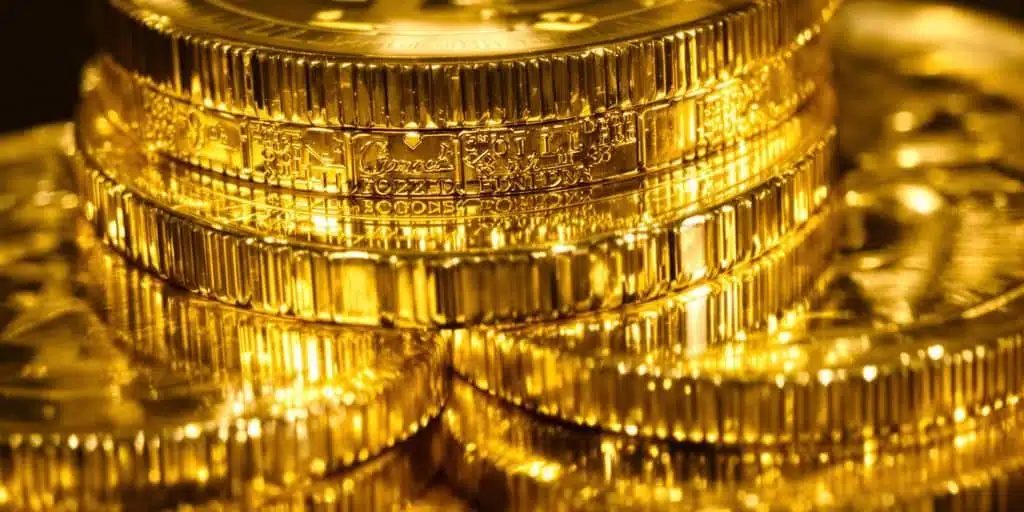
Wondering which gold coins to choose for investment? The Krugerrand, the Maple Leaf, and the Vienna Philharmonic are three names that come up often. Each has its own history, characteristics, and unique features. This article will help you gain insight and make the best choice by comparing these icons of the gold market.
Key Takeaways
- The Krugerrand, the pioneer of bullion coins, has a purity of 916,67‰ and has no face value, but is legal tender.
- The Canadian Maple Leaf is distinguished by its exceptional purity of 999,99‰, making it highly sought after but also more fragile.
- The Vienna Philharmonic, renowned for its artistic design, offers a purity of 999,9‰ and a face value of euros.
- The choice between these coins depends on factors such as desired purity, market liquidity, and appeal for their history or design.
- It is important to be wary of counterfeits, especially for older coins, and to favor modern coins with high purity for better security.
Understanding Bullion Gold Coins
When we talk about gold coins for investment, we often think of so-called "bullion" coins. The term "bullion" comes from English and broadly refers to precious metal in its purest form, like an ingot. These modern coins are therefore designed primarily for those who want to invest in gold, silver, or platinum. Their main advantage is that their weight and purity are standardized, making them easy to evaluate and trade. Unlike collectible coins, which can have numismatic value, the value of a bullion coin depends directly on the price of the metal it contains. Of course, there is also what is called a "premium" that is added to the price of the metal. This premium is a bit like the additional cost linked to manufacturing, market demand, and sometimes the reputation of the coin. Some coins are more sought-after than others, and this affects their price.
Definition of a bullion coin
A bullion coin is essentially a coin whose value is based on the quantity and purity of the precious metal it contains. They are minted by official mints or recognized manufacturers, and while they are often legal tender, their face value is usually much lower than their intrinsic value. Think of them as small ingots in coin form, but with a history and recognition that can add a little extra value.
Standardized purity and weight for investment
What makes bullion coins so convenient for investors is their uniformity. They are typically minted with a very high purity, often 99,9% or higher, and their weight is precise, most often to a troy ounce (about 31,1 grams). Fractions such as half ounces, quarter ounces, and tenths of an ounce are also available, making them suitable for different investment budgets. This standardization greatly facilitates transactions and value assessment.
The gold coin premium
The premium is that little extra you pay beyond the simple value of the metal contained in the coin. It covers the costs of production and distribution, and also reflects market demand. For example, a very popular or rare coin may have a higher premium. It's important to know that this premium can vary depending on the year and economic conditions. For a long-term investment, this premium tends to decrease compared to the value of the metal, but it remains a factor to consider when purchasing. It's always a good idea to compare premiums between different coins to make the best choice, much like you would compare prices before buying a new one. used car.
It's important to note that the quality of a bullion coin's preservation can influence its premium. A coin in perfect condition, without scratches or marks, will generally sell for more and at a price closer to its theoretical value, while a damaged coin could be depreciated.
The South African Krugerrand: a pioneer
Launched in 1967, the South African Krugerrand is often considered the very first modern gold bullion coin. Its appearance truly changed the game in the precious metals market. The idea behind its creation was to make investing in gold more accessible, particularly for small savers. It was minted at a time when South Africa dominated global gold production, accounting for around 75% of extraction in Western countries. Its success was almost immediate, reinforced by the end of the dollar's convertibility into gold in 1971.
History and design of the Krugerrand
The Krugerrand's design is quite simple yet iconic. The obverse features a portrait of Paul Kruger, a South African national hero and former president of the Republic of South Africa. The reverse features a springbok, an animal symbolizing South Africa, along with the country's name and the coin's weight. Its popularity exploded in the 70s, to the point that by 1980, it represented approximately 90% of the global gold coin market, making it the most liquid of all. Unfortunately, international sanctions related to apartheid curbed its exports to many Western countries, leading to a decline in its demand. Despite these obstacles, it remains a highly recognized and traded gold coin worldwide.
Specific purity and composition
Unlike many other modern bullion coins that aim for 24-karat (99,99%) purity, the Krugerrand has a slightly different composition. It is struck from a 22-karat gold alloy, which corresponds to a purity of 916,67 thousandths. This alloy includes copper, which gives the coin a slightly orange hue and makes it more resistant to scratches and dents. A one-ounce Krugerrand coin therefore weighs 33,93 grams in total, including one ounce of fine gold (31,1035 grams). This more robust, although less pure, composition was designed for easier handling, much like a coin.
Legal tender and divisions available
The Krugerrand is legal tender in South Africa, although it does not bear a face value expressed in rands on the coin itself. This is a feature that sets it apart from some other bullion coins. Initially launched in a one-ounce version, the South African Mint quickly expanded the range to meet demand. By 1980, smaller divisions were introduced: half an ounce, quarter an ounce, and one-tenth of an ounce. These different sizes allow investors to choose the amount of gold that best suits their budget and investment objectives. The accessibility and global recognition of the Krugerrand make it a solid choice for many.
The Canadian Maple Leaf: Purity and Safety
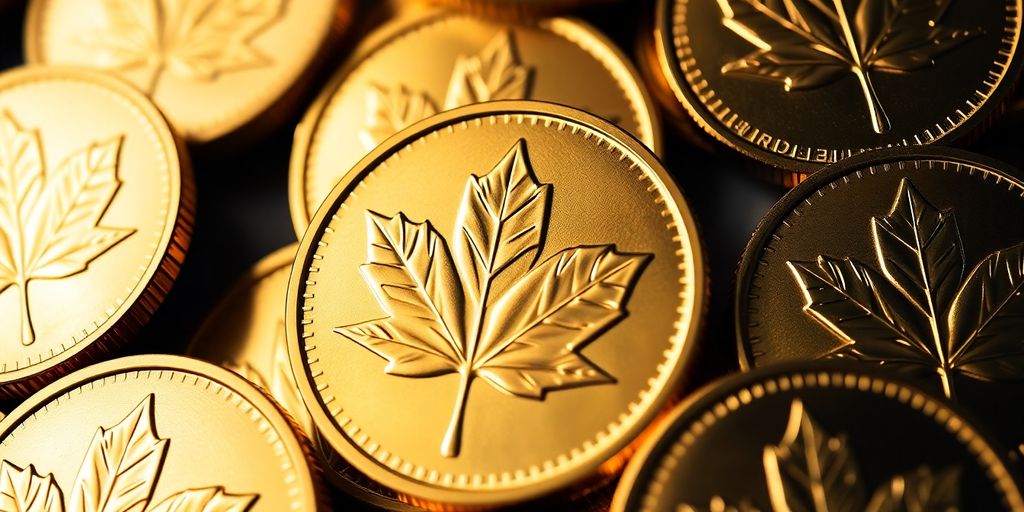
The Canadian Maple Leaf, launched in 1979, quickly became a benchmark in the gold bullion coin market. It was created in part to offer an alternative to the South African Krugerrand, especially during the apartheid era. What really sets the Maple Leaf apart is its exceptional purity. The Royal Canadian Mint aimed high from the start, offering a coin with a gold content of 99,99%. This is truly impressive, even if this purity also makes it a little more fragile than other coins, such as the Krugerrand, which is made of a 22-karat alloy. Therefore, you need to be a little more careful when handling it.
Origins and objectives of the Maple Leaf
The Royal Canadian Mint's creation of the Maple Leaf was intended to provide an internationally recognized, pure gold bullion coin. It was designed to be a reliable, high-quality alternative, particularly given the popularity of the Krugerrand. The choice of the maple leaf as the motif is not insignificant; it is a powerful symbol of Canada, instantly recognizable around the world. The goal was to create a coin that would not only be a sound investment, but also a powerful cultural symbol.
Exceptional purity and fragility
The Maple Leaf's most striking feature is its 99,99% fine gold purity. This very high content makes it a very attractive coin for investors looking for the maximum amount of gold in their purchase. However, this purity has a downside: it makes the coin more malleable and therefore more susceptible to scratches and deformation if not handled carefully. It is therefore advisable to store it in its original packaging or in a protective capsule to preserve its condition. This purity is a guarantee of quality, but requires more delicate handling than coins made of harder alloys.
Safety Innovations
The Royal Canadian Mint has not only offered record-breaking purity. It has also invested heavily in the security of its coins. Since 2013, the Maple Leaf has incorporated highly advanced anti-counterfeiting technologies. On the back of the coin, there is a laser-engraved maple leaf design with micro-lines. These lines are so fine and complex that they are extremely difficult to reproduce, making counterfeiting virtually impossible. This is a real plus for the security of your investment, as it guarantees the coin's authenticity. These innovations make the Maple Leaf one of the most secure gold coins in the world, a strong argument for investors concerned about the provenance and authenticity of their gold. You can also find more information about investment coins on the Royal Canadian Mint's website. Royal Canadian Mint.
The Vienna Philharmonic: European elegance
Artistic design and recognition
The Vienna Philharmonic, launched in 1989, quickly established itself as a leading European investment coin. Its design is particularly meticulous, depicting the famous Vienna Philharmonic Orchestra and its iconic instruments. This artistic touch gives it particular recognition among gold lovers who value both the intrinsic value and the aesthetics of their investment. It is often cited as one of the most beautiful gold coins available on the market.
Purity and evolving face value
The Austrian coin is distinguished by its purity of 999,9‰, a high standard for gold investment coins. An interesting feature concerns its face value. Before the introduction of the euro, it was denominated in 2 shillings. Since 000, its face value has been 2002 euros, although its market value is much higher and depends on the gold price. This development reflects European monetary changes and demonstrates how the face value of a coin can be more symbolic than indicative of its actual value on the gold market.
Different formats available
To accommodate the needs of different investors, the Vienna Philharmonic is available in several sizes. In addition to the one-ounce (31,1 grams) version, there are smaller versions: half an ounce, quarter an ounce, and tenth an ounce. These different sizes allow investors to choose the amount of gold that best suits their budget and investment goals. It's a good option for those new to investing in precious metals, as it offers significant flexibility, as does the Canadian Maple Leaf.
- An ounce: The standard format, representing 31,1 grams of pure gold.
- Half ounce: Smaller, it offers a more accessible alternative.
- Quarter ounce: Ideal for more modest investments.
- Tenth of an ounce: The smallest size, perfect for getting started or as a gift.
The appeal of the Vienna Philharmonic lies in its balance of impeccable purity, renowned artistic design and availability in several formats, making it accessible to a wide audience of investors.
Comparison of key features
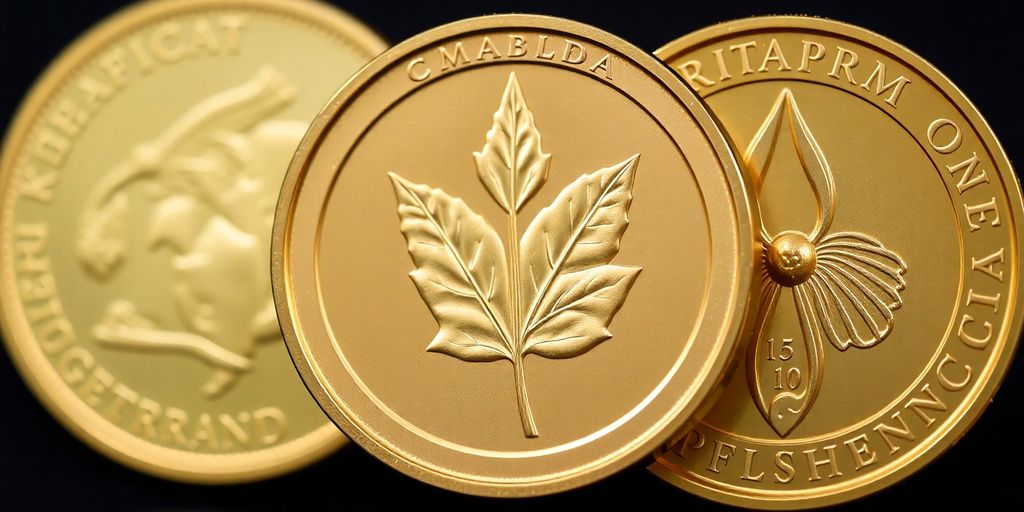
So, we're here to compare these three heavyweights of gold investment: the Krugerrand, the Maple Leaf, and the Philharmonic. It's not always easy to navigate, is it? Each one has its own little things that make it unique. We're going to take a closer look to help you see things more clearly.
Purity differences between coins
This is a super important point when we talk about gold. Purity changes everything. The Canadian Maple Leaf, for example, is known for being super pure, like 99,999% gold. It's very high quality, but it also makes it a little more fragile, so you have to be careful when handling it. The Vienna Philharmonic is also very pure, at 99,99%. The Krugerrand is a little different. It's made of 91,67% pure gold, the rest being copper. This gives it a slightly more orange color and makes it more shock-resistant, which can be an advantage for some.
Weight and diameter variations
Well, size and weight also vary. The Krugerrand is the quintessential one-ounce coin, so it weighs about 33,93 grams, with a diameter of 32,7 mm. The Maple Leaf is also one ounce, so 31,1 grams, and it measures 30 mm in diameter. The Vienna Philharmonic is the same, one ounce, 31,1 grams, but it's a little bigger, about 32 mm in diameter. It's not a huge difference, but it matters when you're picky.
Issuers and legal tender
Each coin comes from a different country, and that matters. The Krugerrand is minted in South Africa. It's legal tender in its country of origin, but it's its gold value that matters everywhere else. The Maple Leaf is produced by the Royal Canadian Mint, and it's also legal tender in Canada. It's a mark of trust. As for the Vienna Philharmonic, it's issued by Austria, and it's legal tender in Austria. Knowing who minted the coin gives you an idea of its reliability and history. For example, the Krugerrand was the first one-ounce coin to be widely circulated, which gives it a somewhat special status in the world of gold investing. It's a bit like the Krugerrand and the Napoleon 20 francs who each have their own story.
Basically, if you're looking for maximum purity, the Maple Leaf is your best friend. If you prefer a more robust coin with a distinctive color, the Krugerrand is not bad. And if you like European art and elegance, the Vienna Philharmonic has something for everyone. The choice will really depend on what you're looking for in your investment.
Factors influencing the choice of a gold coin
Choosing the right gold coin is a bit like choosing a car: there are plenty of models, and each has its advantages. But when it comes to gold, you have to think about things a little differently. You don't just look at the price of the metal, no. You also have to ask yourself if it'll be easy to resell, if it's recognized everywhere, and even a little about its history. It's not just a question of the weight of the gold, far from it.
Liquidity and accessibility in the market
When you buy gold, you want to be sure you can resell it when you need to. That's where liquidity comes in. The most well-known coins, like the Maple Leaf or the Krugerrand, are generally easy to sell. They're recognized worldwide, so there's no shortage of buyers. It's a bit like having an international currency. Less common coins, on the other hand, can be more difficult to sell, and you sometimes have to accept a lower price. So, you should look at whether the coin you're targeting is well-listed on international markets. This gives you an idea of how easy it is to resell. Think about this, because if you need to sell quickly, a coin that's difficult to trade can be a real problem.
Importance of history and reputation
Some gold coins have a story behind them, a reputation built over decades, even centuries. The Krugerrand, for example, was the first modern gold investment coin, which gives it a special status. The Canadian Maple Leaf is renowned for its purity. The Vienna Philharmonic has a very popular design. This reputation influences demand and therefore the premium people are willing to pay. A coin with a good story and a good reputation is often easier to resell and can even increase in value over time, beyond the simple price of gold. It's a bit like collecting objects with a soul, except that this is for investing. So you need to find out about the origin and history of the coin you're interested in. It can make a real difference in the long run.
Impact of counterfeits on the market
Unfortunately, where there's money, there are also dishonest people. Gold coins, especially the most popular ones, can be imitated. Counterfeits can really spoil the party for investors. If you buy a fake coin, you lose all your money, because it's worthless. That's why it's super important to buy from trusted sellers, serious people who can guarantee the authenticity of what they sell. You also need to know how to recognize the signs that show a coin is real: the weight, the diameter, the quality of the strike, and even the sound when you gently drop it. Getting fooled by a counterfeit is the worst thing that can happen when investing in physical gold. You have to be vigilant and don't hesitate to ask for certificates of authenticity. A real gold coin is a sound investment, but a fake one is a dead loss. You really have to be careful about the provenance of your gold coins.
Choosing a gold coin isn't just about its precious metal content. Liquidity, the issuer's reputation, and vigilance against counterfeiting are all equally important factors in securing your investment and ensuring easy resale.
Choosing a gold coin can seem complicated, but there are several important things that come into play. You have to think about the metal purity, its weight, and of course, its current price. The rarity of certain coins can also play a role. To help you make the best choice, discover all the details on our website.
So which one to choose?
Ultimately, choosing between the Krugerrand, the Maple Leaf, and the Philharmonic really depends on what you're looking for. If you want a coin with a long history and wide recognition, the Krugerrand is a solid option, even if its purity is a little lower. The Maple Leaf focuses on purity, which is great for those who want the maximum amount of gold, but beware, it's more fragile. As for the Philharmonic, it offers a good balance with beautiful purity and a design that's very popular, especially in Europe. Weigh the pros and cons carefully, look at current prices, and make your choice based on your priorities. The important thing is to find the coin that best suits your investment.
Frequently Asked Questions
What is a bullion gold coin?
Gold bullion coins are coins made for people who want to invest in gold. They have a weight of precious metal that is always the same and they are very pure. Their value depends mainly on the gold price. You can also find small coins that are worth a little more than their weight in gold, because of their manufacture or because many people want them.
Why is the Krugerrand special?
The Krugerrand is the very first modern gold coin for investors, it has been around since 1967. It comes from South Africa. It is not as pure as other coins, but it still contains an ounce of gold. It has an official value in its country, but it is not used to buy things every day.
What makes the Canadian Maple Leaf unique?
The Canadian Maple Leaf is super pure, almost 100% gold! It's great for investment, but be careful, it's also very fragile and you have to be very careful when handling it. To prevent copies, it has special security systems.
What is special about the Vienna Philharmonic?
The Vienna Philharmonic is the most famous European gold coin. It is beautiful, with designs of musical instruments and the Vienna State Opera. It is also very pure, like the Maple Leaf. Its official value changed when the euro was introduced.
Are there any differences in purity and size between these coins?
Gold purity varies across coins. The Maple Leaf and Philharmonic are very pure (99,99%), while the Krugerrand is slightly less pure (91,67%). Weight and size can also vary slightly, although they often contain an ounce of gold.
How to choose the best gold coin for investment?
You should check whether the coin is easy to buy and sell, whether it is well-known, and whether it has a good reputation. You should also be wary of counterfeits, especially the most famous models like the Krugerrand. High-purity coins like the Maple Leaf are more difficult to copy.