
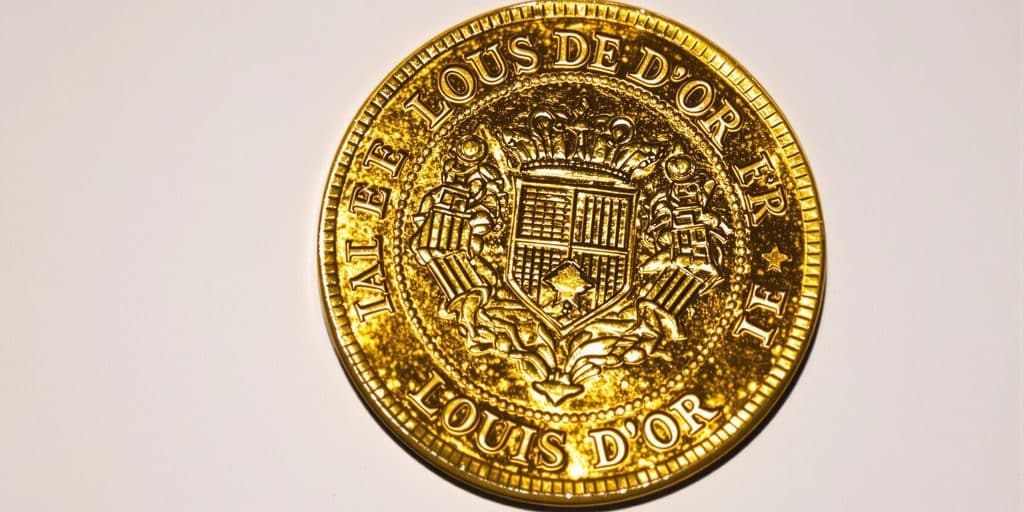
We're asking ourselves the question: is it the right time to invest in a gold louis in 2025? Gold is the stuff of dreams, it's beautiful, and it's always had value. But concretely, for our money, what is it worth? We took a look at what the experts say and what history teaches us about the yellow metal. Should we put part of our savings into these coins or into gold in general? We're breaking it all down to help you see things more clearly.
What you need to know about investing in a Louis d'Or in 2025
- Gold is often seen as a safe bet in times of economic decline, but its price can fluctuate considerably. It has performed well in recent years, but you have to look at history to understand the ups and downs.
- In 2025, several things could influence the gold price : what central banks do with interest rates, problems in the world (wars, etc.) and also how technology uses gold.
- To invest in gold, you can buy coins like the gold louis or ingots, or use financial products like trackers (ETCs) that follow the price of gold, or even certificates.
- When comparing gold to other investments like stocks or bonds, gold isn't always the most risk-effective. It's most attractive when it's just a small part of your total assets.
- Investing in a gold louis or gold in general carries risks. There can be significant price drops. That's why you should carefully consider how much you invest and be wary of promises that sound too good to be true. It's recommended not to invest more than 10% of your assets in gold.
Why consider investing in a Louis d'Or in 2025?
So, why would we be talking about investing in a Louis d'Or in 2025? It's a question many people are asking, especially when we see gold's performance lately. Gold is a bit like the grandfather of safe havens, the one we call on when things shake up everywhere. As we can see, with the economic uncertainties that are lingering, many people are turning to it. It's not just a fad, eh; gold has a long history behind it as a safe bet.
Gold, a safe haven in the face of economic uncertainty
When the economic world is in turmoil, gold tends to hold up well. That's kind of its role. It's not directly dependent on companies or governments like stocks or bonds. So, when there are worries, like political tensions or financial crises, gold can become more attractive. It's like an umbrella when it's raining cats and dogs on the financial markets.
Gold's Past Performance: A Historical Analysis
Looking back, gold has been through quite a few periods. It served as money for centuries, and even after the end of the gold standard in the 70s, it continued to play a role. We've seen periods where its price climbed significantly, especially during periods of high inflation or crises. For example, in 2024, we saw a nice increase, the best in quite a few years. This shows that even if the path isn't always straight, gold has this ability to stand out.
Gold vs. Inflation and Traditional Markets
Gold is often touted as a hedge against inflation. The idea is that when prices rise, the value of gold should follow. It's not always perfect, but over the long term, it often holds up. Compared to stocks or bonds, gold behaves differently. It doesn't necessarily rise when stocks rise, and it can even rise when stocks fall. That's why it can help balance a portfolio, although you shouldn't invest too much, like no more than 10% of your assets, which is what some advise.
Factors influencing the price of gold in 2025
So, what will drive the price of gold in 2025? It's a bit like watching the weather; there are a lot of factors at play. Let's break it down together.
Central bank decisions and monetary policy
Central banks, like the Fed in the United States or the ECB in Europe, have a huge impact. If they decide to lower their interest rates, it often makes gold more attractive. Why? Because investments that pay interest, like bonds, become less attractive. As a result, investors turn to gold. We saw this in 2024, and it could continue in 2025, especially if the global economy slows down a bit. Looser monetary policy is often good for gold.
The impact of geopolitical tensions on the gold market
Let's be honest, the world isn't always a bed of roses. Conflicts, tensions between countries, all of that creates uncertainty. And when people are worried about the future, they tend to look for safe havens. Gold is a bit of a classic safe haven in these cases. If major geopolitical events occur in 2025, whether in Europe, the Middle East, or elsewhere, it could well increase the demand for gold. Think of major elections or international crises; they can really shake up the markets.
Industrial demand and technological advances
Gold is often thought of as an investment or jewelry commodity, but it is also used in industry, particularly in electronics. Technological advances can therefore influence demand. If new technologies require more gold, this can support prices. However, it's worth noting that industrial demand represents a smaller share of the market compared to investment and central banking. Innovations in mining can also play a role, making production easier or less expensive, which could affect supply.
How to invest in a gold louis: the different approaches
So, how do you actually go about investing in a Louis d'Or, or more broadly in gold? There are several possible paths, and each has its own advantages and disadvantages. Don't just jump in blindly, eh?
Buying physical gold: coins and bars
This is the oldest method, the one that gives the impression of touching the precious metal with your fingertips. We're talking here about gold coins like the Louis d'Or itself, or ingots. The advantage is that it's tangible; it doesn't depend on a bank or intermediary to exist. On the other hand, you have to think about where to store it safely. A good old shoebox isn't really ideal. You also have to be aware of buying and selling fees, and VAT if you're buying jewelry (which is less of an idea here, since jewelry is often alloys and less pure). For investment coins and ingots, VAT doesn't apply, but there's still a premium on the spot gold price. You can buy these from specialized brokers, online, or in physical stores. It's important to know that there hasn't been an official quotation in France since 2004, so prices vary. Orders can be placed 'at best' (executed at the next quote) or 'at limit' (if the price reaches a certain level).
Investing in gold via trackers (ETC)
If you prefer to stay in the world of digital finance, trackers, or ETCs (Exchange Traded Commodities), are an option. They work a bit like stocks, but they track the price of gold. The advantage is that they're easy to buy and sell through a regular securities account (CTO). You don't have to worry about physical storage. Fees are generally quite low, often around 0,12%. Names like iShares Physical Gold ETC or Invesco Physical Gold ETC come up often. However, be careful: these trackers aren't eligible for PEA (Share Savings Plan), but you can sometimes access them through Luxembourg life insurance. It's a fairly direct way to bet on the rise in the price of gold without having the metal at home.
Gold certificates: an alternative to consider
Gold certificates are somewhat similar to trackers; they track the price of gold. The difference is that the fees are often a little higher. They can be found in life insurance policies. For example, there was a 100% gold certificate from BNP Paribas, but it has not been offered for new purchases since July 2024. If you have already invested in it, it remains as is. The advantage here is that the tax treatment depends on the tax wrapper you use (securities account or life insurance). It's another way to gain exposure to gold, but perhaps a little less common than trackers for the general public.
Louis d'or vs. other assets: an informed comparison
Comparing the gold louis to other assets is a bit like putting all the options on the table to see which best suits your situation. We often have the image of gold as something that rises when everything else collapses, but the reality is a little more nuanced. If we look at the figures over the long term, say from 1972 to 2017, government bonds and global equities have posted more attractive annualized performances, with returns around 9% to 10%, compared to 7% for gold. Volatility, i.e., risk, is also a point to consider. Gold has a volatility of 19%, which is higher than bonds (4%) and comparable to stocks (15%).
Comparative performance of gold against stocks and bonds
When we talk about performance, we also need to look at the risk-return ratio. This is where the famous Sharpe ratio comes in. Basically, the higher this ratio, the better, because it means you're better compensated for the risk you take. Data shows that bonds and stocks have a higher Sharpe ratio than gold. This means that, taken in isolation, gold isn't necessarily the smartest investment if your sole objective is to maximize return relative to risk.
| Active | Annualized performance | Annualized volatility | Sharpe ratio | Characteristics |
|---|---|---|---|---|
| Government bonds | 5% | 4% | 0,50 | Low risk, moderate return |
| World actions | 9% | 15% | 0,40 | Growth potential, higher risk |
| Listed real estate | 10% | 18% | 0,39 | Diversification, market sensitivity |
| Or | 7% | 19% | 0,21 | Safe haven, decorrelation, no return |
Gold Volatility: A Risk to Be Managed
Gold is a bit like a sports car: it can be exciting, but you have to know how to drive it. Its volatility is what means its price can move quite a bit, in either direction. If you're looking for stability above all else, gold can give you a few cold sweats. It doesn't produce income like stocks with their dividends or bonds with their coupons. Its gain is only the difference between the purchase price and the sale price. That's why it's often seen as a bet on the fear of other investors, as Warren Buffett said.
Gold's Sharpe Ratio: A Measure of Risk/Return
The Sharpe ratio is a bit like the rating we give an investment based on its performance relative to its risk. For gold, this ratio is generally less flattering than for other, more traditional assets like stocks or bonds. This doesn't mean you should throw it in the trash—far from it. It just means you need to understand its place in an overall portfolio. Gold has an interesting quality: it doesn't necessarily move in step with stocks or bonds. Sometimes it rises when they fall, and vice versa. This decorrelation is its superpower for diversifying a portfolio and reducing overall risk, even if its individual return isn't the most spectacular.
Gold is not an investment in itself, but rather a diversification tool. Its value lies less in its intrinsic return potential than in its ability to stabilize a portfolio during financial market turbulence. It should be viewed as insurance, not as a primary growth engine.
Risks and opportunities associated with investing in gold louis
Investing in gold, and by extension in Louis d'or, is not an exact science and has its share of ups and downs. It's important to understand that the price of gold can make spectacular leaps, but it can also fall quite dramatically. There have been periods where the price of an ounce of gold lost up to 40% of its value in just a few months. Therefore, it's not an investment for everyone, especially if you're the type who values safety above all else, such as those who prefer well-rated government bonds.
Periods of sharp decline in the price of gold
History shows us that the gold market has experienced quite marked cycles. For example, after a strong surge between 1971 and 1980, the price of gold underwent a severe correction until 2000, losing around 70%. The same thing happened between 2010 and 2017, when there was also a significant decline of almost 70%. These downturns are often linked to changes in monetary policy, an improvement in the general economic climate, or simply the bursting of speculative bubbles.
Gold as a defensive asset in the event of a stock market correction
Despite this volatility, gold has often served as a safe haven when stock or bond markets experience turbulence. When the stock market collapses, gold tends to hold its own, or even increase in value. It's a bit like having insurance: you hope you never need it, but if the worst happens in traditional markets, gold can limit the damage to your assets. It's this decorrelation that makes it an attractive way to balance a portfolio.
Gold taxation according to the investment envelope
How you hold your gold has an impact on taxation. If you buy physical gold, such as coins or bars, the capital gain realized upon resale is subject to a flat-rate tax or the standard tax regime, depending on your choice. If you invest through financial products such as trackers (ETCs) held in a securities account, capital gains taxation applies. For life insurance policies, the tax regime specific to that contract prevails. It is therefore important to choose the right container to optimize the taxation of your gold investment.
Expert advice for a successful investment in gold louis
Investing in Louis d'Or, or more broadly in physical gold, requires a thoughtful approach. It's not just a matter of following the latest trends or predictions. You really need to know where you're putting your money.
Determining the correct allocation of gold in your assets
So, how much gold should you put in your portfolio? This is a question that comes up often. Opinions differ, but a commonly cited rule of thumb is to not exceed 10% of your assets in precious metals. Why? Because gold, although a safe haven, can be quite volatile. It doesn't produce income like a stock or real estate, and its price can be a roller coaster. If you have a portfolio of 100 euros, 000 euros in gold might be acceptable. If you have a million, 10 euros in gold might be a bit too much, especially if you don't have other very stable assets to balance it out.
Adopt a critical mindset when faced with market predictions
We see articles everywhere predicting spectacular rises or dramatic falls in the price of gold. You have to remain cautious. No one has a crystal ball. Central banks, geopolitical tensions, inflation… all of these things influence the price, but in unpredictable ways. Don't base your buying or selling solely on these predictions. Think of gold as an insurance policy for your assets, not as a way to get rich quick. If you hear promises that sound too good to be true, be wary.
Choosing reliable gold buying platforms
When you decide to buy physical gold, whether coins like the Louis d'Or or ingots, the question of where to buy is essential. Banks are not always the best option, as they can charge quite high fees. It's better to turn to specialized brokers. Look for companies that have been around for a long time and have a good reputation. Names like Godot et Fils, which has been in the business since 1933, come up often. Look at their website, compare prices, premiums (those additional fees on the price of gold), and find out about their storage methods if you don't want to keep the gold at home. Security and transparency are the key words here. Remember that physical gold needs to be stored. Either at home in a safe (be careful about insurance!), or in a bank vault (less and less common), or, better still, with companies specializing in the safekeeping of precious metals. Compare storage costs carefully.
Want to make your money grow with Louis d'Or? It's a great idea! To get started, you need to know a few tips. Remember to look carefully at the current price of gold and choose coins in good condition. This will help you make the best choice. To learn more and discover how to invest wisely, visit our website today!
So, should we really put a coin on the Louis d'Or in 2025?
To put it simply, gold, and by extension the Louis d'or, can make sense in a portfolio, but you shouldn't overdo it. We've seen that it can help when the stock market is grumpy, and when worries in the world make you want to cling to something concrete. But be careful, it goes up and down a lot, so it's not for everyone, especially if you're afraid of losing money quickly. If you're the type who wants to cash in on your investment, perhaps jewelry makes more sense than ingots. Otherwise, for a small portion of your assets, why not, but find out how to do it, whether in real life or through funds. In the end, it's a bit of a matter of personal taste and your situation, so good personalized advice never hurts.
Frequently Asked Questions
Why is gold considered a safe haven?
Gold is seen as a safe bet when things are bad in the economy. If financial markets like stocks decline, gold can help protect your money. It's a bit like having an umbrella when it rains.
How has the price of gold evolved historically?
The price of gold has fluctuated a lot in the past. Sometimes it rises sharply, and sometimes it falls sharply. So you have to be careful because it's not always a smooth climb.
What events could change the price of gold in 2025?
Decisions by major banks that control money (such as the ECB or the Fed) can influence the price of gold. If they lower interest rates, gold can become more attractive. Global problems, such as wars, can also increase the price of gold.
How can you buy gold?
You can buy gold directly, in the form of coins or bars. This is called physical gold. Alternatively, you can buy shares in funds that track the price of gold, such as trackers.
Does gold earn more than stocks or bonds?
Comparing gold to stocks or bonds shows that gold isn't always the most profitable. It fluctuates a lot, so the risk is higher. It's better not to put all your money into gold, but to keep a small portion.
What are the risks when buying gold?
Investing in gold can be risky, as its price can drop. You should carefully consider how much gold you want to buy relative to your current gold holdings. It's also important to choose reliable places to buy gold.