
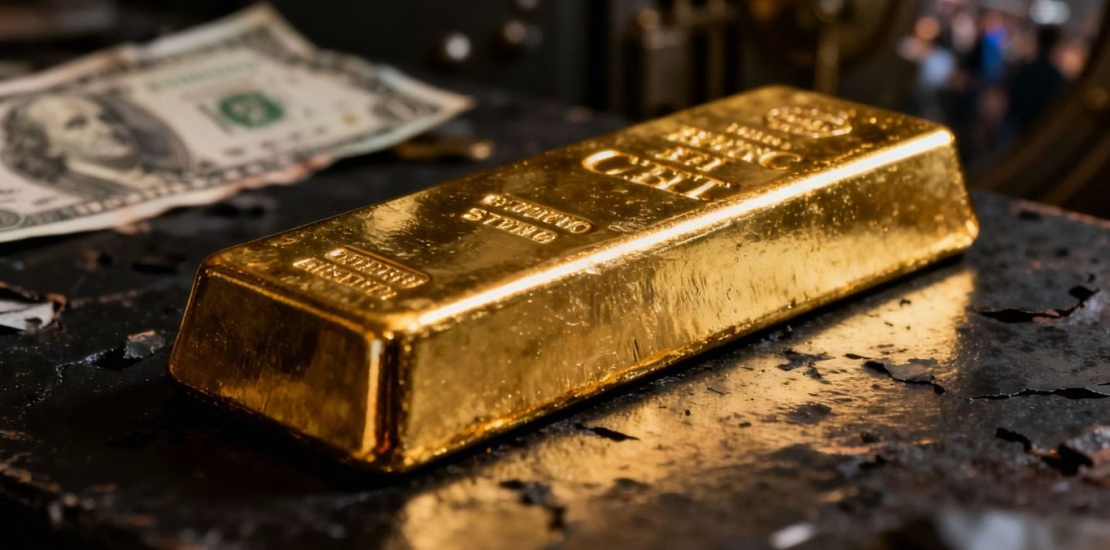
Recent news about the health of the banks is worrying. We hear about bankruptcies and bailouts, and it makes us wonder if our money is truly safe. In times like these, many turn to safer assets. And gold often comes up in conversation. So, should we hold gold in the event of a banking crisis? It's a legitimate question, especially when we see the financial markets on such a rollercoaster ride.
Key Takeaways
- Gold has historically been a recognized safe haven asset, valued by individuals and central banks alike for its stability in times of crisis.
- Holding physical gold offers protection against inflation and financial market instability, as it is a tangible asset independent of banking systems.
- Different formats of gold, such as 50g, 250g or 500g bars, allow you to adapt your investment to your needs and budget.
- In France, the purchase and resale of gold benefits from favorable taxation, making the investment all the more attractive.
- Physical silver, in the form of bars or coins, represents an attractive alternative to gold, combining safe-haven value and industrial potential.
Gold, That Everlasting Companion in Times of Crisis

A Symbol of Wealth Through the Ages
Say what you will, gold has always fascinated. Since the dawn of time, it has passed through the hands of the powerful, but also among those seeking to protect their nest eggs. It's no coincidence that this shining metal is always found, from an Egyptian tomb to a Swiss bank. While silver has changed its appearance a thousand times, gold has never ceased to embody stability. Even when paper currencies collapsed or transformed, gold remained. No other material has survived crises, wars and the fall of kingdoms while retaining this same aura.
Keeping a little gold at home is like preserving a piece of history, while also providing security for the days ahead.
Why Central Banks Love Gold So Much
Just look at what the major institutions are doing to immediately understand the power of gold. Central banks, for example, are stockpiling gold bars, and not for fun. It's a matter of confidence, prudence, but above all, security. This pile of yellow metal in their vaults is a safeguard in case everything goes haywire in the markets. Ever since paper money replaced coins, they've kept gold close at hand, in case they need to restore confidence or reassure the markets. Moreover, in their crisis management, when there's a breach in the monetary system, their first instinct? Gold. Always. Its enduring nature means that, even today, no major bank in the world can do without it.
| Gold reserves (in tonnes) | USA | Germany | France | Italie |
|---|---|---|---|---|
| Latest known figure | 8 133 | 3 355 | 2 437 | 2 452 |
Gold: An Unrivaled and Reliable Investment
There's this cliché: when everything goes wrong, gold soars. But it hasn't earned its reputation by chance. On the stock market, shares sometimes plummet, and the euro and the dollar falter at the slightest shock. Gold, however, holds firm, regardless of the surrounding chaos. It's this ability to weather storms unflinching that makes it the benchmark whenever confidence wanes. Wealthy families and governments alike accumulate gold for good reason: nothing else offers such peace of mind in times of crisis. Whether you're the cautious type or just a little prudent, Gold never disappoints in the face of time.
Keep this in mind: gold is like that old sweater you've kept for years. Not the most stylish, but when winter arrives, it's the first one you reach for without hesitation.
How Gold Protects You When Banks Tremble
When we hear about a banking crisis, it immediately gives us a knot in our stomach, let's face it. We wonder if our money is really safe. That's where gold comes in, a bit like a reliable old friend who shows up when things go wrong.
Physical Gold: Your Anti-Inflation Shield
Imagine prices skyrocketing, your purchasing power melting away. That's the nightmare of inflation. Gold, however, has the unique characteristic of retaining its value over the long term. When currencies lose their luster, gold holds firm. It's a bit like having insurance against the devaluation of your money. Central banks know this well, which is why they hold enormous quantities of gold to stabilize their economies. By holding physical gold, you're doing something similar: protecting yourself against this silent erosion of your savings.
Gold is the only currency that has no debt. It has an intrinsic value that transcends ages and crises.
The Universal Liquidity of Gold
One of gold's major advantages is its global recognition. Whether you're in Paris, Tokyo, or New York, a gold bar or coin is easily understood. In times of trouble, if you need to quickly convert your assets into cash, gold is far easier to exchange than, say, a work of art or real estate. There's always a market for gold, buyers ready to purchase it. It's this worldwide acceptance that makes it such a valuable asset when things get difficult.
A Tangible Asset Independent of the Markets
When you buy physical gold, you hold something tangible in your hands. It's not just a number on a computer screen or a promise on a piece of paper. It's a metal, a commodity with intrinsic value. Unlike stocks or bonds, which can plummet based on the day's news or the decisions of the financial markets, gold has its own dynamics. It's less susceptible to the whims of traders and stock market volatility. In times of banking crisis, when confidence in the financial system can erode, owning a tangible asset, independent of these fluctuations, offers tremendous peace of mind.
Choose the Right Gold Format for Your Security
When considering investing in gold, especially during uncertain times, the question quickly arises: which format to choose? It's not like buying a loaf of bread; it requires some thought. Gold bars are the classic choice, but they come in all sizes. And frankly, it can quickly become complicated if you don't know where to begin.
The 50g Ingot: Practical and Affordable
For beginners or those who simply want to dip their toes into gold without risking their life savings, a 50-gram ingot is a good option. It's small enough to be easy to store, even at home in a sturdy safe. And if you ever need to sell some, it's simpler than with a larger ingot. It also allows you to buy little by little, which is a good strategy for smoothing out price fluctuations. It's a bit like shopping daily rather than buying everything at once.
The 250g Ingot: Perfect Balance
Now we're moving up a notch. The 250-gram ingot is a good middle ground. It's substantial enough to represent a real investment, yet still manageable enough for easy storage. It's the size many choose to build a solid long-term reserve. It offers a good compromise between the cost per gram, which is more attractive than with smaller ingots, and the flexibility for potential resale. It's the choice of investors with a long-term vision.
The 500g Gold Bar: For a Solid Investment
And finally, the 500-gram ingot. This represents a more substantial investment, clearly intended for those who want to secure a significant portion of their wealth. This format is highly valued by more experienced investors and even some institutions. It offers an excellent price per gram, making it more profitable in the long run. However, storage needs to be considered, as it does require a bit more space. But if your goal is to build a genuine store of value, it's a very sound choice.
Choosing the right size of gold bar is a bit like choosing the right size of shoes: it needs to be comfortable for you, suited to your situation and your goals. Don't rush, look for what suits you best.
Gold, a Smart Investment in France

A Tax System That Smiles on You
When talking about investing in gold in France, there's one really cool thing to know: the tax system. Basically, buying investment gold, like bars or certain coins, is exempt from VAT. This means the price you see is the price you pay, without that tax inflating the bill. That's already a good starting point, isn't it? And it's pretty good for reselling too. You have a choice between two tax regimes. Either the Precious Metals Tax (TMP), which is 11% of the sale price, or the capital gains tax regime for movable property. The latter can be more advantageous if you've held your gold for a long time, because after 22 years, you're completely exempt from capital gains tax. That's significant when you're thinking about long-term holding.
The Simplicity of Resale
One of the major advantages of gold is its global recognition. This means that when you want to sell your gold, you don't have to look far. There are plenty of potential buyers, from specialized professionals and banks to online platforms. Gold bars, especially those certified by reputable refiners like those adhering to LBMA (London Bullion Market Association) standards, are particularly easy to resell. They have guaranteed purity (often 999,9‰) and are frequently sealed in packaging with a certificate. This reassures the buyer and simplifies the transaction. Even antique gold coins, like the famous 20 Francs Marianne Rooster, are highly liquid because they are in high demand.
Renowned Cheese Refiners for Your Peace of Mind
To ensure a sound investment and a smooth resale of your gold, it's crucial to choose products from reputable refiners. In France and Europe, certain names frequently come up: Umicore, Metalor, Heraeus, C-Hafner… These companies are LBMA-certified refiners, guaranteeing the quality and purity of the gold they produce. When you purchase a bar or coin from a reputable dealer, you'll typically receive a certificate of authenticity that specifies the refiner. This provides added security. Knowing your gold meets international standards is reassuring, especially if you plan to keep it for a long time or pass it on to future generations.
In France, investing in physical gold means benefiting from a rather favorable tax framework and the ease of resale thanks to the global recognition of this precious metal. Choosing quality products from reputable refiners is the key to complete peace of mind.
Silver, the Other Precious Metal to Consider
Silver: More Than Just a Currency Metal
We often think of gold when we talk about precious metals, but silver is a bit like its less flashy but equally solid cousin. Frankly, this metal has been used for millennia for exchange and to store value. The ancient Greeks, the Romans, everyone used it to make coins and for trade. It was the metal of the people, the one that kept the economy going, not just the metal of kings. And today, it's still very much alive; silver is incredibly important in all sorts of high-tech things, like solar panels and electronics. It's not just something that shines; it's also a strategic raw material.
Why Invest in Physical Money
So, why turn to physical silver, like bullion? For starters, it's more accessible than gold. If you want to start building up a small nest egg in precious metals without breaking the bank, silver is a great entry point. Plus, it has this dual purpose: it can serve as a safe haven when times get tough, like gold, but it's also in high demand by industry. This gives it a kind of floor, a constant demand that can help maintain its value. And let's be honest, having something tangible in your hands is reassuring when markets go haywire or banks act up. It's kind of like your personal insurance, really.
Physical money is a bit like having a discreet but powerful energy reserve. It has stood the test of time, it's essential today, and it's likely to remain relevant tomorrow. It's not just an investment; it's a tangible form of security.
Silver Ingots: A Strategic Choice
When we talk about silver bars, we find different sizes, just like with gold. One-kilogram bars, for example, are a fairly standard size for those who want to invest more seriously. It's a good way to store a significant amount of value in a relatively small space. Then there are smaller sizes, like 250g or even 50g, which are perfect for starting out or for more carefully diversifying your portfolio. The advantage is that they are recognized worldwide, often certified by organizations like the LBMA, which makes them easier to resell. It's a bit like having dollars or euros, but in precious metal form, universally accepted and less subject to the whims of governments.
Gold Coins: A Piece of History to Own
The 20 Francs Marianne Rooster: A French Classic
Ah, the famous 20 Francs Marianne Rooster coin! If you're looking for a gold coin with a history that resonates with the French, this is it. Minted between 1899 and 1914, it's witnessed quite a lot. One side features Marianne, the symbol of the Republic, wearing her Phrygian cap. The other depicts a proud rooster, keeping a watchful eye. It's like holding a piece of French history in your hand.
What's cool is that it was restruck later, in the 50s. These new coins, called "Pinay restrikes," use the old dies, so they look like the originals, but with more recent dates. It's a highly sought-after coin, easy to resell, and what's more, it benefits from rather favorable tax treatment in France. It truly embodies the values of the Republic and is a classic for those who want to invest in physical gold.
Owning a coin like the 20 Francs Marianne Rooster is a bit like possessing a tangible testimony of French monetary history, an asset that has spanned eras and continues to attract with its strong symbolism and intrinsic value.
The US $10 Eagle: An American Symbol
Let's cross the Atlantic to the $10 US Eagle, also known as the "Indian Head." This coin is something of an icon in American monetary history. It was designed by a renowned sculptor and commissioned by a president with a vision. When you hold it, you feel like you're holding a piece of American history. It's highly prized by collectors and investors because it combines the value of gold with undeniable historical and artistic appeal.
What's interesting about this coin is its liquidity. It's recognized worldwide, so if you ever need to resell it, it's quite easy. In France, it also benefits from favorable tax treatment, with no tax on purchase and attractive resale options. It's a solid way to diversify your portfolio with a tangible asset that isn't subject to the vagaries of the stock market.
The Vreneli 20 Swiss Francs: The Latin Monetary Union on Your Wrist
And to finish on a high note, let's talk about the Vreneli 20 Swiss Francs coin. This little gem is a symbol of Swiss stability and neutrality. First minted in 1897, it depicts a young Swiss woman, the Vreneli, surrounded by edelweiss flowers. It's a coin of genuine historical and cultural value.
The Vreneli is part of the Latin Monetary Union, a monetary agreement that linked several European countries in the 19th century. This means it was accepted and traded throughout Europe, giving it international recognition. It is prized for its beauty, purity (900/1000 gold), and ease of resale. It's an excellent choice if you're looking for a gold coin with a strong European history and a recognized safe-haven status. It's perfect for those who want a tangible and easy-to-manage investment.
The gold coinsIt's like having a little piece of history in your home. Each item tells a story, an event. It's fascinating to think about who might have owned it before you! If you too would like to possess a piece of this rich and precious past, don't wait any longer. Come and discover our unique collection on our website and find the piece that will transport you back in time.
So, should we buy gold or not?
Okay, so we've talked quite a bit about gold, its history, why central banks have so much of it in their vaults, and how it can help us when things get tough. Clearly, gold has always had value, especially when everything else falters. But be careful, it's not a magic wand either. It can be a good idea to have some, just to sleep soundly, but you shouldn't put all your eggs in one basket, you know? Like with everything, you need to do your research before jumping in and maybe start small. And then, if things really go south, having a few coins or bars on hand can always come in handy. It's a bit like insurance; you hope you never need it, but you're glad to have it if the worst happens.
Frequently Asked Questions
Why is gold considered a safe haven, especially in times of banking problems?
Gold has been precious for a very long time. People trust it because it has always retained its value, even when other things lose it. When banks have problems, gold is not dependent on a bank or a government. It is accepted everywhere in the world, making it a safe way to keep your money secure.
Is owning physical gold, such as gold bars, safer than keeping your money in the bank?
Yes, owning physical gold is like having a personal treasure. It's unaffected by the problems a bank might encounter. If a bank fails, your gold remains yours. It's a tangible asset you can touch and keep at home or in a safe place.
What are the advantages of buying gold in France?
In France, buying gold is quite simple and advantageous. There is no purchase tax (VAT). Furthermore, if you resell your gold after holding it for a certain period, you may be exempt from capital gains tax. It is also easy to find reputable professionals to buy or sell gold.
Is money also a good investment in times of crisis?
Silver is also an interesting precious metal. It has historical value and is used in many modern industries, such as electronics and solar panels. It is less expensive than gold, making it more accessible for beginners. It can also be a good hedge against economic downturns.
Which gold coins are best known for investment?
There are several popular gold coins. In France, the 20 Francs Marianne Rooster is very well-known. In the United States, the $10 US Eagle is popular. The Vreneli 20 Swiss Francs is also a good option, as it comes from a former European monetary union. These coins are recognized and easy to resell.
What size gold bar is most recommended to start with?
To start, a 50-gram gold bar is a good choice. It's not too expensive and it's easy to store. If you want to invest a little more, 250g or 500g bars are also good options. They offer a better price per gram while remaining fairly easy to manage.
