Are you interested in Japanese Gold: Cultural Tradition and Modern Investment? It's a fascinating topic that blends a country's heritage with its rich practices. Japan has a long history with gold, not only as a precious material for craftsmanship, but also as a powerful cultural symbol. At the same time, like everywhere else, gold has become an important investment asset. So, how do these two aspects intersect? Let's explore this together.
Key Takeaways
- Gold occupies a significant place in Japanese culture and traditions, being a central element of craftsmanship and aesthetics.
- Physical gold, in the form of bars or coins, is considered a tangible safe haven and a way to diversify one's assets.
- Japan has a rich history with gold, using it in cultural practices and art objects that reflect a deep philosophy.
- Investing in gold offers protection against inflation and market volatility, while often benefiting from advantageous tax treatment.
- Japanese craftsmanship, while preserving ancestral techniques, adapts to modernity, creating a bridge between the past and the future.
Gold, a Japanese cultural heritage
The Place of Gold in Japanese Traditions
In Japan, gold is more than just a precious metal; it is deeply rooted in the country's history and culture. For centuries, it has adorned Buddhist temples and Shinto shrines, symbolizing purity, divinity, and eternity. Think of the magnificent gold leaves covering Kinkaku-ji, the Golden Pavilion in Kyoto—an image that immediately comes to mind when discussing gold in Japan. It is also present in rituals, such as during festivals where it can be used in offerings or decorations. Gold is truly linked to spiritual concepts and the pursuit of perfection.
The Craftsmanship and Aesthetics of Gold in Japan
Japanese goldsmithing expertise is exceptional. Artisans use ancestral techniques to work gold, often with incredible precision. Whether creating delicate jewelry, decorative objects, or even gilding everyday objects, Japanese aesthetics are reflected in the finesse of details and the harmony of forms. This quest for beauty is found in arts such as Maki-e, where gold lacquer is applied with great skill to wooden objects. It is an art that requires patience and great dexterity, a true goldsmith's work.
The philosophy behind the use of gold
Beyond its material value, gold in Japan is often associated with philosophies such as wabi-sabi,, which finds beauty in imperfection and the ephemeral. Although it may seem paradoxical for such a durable metal, gold is used to emphasize the preciousness of the moment, the beauty of an object that ages. There is also an idea of transmission, of value that endures through time, much like a family heirloom. Gold thus embodies both the permanence and the preciousness of passing moments.
Gold as a safe haven and investment asset
Physical gold: a tangible and universal asset
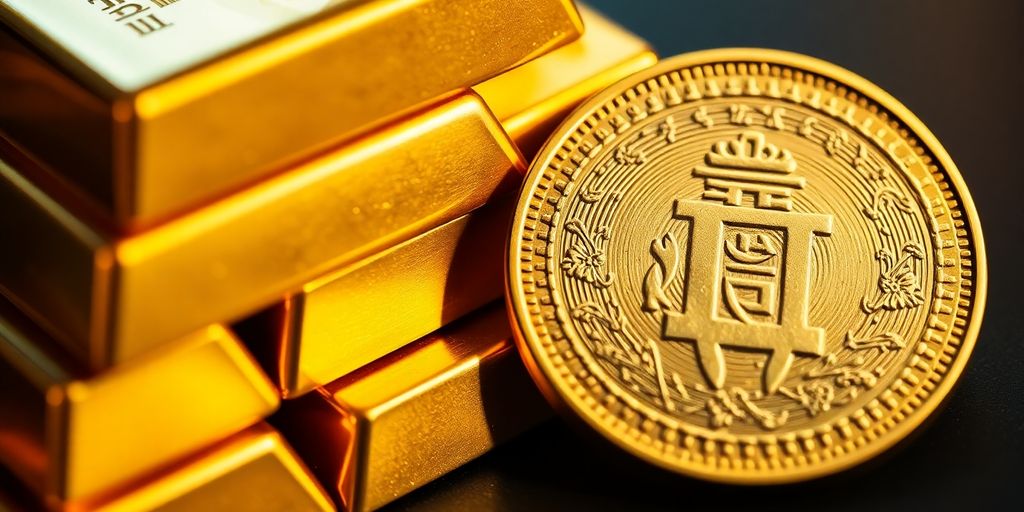
Gold is a bit like the grandfather of safe havens, isn't it? We've known it for millennia and trusted it when times get a bit turbulent. Unlike stocks, which can soar or collapse, gold is there, solid. You can touch it, hold it. It's this materiality that reassures. When we talk about investing in gold, we often think of ingots, those shiny blocks that have survived the ages, or coins, like the famous Napoleons or American coins like the 10 Dollar Indian Head. These formats have the advantage of being recognized all over the world. No matter where you are, a 250-gram gold ingot or a 20 Franc Marianne Coq coin has value. It's a bit like having a universal store of value in your pocket, or rather, in your safe.
Gold bars and coins: investment formats
When you decide to invest in gold, you have several options. Ingots are the classic. They come in all sizes, from the small 20-gram ingot, perfect for getting started without breaking the bank, to large ingots of 1 kilo or more. The great thing about ingots is that they're usually made of pure gold, often 999,9‰. This is the case with LBMA-certified ingots, which are a benchmark. Gold coins are a little different. They have a history, a numismatic value that can be added to that of the gold they contain. Think of the 20 Swiss Francs, the Vreneli, or American coins like the 10 Dollar US Eagle Indian Head. They're also highly sought after, sometimes even more so than ingots for some collectors. The important thing is to choose a format that matches your goals and your budget. A 250g ingot, for example, is a good compromise: it is large enough to have a significant weight, but it remains easier to store and resell than a one-kilo ingot.
The advantageous taxation of investment gold
Let's talk a little about taxes, because it can make a real difference. In France, for example, the purchase of investment gold, whether ingots or coins, benefits from a rather attractive tax system. Already, upon purchase, you don't have to pay VAT. That's a significant advantage. And when you decide to sell, you have a choice. Either you opt for the precious metals tax, which is a flat rate, or you choose the capital gains tax regime. This latter regime can be very interesting if you've held your gold for a long time, because after 22 years of ownership, you are completely exempt from capital gains tax. It's a bit like an investment that improves over time, from a tax point of view. This makes gold even more attractive as a way to secure and grow your wealth over the long term.
The Changing Role of Gold in Finance
From the Gold Standard to Modern Markets
You know, gold wasn't always just something you bought to make your money grow. For a long time, it was basically the basis of the global economy. We talked about the gold standard, a system where the value of a country's currency was directly linked to a fixed amount of gold. It was kind of the guarantor of stability, you know? Countries had gold reserves, and that determined the value of their currency relative to others. That was the case for a good part of the 19th and early 20th centuries. But then, wars and economic crises kind of messed things up. After World War II, we had the Bretton Woods Agreement, which tied the dollar to gold, and other currencies to the dollar. That held for a while, but in 1971, the United States stopped converting dollars to gold. And in 1976, gold was completely
Investing in gold: a wealth strategy
Incorporating gold into your wealth strategy is a bit like building a fortress for your money. You're looking to protect what you've accumulated, and gold has been doing just that for millennia. It's not just a passing fad; it's something that's survived the ages, empires, and economic crises without ever losing its intrinsic value. Think about it: even when everything else collapses, gold remains gold.
Diversify your portfolio with gold
It's often said that you shouldn't put all your eggs in one basket, and that's exactly where gold comes in. If you've invested everything in stocks or real estate, a bad run in those sectors can be very damaging to your assets. Gold, on the other hand, tends to react differently. When stock markets plunge, the gold price often rises. This is called decorrelation, and it's super useful for smoothing out the ups and downs of your overall portfolio. It gives you a kind of safety net.
Gold as a hedge against inflation
Inflation is that insidious little thing that eats away at the purchasing power of your money. Every year, with the same amount of money, you can buy a little less than before. Gold, historically, has been pretty resilient to this. When currencies lose value due to inflation, the price of gold tends to rise, compensating for the loss in value of your cash. It's a bit like gold holding its value when other currencies weaken.
Liquidity and ease of resale of gold
When it comes to investing, you also need to think about how you'll get your money back if you need it. Gold, especially in the form of bars or recognized coins, is quite liquid. This means you can resell it fairly easily and fairly quickly if you have an unforeseen expense or an opportunity to seize. There's a global market for gold, with buyers everywhere, whether professionals or individuals. It's not like real estate, which takes months to sell. You can even resell small quantities, like 1g or 2g bars, which gives you significant flexibility.
Japanese craftsmanship: ancestral know-how
Japan is a country where craftsmanship occupies a special place, a know-how that is passed down from generation to generation. You will discover how these ancestral techniques, far from being static, continue to evolve while retaining their soul.
Preserving traditional techniques
In Japan, passing on artisanal skills is a serious matter. Master craftsmen devote years, even decades, to perfecting their craft. Think of pottery, lacquerware, or even metalworking: every gesture is precise, every tool mastered. This quest for perfection is at the heart of Japanese craftsmanship philosophy. It is not just about reproducing, but about understanding the very essence of the material and the technique in order to breathe new life into it.
The influence of Japanese decorative arts
The decorative arts have played a major role in the preservation and promotion of craftsmanship. In the 19th century, for example, a period of intense modernization saw the emergence of new approaches. Craftsmen had to adapt, incorporating new technologies while ensuring they did not lose the essence of their art. This period saw the emergence of creations that combined traditional finesse with a more modern aesthetic, lastingly influencing Japanese craftsmanship.
The transmission of exceptional know-how
Transmission doesn't only take place in family workshops. Specific institutions and programs have been established to safeguard these crafts. The idea is to ensure that these unique skills do not disappear. Different approaches are observed: some artisans focus on technical virtuosity, others on the regional dimension of their work, and still others on the popular or functional aspect. These different facets demonstrate the richness and complexity of Japanese craftsmanship, which continues to fascinate with its depth and beauty.
Japanese gold: between tradition and modernity
Japan has this fascinating ability to combine its rich past with a resolutely forward-looking eye. It's almost as if you could admire an ancient temple while being connected to the latest technology. This duality is evident everywhere, particularly in the way gold is perceived and used.
The balance between heritage and innovation
In Japan, gold isn't just a precious metal; it's deeply rooted in history and culture. Think of temples covered in gold leaf, like the glittering Kinkaku-ji, the Golden Pavilion, in Kyoto. These achievements show immense respect for time-honored techniques, where each leaf of gold is applied with meticulous precision. But that's not all. Modern Japanese artisans are taking these traditions and adapting them. They use gold in contemporary creations, whether in jewelry, art, or even everyday objects, adding a touch of innovation. It's this ability to innovate while honoring the past that makes Japanese gold craftsmanship so unique.
The impact of modernization on crafts
Modernization has certainly changed the landscape for artisans. While previously, all work was done by hand using traditional tools, today, new technologies complement these skills. For example, laser engraving or 3D modeling techniques can be used to create intricate designs that would otherwise be impossible. Yet, the very essence of goldwork remains the same: the pursuit of perfection, respect for the material, and refined aesthetics. Artisans are learning to master these new tools without losing sight of the traditional methods for which Japanese craftsmanship is renowned.
The Future of Gold Craftsmanship in Japan
So, what is the future of gold craftsmanship in Japan? It looks quite promising. We're seeing more and more young designers taking an interest in these ancestral techniques, but with a modern outlook. They're experimenting with new shapes and alloys, and finding creative ways to make gold accessible and desirable to a new generation. The idea isn't to replace tradition, but to keep it alive, adapting it to today's tastes and needs. Japan has succeeded in transforming gold, a symbol of wealth and tradition, into a living material that continues to inspire and create value, both culturally and economically. It is a beautiful example of how the past can shed light on the future.
Japanese gold is a fascinating mix of old and new. You can see how old traditions blend with modern ideas. It's a bit like watching an old ceremony with a touch of technology. If you want to know more about how gold is used today, take a look at our website to discover all the possibilities.
In summary: gold, a link between yesterday and tomorrow
So, now you have a better idea of what gold is, both as a treasure from our past and as a tool for the future. Whether you're drawn to its fascinating history or its investment potential, gold always has something to offer. It's a bit like an old book that tells stories, but it can also help you build your own future. So, don't hesitate to explore this precious metal further, whether to understand its place in our culture or to diversify your own projects. Gold is an adventure that's only just beginning for you.
Frequently Asked Questions
Why is gold so important in art and decoration in Japan?
Gold has always been used to create beautiful jewelry, luxury items like watches, and also to decorate things like furniture and books. It is a metal that shines and does not rust, which is why it is valued for its beauty and durability.
How do Japanese artisans work gold in the traditional way?
In Japan, gold is used not only to make jewelry, but also to decorate everyday objects. Craftsmen learn ancient techniques for working gold, such as making it pliable to create simple shapes or mixing it with other metals to create different colors.
Why is gold seen as a good way to protect your money?
Gold is considered a safe haven, akin to a reserve of money that doesn't lose much of its value, even when the economy is doing poorly. This is why many people buy gold, in the form of coins or bars, to protect their money.
What are the most common ways to invest in gold?
When we talk about investing in gold, we often think of buying gold bars or coins. These items are easy to buy and resell, and they have recognized value worldwide. It's a simple way to own gold.
How does Japan manage to blend old methods and new ideas for gold craftsmanship?
Japan strives to preserve its ancient traditions while embracing new ideas. For gold crafts, this means that artisans still use the techniques learned from their elders, but they also strive to create new products that appeal to people today.
How can the price of gold tell us about the state of the economy?
Gold is a bit like a barometer for the economy. When things are bad, people tend to buy gold, which drives up its price. When the economy is doing well, gold is less in demand. Therefore, observing the price of gold can give us an idea of how the global economy is doing.