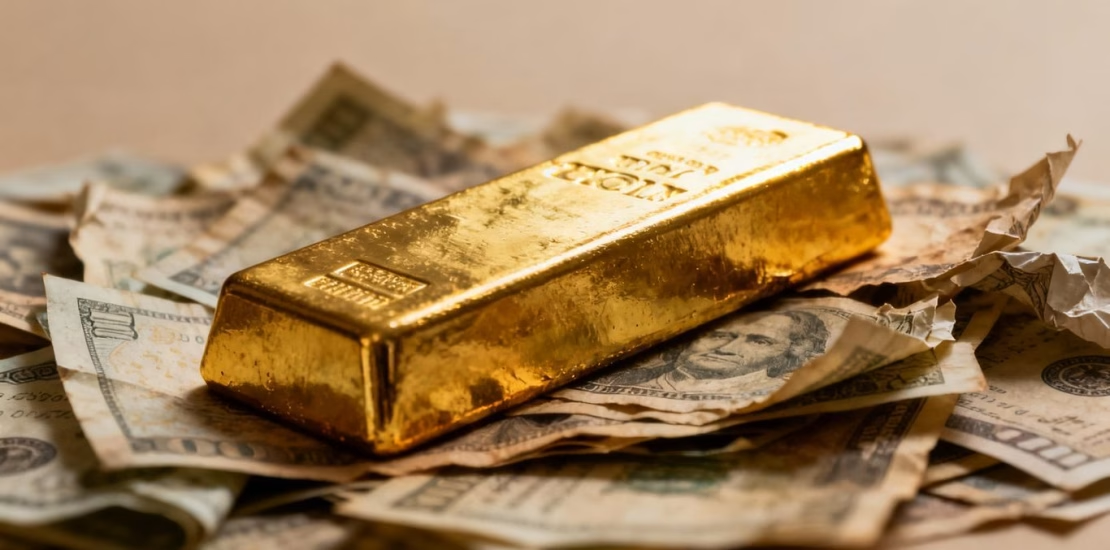
Are you wondering if gold is still the safe investment it once was, especially when it comes to protecting your money against currency devaluation? It's a legitimate question, especially with all the economic fluctuations we're seeing. We'll examine together how gold, this ancient metal, performs against today's currencies and whether you can still rely on it to keep your wealth intact. Buckle up, we're going to break it all down.
Key points
- Gold, used for millennia, retains its status as a safe haven asset thanks to its rarity and its resistance to crises.
- Historically linked to currencies, gold has seen its official monetary role come to an end, but it remains a tangible asset in the face of fiat currencies.
- Faced with inflation and devaluation, physical gold offers tangible protection, its value being less subject to arbitrary political or economic decisions.
- Central banks continue to hold significant gold reserves, a sign of its relevance to global economic stability.
- Investing in gold, whether through bars, coins or other forms, can be a strategy to preserve your wealth in the long term.
Gold, a safe haven throughout history
The origins of human use of gold
You know, gold has fascinated humanity for millennia. Traces of it can be found dating back to the end of prehistory; it was the second metal humans learned to work, right after copper. The oldest gold coins ever found come from Bulgaria, from the Varna necropolis. At that time, gold was mainly used to make beautiful jewelry for the powerful and for religious ceremonies. It was already a symbol of wealth and status.
Gold as a monetary standard: from Antiquity to the modern era
Things really changed with the kings of Lydia, around the 8th century BC. They had the idea of minting the first gold coins. This marked the beginning of a long history in which gold became a currency in its own right. Later, under Louis XIII in France, the Louis d'or became an international symbol of a safe investment. It's partly thanks to this coin that the precious metals market in London still bears the name of its inventor, Claude de Bullion. The search for gold was even one of the main reasons for the conquest of America. The influx of gold from the mines of the New World made Spain and Portugal very rich at the beginning of the modern era, before other European countries like France and Great Britain also benefited. In the mid-19th century, there was a veritable gold rush in California, which contributed significantly to the conquest of the American West and the growth of cities like San Francisco. Gold served as the exclusive monetary standard, known as the gold standard, first in the United Kingdom and then worldwide after the abandonment of gold-silver bimetallism around 1870. Unfortunately, the First World War brought this system to an end, and it has never really been reinstated.
The end of the gold standard and the devaluation of currencies
After World War II, the Bretton Woods system attempted to stabilize exchange rates by pegging the dollar to gold, and other currencies to the dollar. However, American trade deficits weakened this system from the 1960s onward. Finally, in 1971, the United States stopped converting dollars into gold. Then, in 1976, the Jamaica Accords officially demonetized gold, removing its official monetary role. Since then, gold is no longer a currency in the strict sense, but it remains traded on major global stock exchanges and is considered an important economic barometer, especially during times of crisis. The price of an ounce of gold has fluctuated considerably, exceeding $35, climbing in the 1970s to nearly $200, then reaching a peak of $850 in 1980 before falling back down. It was not until 2002 that it hit a low point before starting to rise again.
Gold protection mechanisms against currency devaluation
The intrinsic scarcity of gold as a factor of stability
You know, gold is a bit like a natural resource that isn't found on every street corner. Unlike banknotes, which governments can print at will, the amount of gold on Earth is limited. This scarcity is the first key to its value. When fiat currency loses value because there's too much of it in circulation, gold retains its scarcity. It's a bit like having a collection of rare stamps: their value doesn't depend on how many stamps are printed today, but on how many exist in total and how many people want them.
Physical gold versus fiat currencies
When we talk about physical gold, we think of bars and coins. It's something you can touch and store. It's different from fiat currencies, like the euro or the dollar, which are promises, numbers in an account. Physical gold, on the other hand, has intrinsic value. It doesn't depend on the health of a bank or government policy. If you look at history, even when currencies have gone through difficult periods, gold has often managed to maintain its value, or even increase it. It's a bit like your tangible insurance.
Here are some points that illustrate this difference:
- Tangibility: You can hold it in your hand, put it in a box. It's tangible.
- Independence : Its value is not directly linked to central bank decisions or stock market fluctuations.
- History It has proven its ability to survive through the ages and crises.
Gold as a bulwark against inflation and the loss of purchasing power
Inflation is what makes your money buy less and less over time. When prices rise, the purchasing power of your currency decreases. Gold, on the other hand, tends to go the other way. In the long run, its price has often increased faster than inflation. That's why it's said to protect your wealth. Imagine you have €1000 today. In 10 years, with inflation, that €1000 won't be worth as much. If you had invested that sum in gold, there's a good chance its value would have increased, thus compensating for the loss of purchasing power of the euro. It's a way to keep a portion of your wealth intact.
Gold, by its very nature, escapes the mechanisms of unlimited money creation that can weaken currencies. Its scarcity and constant demand make it an asset that, historically, has preserved purchasing power in the face of economic uncertainties and monetary erosion.
Gold in the current economic context
So, how is gold doing today, in our somewhat crazy economic world? It's a question many are asking, especially when you see the economic news unfolding at breakneck speed. We hear about rising inflation, currencies that seem to be losing value, and gold often comes up in conversation.
The influence of economic crises on the price of gold
You've probably noticed that whenever there's a bit of turmoil in the markets, whether it's a financial crisis or political instability somewhere, the price of gold tends to jump. It makes perfect sense, actually. When other investments become risky, like stocks that can suddenly plummet, people look for a safe haven for their money. Gold, with its history of stable value, then becomes something of a safe haven. It's a bit like wanting to put your most precious possessions in a safe when facing a storm.
- Periods of uncertainty attract investors towards gold.
- Stock market volatility encourages the search for less volatile assets.
- Fear of currency devaluation reinforces the appeal of tangible value.
The role of central banks and their gold reserves
It's not just us, private individuals, who are interested in gold. Central banks, those institutions that manage a country's currency, also attach great importance to gold. They hold enormous quantities of it, and not just for show. These gold reserves are a bit like their all-risk insurance. It gives them a certain credibility and stability, especially when things get complicated on the global economic stage. It's their ultimate safety net. They continue to accumulate gold because it's an asset that doesn't depend on government decisions or the health of a company. It's a form of security that few other things can offer, and it helps maintain confidence in the national and international economy. You can see how central banks continue to accumulate gold as a key element of financial stability [a453].
The growing demand for gold and its future prospects
So, will this trend continue? Many experts think so. Demand for gold, whether for investment, industry, or even jewelry, seems to be holding steady, or even increasing. The reasons are numerous: the growing debt of some countries, the search for protection against inflation, and the fact that gold, by its very nature, remains a limited resource. We are also seeing new uses for gold in technology, which could further stimulate demand. In short, gold will continue to be a major player in the current economic landscape.
Gold, due to its rarity and history, continues to play an important role in the strategy of investors and financial institutions seeking to preserve their capital in the face of economic uncertainties.
Investing in gold to preserve your wealth
Are you wondering how to protect your savings from economic uncertainties? Gold, this precious metal that has fascinated people for millennia, could well be the answer. It's not just about flashy displays of wealth, but rather a well-thought-out strategy to secure what you've built.
The different forms of investment in gold
When we talk about investing in gold, we often think of gold bars. And it's true, it's a solid option. You can find bars of various sizes, from small 1-gram bars to bars weighing several kilograms. It's a very tangible way to own value. But it's not the only way.
- Gold coins: Consider coins like the Marianne Rooster or the Napoleon. They have a history, a numismatic value that can be added to their intrinsic gold value. They are often easier to handle and resell than large gold bars.
- The ingots: They are available in a wide range of weights, such as 250g or 500g gold bars. They are valued for their purity and the ease with which their value can be calculated per gram.
- Gold ETFs: If you prefer not to carry physical gold, there are exchange-traded funds (ETFs) that track the price of gold. This is a more modern and often more liquid way to gain exposure to gold.
The tax advantages of investing in gold
This is a point of interest to many people. In France, for example, the purchase of investment gold (bullion or recognized coins) is generally exempt from VAT. This is already a significant advantage. Then, for resale, you have a choice between two tax regimes: the Precious Metals Tax (TMP) or the capital gains tax regime for movable property. The latter can become very advantageous after 22 years of ownership, since the capital gain is then completely exempt. This is a real plus for the long-term transfer of your assets.
Liquidity and the transfer of gold as an asset
Gold is a bit like a universal currency. Whether you're in Paris, Tokyo, or New York, a recognized gold bar or coin will have value and can be exchanged. Global recognition makes gold particularly liquidThis means you can resell it fairly easily when needed. Furthermore, gold is a tangible asset that is easily passed down from one generation to the next. Unlike stocks or real estate, which can require complex procedures, gold can be given or bequeathed more simply, ensuring continuity in the preservation of your family's wealth. It's a concrete way to leave something solid for your heirs. To learn more about the different options, you can consult [link to relevant information]. the different forms of investment.
Gold in the face of contemporary monetary challenges
The impact of monetary policies on currency values
You see, the world of finance is a bit like a giant game of chess, and central banks play a major role. When they decide to change the rules of the game, for example by printing more money or adjusting interest rates, it has a direct impact on the value of our euros, dollars, or other currencies. This is what we call monetary policy. Sometimes, these decisions can weaken a currency, a bit like adding too much water to a recipe; it makes it less concentrated. And when a currency loses value, your purchasing power decreases. That's where gold can come in.
The perception of gold as insurance against instability
Many people see gold as a kind of insurance policy for their money. When things get a bit chaotic in the financial markets, or when there's talk of rising inflation, gold tends to be perceived as a safe haven. It's a bit like having an umbrella when rain is forecast. It doesn't guarantee it won't rain, but it helps you stay more at ease. This perception is reinforced by the fact that gold is a limited resource, unlike currencies, which can be created in much larger quantities.
Gold and the preservation of wealth over the long term
So, can gold really help you keep your wealth intact over the long term? It's a question many people ask. Historically, gold has shown a certain ability to retain its value, especially when fiat currencies go through rough patches. Think of it like an old oak tree: it's not the fastest growing, but it's strong and weathers storms well. Of course, its price can also fluctuate; it's not a guarantee, but for those seeking long-term stability, far removed from the daily volatility of the markets, gold remains a serious option to consider. It's a bit like choosing a good old book over a blog post that could disappear tomorrow.
Gold, this precious metal, faces significant challenges today. Changes in the global economy and central bank decisions are creating a complex environment. Understanding how gold reacts to these events is crucial for those interested in investing. It's a fascinating topic that touches on both the history and the future of our money. To learn more about how gold can play a role in your financial strategy, visit our website.
So, is gold your ally against crumbling currencies?
Ultimately, it's clear that gold isn't just for old people or enthusiasts. It has stood the test of time and continues to be a topic of discussion when times get tough for our euros or dollars. It's true, its price can fluctuate, like any investment, but when you look at the long term, it has this ability to hold its value, a bit like a rock in a storm. So, if you're wondering whether putting some gold aside can help when fiat currencies are acting up, the answer seems to be yes. It might not be a miracle cure for all your financial worries, but it can certainly offer you added peace of mind. Think about it; it's worth considering to diversify your assets.
Frequently Asked Questions
Why is gold considered a safe haven?
Gold is seen as a safe haven because it is rare, it does not degrade over time, and there is always a demand for it, whether for jewelry, industry, or as an investment. When other investments are risky, such as during economic crises, gold often retains its value, which reassures people who want to protect their money.
How does gold protect against inflation?
Inflation is when prices rise and your money buys less than before. Because gold is rare and its value doesn't depend on government decisions to print more money, it tends to maintain its purchasing power. When inflation increases, the price of gold often rises as well, allowing you to hold onto what you can buy.
What are the different ways to invest in gold?
You can invest in gold in several ways. You can buy physical gold, such as bars or coins. There are also indirect ways, such as buying shares in mining companies that extract gold, or investing in funds that track the price of gold (like ETFs). Each method has its advantages and disadvantages.
Why do central banks own gold?
Central banks hold gold as a safety reserve. It's a bit like insurance for their country. Gold helps stabilize the value of their currency and strengthens confidence in their economy, especially during times of global economic hardship. It's an asset that has proven its worth throughout the centuries.
How has gold been used in history?
Gold has been used for many things for a very long time! Initially, it was used to make beautiful jewelry and for important ceremonies. Then, gold coins began to be minted to buy things, like the first kings in Lydia. Later, countries used it to fix the value of their currency (the gold standard), and central banks accumulated enormous quantities to ensure the stability of their countries.
What are the benefits of buying gold during a recession?
During a recession, when the economy is struggling and financial markets are volatile, gold is often a good place to invest. It tends to fall less, or even rise, when other investments lose value. It's therefore a way to protect your hard-earned money and maintain your purchasing power during tough times.