
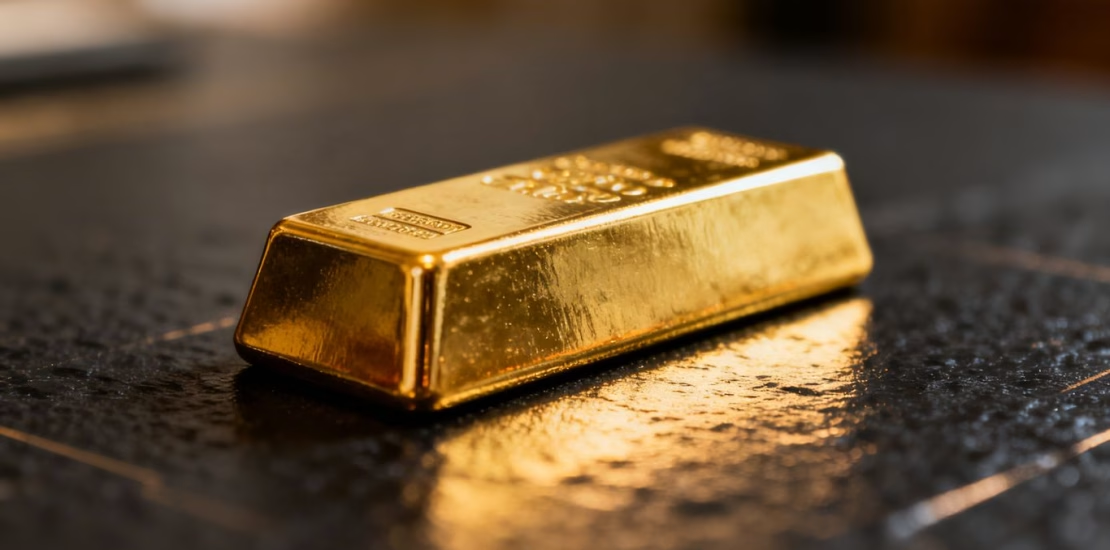
You might be wondering if gold futures trading is a game where one person's gains exactly match another's losses. It's a legitimate question, especially given the sometimes surprising price movements in this market. Let's delve into the workings of the gold market together to see if this zero-sum game idea truly holds true.
Key Takeaways
- The gold market, while often perceived as a simple game where every win implies a loss, is actually influenced by a multitude of complex economic and institutional factors. Understanding these dynamics is essential for anyone interested in gold futures trading.
- The mechanisms for setting the price of gold, whether it be the traditional fixing or the continuous price, are the result of interactions between central banks, financial institutions and physical demand, making the zero-sum concept difficult to apply strictly.
- Although futures contracts may appear to be a zero-sum game, interventions and the perception of price control by some players add layers of complexity that go beyond the simple balance between buyers and sellers.
Understanding the dynamics of the gold market
To fully grasp the implications of gold futures trading, one must first understand how this precious metal functions in the markets. Gold isn't just a pretty, shiny metal used in jewelry or electronics. No, it's much more than that. It has a long and rich history, serving as currency, a store of value, and even a symbol of power throughout the ages.
Gold as a safe haven and economic barometer
You've probably heard gold referred to as a "safe haven." It's a bit like an investor's vault when things go wrong. When financial markets panic, currencies collapse, or geopolitical tensions rise, gold tends to maintain its value, or even increase. It's as if, in a storm, everyone rushes toward the same solid shelter. Central banks around the world understand this well; they hold enormous quantities of gold in their vaults, a bit like insurance against unforeseen events.
But gold isn't just insurance. It's also a barometer. Its price can give us clues about the state of the global economy. If the demand for physical gold skyrockets, it can signal a general distrust of traditional currencies or an anticipation of economic problems. Conversely, a price drop can sometimes indicate a period of stability or a renewed confidence in the financial markets.
Unlike currencies that central banks can print at will, gold has a limited supply determined by what the Earth provides and what we are able to extract. This intrinsic scarcity is one of the keys to its value.
The historical evolution of the price of gold
The history of the price of gold is a real rollercoaster. For a long time, gold was used as a monetary standard, meaning that the value of currencies was directly linked to a quantity of gold. This was the case with the Bretton Woods system after World War II, where the US dollar was convertible into gold. But it didn't last. American deficits undermined this system, and in 1971, the United States stopped guaranteeing the convertibility of the dollar into gold. That's when the price of gold really started to skyrocket.
We've seen spectacular peaks, like in 1980 when the price of an ounce approached $850, followed by sharp declines. In the 2000s, gold resumed its meteoric rise, reaching over $1800 an ounce in 2012, before falling back. These fluctuations are influenced by many factors: central bank policies, demand from jewelers (especially in India and China), industrial needs, the discovery of new mines, and of course, speculation in the markets.
Here is a simplified overview of the evolution of the price of an ounce of gold:
| Period | Approximate price per ounce of gold |
|---|---|
| 1970s | Fluctuations, peak around $200 |
| 1980 | Peak at approximately $850 |
| 2002 | Low point after the 1980 rise |
| 2012 | Peak at over $1800 |
| 2015 | Approximately $1200 |
Understanding these past movements is already a good starting point for anticipating what might happen next. It shows that the price of gold is not fixed and that it reacts to global events.
Gold Price Fixing Mechanisms
So, how is the price of gold, this material that fascinates so many, determined? It's not simply a matter of supply and demand, as with any other commodity. Much more influential players are involved, and their role can sometimes seem a little mysterious. Understanding these mechanisms is already a step towards understanding the markets.
The role of central banks and financial institutions
You know, central banks and major financial institutions have a huge influence on the price of gold. They don't just hold reserves; they can also intervene directly or indirectly in the markets. Historically, they used gold as an anchor for currencies, but since the direct link to gold was broken, their role has evolved. They can buy or sell large quantities of gold, which, as you can imagine, moves prices. Sometimes these interventions are quite discreet, carried out through futures markets, which makes it difficult to know exactly who is doing what and why.
- Central banks hold enormous quantities of gold, often as a store of value and to stabilize their currency. The United States, for example, has considerable reserves.
- They can influence the price through strategic buying or selling, sometimes to manage their own balance of payments or to influence global monetary policy.
- THE **
Gold futures trading and the concept of a zero-sum game

So, let's talk a little about gold futures contracts. You might be wondering if, ultimately, it's a bit like playing the lottery, where one person's win inevitably means another's loss. It's a very relevant question when you look at how these markets work.
The influence of interventions on the futures market
What's interesting about gold futures contracts is that they can be influenced by players who don't necessarily intend to hold physical gold. Think of large banks or investment funds. They can buy or sell tons of contracts, not because they want gold in their vaults, but to speculate on prices or to hedge other positions. Sometimes, we see quite abrupt price movements that don't really seem to reflect the actual supply and demand for physical gold. This is where the idea of a 'zero-sum game' starts to come into play. If someone sells a large number of futures contracts, they're betting on a price decrease. If the price falls, they make money, but whoever bought those contracts at a higher price ends up with a loss. That's the basic principle: for there to be a winner, there has to be a loser.
The perception of price control and its implications
Now, there's also this idea, sometimes raised, that the price of gold on the futures markets could be, let's say, 'driven' by certain institutions. The idea is that powerful players could use these contracts to influence the price of gold, perhaps to serve broader economic objectives. If this is the case, it further complicates the notion of a zero-sum game. It would no longer be simply a matter of speculation between buyers and sellers, but a kind of manipulation where the 'playing field' itself would be unbalanced. Proponents of this idea often cite examples of massive and sudden sell-offs of futures contracts, which cause the price of gold to plummet while physical demand remains strong. They question whether these movements are truly random or if there's an invisible hand guiding the market.
It is difficult to formally prove that there is price control in the gold futures market. However, the scale of the transactions and the speed of some price movements lead many observers to question the true dynamics of supply and demand reflected in these contracts.
Ultimately, if the gold futures market is indeed influenced by coordinated interventions or price-controlling strategies, then the notion of a zero-sum game becomes more complex. It is no longer simply a matter of individual forecasts, but potentially a struggle between different interest groups, where some might have a structural advantage.
The trading of gold futures contracts It can resemble a game where one person's gain is another's loss. This idea might sound complicated, but in reality, it's simply a way of saying that for one person to make money in this market, another person has to lose money. Think of it like a trade: someone buys gold hoping its price will rise, while someone else sells it expecting it to fall. It's a constant balance between buyers and sellers. If you want to learn more about how this market works and how to participate, visit our website for guides and tips.
So, is gold futures trading a zero-sum game or not?
To put it simply, if you jump into gold futures trading thinking it's a game where one person inevitably wins what the other loses, you're likely in for a nasty surprise. As we've seen, the gold market is complex, influenced by many things, from central banks to global events. It's not just a question of whether you're right and the other person is wrong. There are factors that are completely beyond your control. So, before you dive in, make sure you fully understand the risks. It's not a walk in the park, and you need to be well-prepared.
Frequently Asked Questions
Why is gold considered a safe bet?
Gold is seen as a safe haven because it is not subject to central bank decisions like currencies. Its quantity is limited to what can be extracted, making it less susceptible to inflation. In times of economic uncertainty, people often turn to gold to protect their money.
How is the price of gold determined?
The price of gold is set by trading on major exchanges such as London and New York. There are two key moments in determining the price: the 'fixing', a kind of meeting where supply and demand are adjusted, and the continuous trading session which shows prices in real time throughout the day.
Is trading gold futures like playing the lottery?
Gold futures trading can resemble a game where not everyone wins, because for a buyer to win, a seller must lose, and vice versa. However, it's important to understand that interventions, sometimes subtle, can influence prices, making the situation more complex than a simple betting game.
