Wondering how to create gold jewelry with the boldest shapes and finest details? The lost wax technique is your ally. It's an ancient method that has stood the test of time, and it remains one of the most effective for bringing complex jewelry creations to life. Whether you're a beginner craftsman or a jewelry enthusiast, understanding this process will open the doors to a world of creative possibilities.
Key Takeaways
- Lost wax casting is an ancient casting technique that allows for the creation of highly detailed and intricate gold jewelry.
- The process begins with sculpting a wax model, which is then used to create a mold.
- The wax is forced out of the mold by heat, leaving a space for the molten gold to pour.
- This method offers great creative freedom and is ideal for custom pieces and small series.
- 3D printing modernizes the creation of wax models, combining tradition and technology.
Understanding the Basics of Lost Wax Casting for Gold Jewelry
If you're looking to start creating intricate gold jewelry designs, it's essential to understand the principles of lost-wax casting. It's a technique that, while ancient, remains incredibly effective for achieving remarkably fine pieces. Think of it like a recipe: every step is important to achieve the desired end result.
The basic principle of casting in jewelry
Casting, in the world of jewelry, is the art of giving shape to gold while it is still liquid. Imagine you have a specific idea for a ring or pendant. To bring it to life, you will first create a model, often in wax. This model is then used to make a mold. It is into this mold that the molten gold will be poured. Once the gold has cooled and solidified, the mold is broken to reveal your creation. It is a process that requires great precision, as the slightest imperfection in the model or mold will be reflected in the finished piece.
The Historical Significance of Lost Wax Casting
The "lost wax" technique has been used for thousands of years, and for good reason. The Egyptians were already using it a very long time ago! The principle is quite simple: you sculpt your jewelry in wax. This wax, once placed in a mold (often plaster), will be heated to melt and evacuate. The empty space thus created is perfect for holding the molten gold. It is this wax that is "lost," making way for the precious metal. This method is particularly appreciated because it allows for the reproduction of very fine details and complex shapes, which is ideal for the finesse of jewelry.
The essential steps in creating a gold jewel
Making a piece of gold jewelry is a bit like a journey of discovery. Here are the main steps you'll follow:
- Creation of the wax model: This is where your design comes to life. You can sculpt the wax by hand or use modern techniques like 3D printing.
- Mounting on the casting shaft: Several wax models are assembled on a common rod, called a "casting shaft." This allows several pieces to be cast at the same time.
- Coating in the mold: The wax tree is dipped into a refractory material (often a mixture of plaster and other components) which will harden to form the mold.
- Wax removal: The mold is heated in an oven to melt and evaporate the wax. All that remains is the impression of the jewel.
- Metal casting: The molten gold is poured into the hot mold.
- Cooling and demolding: Once the gold has cooled, the plaster mold is broken to extract the raw piece.
- finish: The piece is cleaned, polished and any defects are corrected to obtain the final jewel.
It is important to note that each step requires great attention to detail. The quality of the wax used, the precision of the sculpture, the temperature of the furnace, and the fluidity of the gold are all factors that will influence the final result.
The meticulous preparation of the wax model
Before you can cast your gold, you must first create the jewelry itself, but not directly in metal. You start by shaping a wax model. This is a step that requires a lot of patience and precision, as it's where all the details of your future piece take shape. You'll work the wax with specific tools, much like a sculptor with clay, but much finer.
The sculpture of the jewel in wax
To begin, you'll carve your piece directly from a block of wax. The complexity and size of this model will depend on your manual skill and the tools you have at your disposal. This is where your creativity really shines. You can use engraving tools, small files, gouges, and even a soldering iron to add or modify details by melting the wax. Every stroke of the tool counts to achieve the desired result. Once your wax model is perfect, it must be carefully polished to make it as smooth as possible. This finish will determine the surface quality of the final piece of jewelry.
The different types of wax used
There are several types of wax, each with its own advantages depending on the work to be done. You have hard wax, which is ideal for sculpting very precise shapes with fine tools, as it resists pressure well. Then there is softer wax, which is easier to model by hand, perfect for organic shapes or when you want to easily add material. Finally, injected wax is mainly used when you want to make several copies of the same model, as it is designed to be injected into rubber molds.
Here is a quick overview of common waxes:
- Hard wax: Perfect for fine details and precise carving.
- Moldable wax: More flexible, it is easy to work by hand or with heated tools.
- Injection wax: Used for mass reproduction from a mold.
Integration of the casting tree for production
Once you have your wax models, you need to prepare them for casting. You can't just cast one small piece of jewelry; you need to make several at once to make the process cost-effective. To do this, all the wax models are assembled on a central rod, much like fruit on a skewer. This is called a "casting tree." Small rods, called sprues, are added to each model, then all these sprues are connected to form this tree. This tree is essential because it will allow the molten wax to flow easily during the mold firing, and later, it will guide the molten metal so that it perfectly fills the mold cavity. It's a bit like creating a channel system for the liquid metal. The arrangement of the pieces on the tree is important: the heaviest are placed at the bottom and the thinnest towards the top, to ensure good balance during casting.
The process of casting and finishing gold jewelry
Once your wax model has been meticulously prepared and integrated into the casting shaft, comes the long-awaited moment: transforming this wax structure into a magnificent piece of gold jewelry. This is a step that requires great precision and expertise.
Evacuating the wax and creating the mold
To begin, your wax tree is dipped into a mixture of refractory plaster. This plaster will coat every detail of your creation, forming the final mold. Once this plaster has hardened, the wax must be removed. To do this, the mold is placed in a special oven. The heat will melt the wax, which will flow naturally, leaving behind a perfect imprint of your jewelry in the plaster mold. This is where the name "lost wax" comes from: the wax is no longer there, but it was used to create the perfect negative for your gold piece.
Pouring molten gold
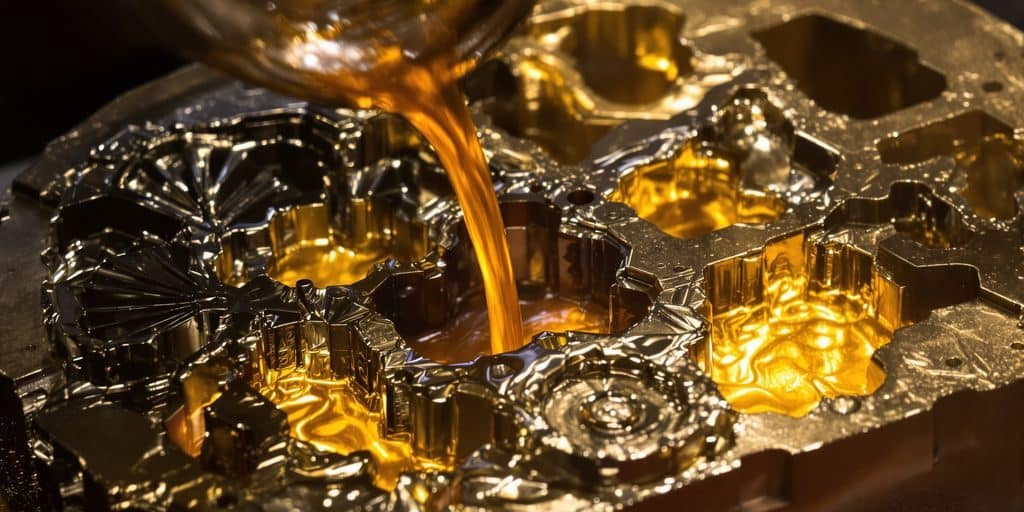
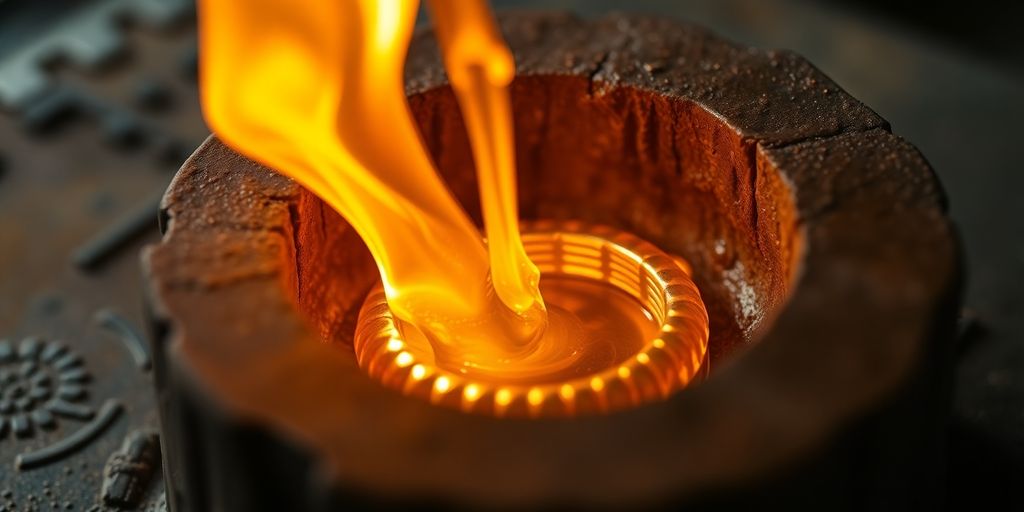
Now that the mold is ready and empty, the gold must be prepared. Pure gold melts at around 1064°C. It is heated in a crucible, often using a blowtorch or in an induction furnace, until it is completely liquid and fluid. Controlling the temperature is crucial to avoid burning the metal or making it too viscous. Once the gold reaches the right consistency, it is carefully poured into the plaster mold. The molten metal then fills every nook and cranny, capturing every nuance of your original model.
Here are the key steps of this phase:
- Gold Melting: Heat the gold to its melting point (around 1064°C) to make it completely liquid.
- Pouring into the mold: Carefully pour the molten gold into the prepared mold, making sure it fills all the cavities.
- Cooling and solidification: Allow the metal to cool naturally to take its final shape. Be patient, as cooling too quickly can create stress in the metal.
The success of this step relies on precise temperature control and expert handling of the molten metal. It's a blend of science and craftsmanship.
Post-casting finishing steps
Once the gold has cooled and solidified, it's time to remove the jewelry from its mold. Often, several pieces are cast at the same time on the same shaft. First, the plaster mold must be broken, then each piece of jewelry must be detached from its shaft. This is where the finishing work really begins. The raw pieces are often still a little rough, with small burrs or casting marks. Therefore, several steps are required:
- De-scaling and deburring: Remove excess metal and small imperfections using files and fine chisels.
- Crimping (if applicable): If your jewelry will hold gemstones, now is the time to set them in their designated locations.
- Polishing: This is the step that will reveal the gold's shine. Using various brushes, polishing pastes, and buffs, the surface will be polished until a shiny, flawless finish is achieved.
- Final cleaning: A final pass in an ultrasonic bath or with specific products to remove all traces of grease or dust.
The unique advantages of lost wax casting for complex creations
The reproduction of details of exceptional finesse
What's really great about lost wax casting is the precision you can achieve. You can carve incredibly fine patterns, delicate textures, tiny reliefs... things that would be impossible to do otherwise, such as with more basic cutting or hammering techniques. It's like having a blank canvas to let your creativity flow without limits.
Creative freedom offered to artisans
Wax is incredibly malleable. It gives you complete freedom to create truly unique, bold shapes, or even to reproduce old styles with impressive fidelity. Each piece you craft by hand becomes a unique work, truly bearing the mark of your craftsmanship. This is what gives jewelry its artisanal value.
Adaptation to custom parts and small series
If you want to make a truly personalized piece of jewelry, like an engagement ring with a special engraving or a pendant with a story, lost wax casting is perfect. You can respond exactly to what the customer requests. It's also great for making small batches, where each piece remains consistent while maintaining that handmade feel. It's the best of both worlds, really.
Lost wax casting's ability to capture the smallest details allows for pieces that would otherwise be impossible to manufacture, opening the way to designs of unparalleled complexity and finesse in the world of jewelry.
The technological evolution of lost wax casting in jewelry
You know, the lost wax technique is a bit like an old wine: it has survived the ages, but it knows how to reinvent itself. Today, it is at the heart of a super interesting transformation, thanks to new technologies that are modernizing it without erasing its artisanal soul.
The impact of 3D printing on model creation
This is perhaps the most visible change. Before, you had to sculpt the wax by hand, a process that required patience and precision. Now, you can create your design directly on a computer using CAD (Computer-Aided Design) software. Then, hey presto, a 3D printer takes care of manufacturing the model in resin or special wax. It's amazing how fine it can be, details that would have been incredibly difficult to create by hand.
- Millimeter precision : The printed models are incredibly regular and fine.
- Time Saving : Creating models is much faster, especially for complex shapes.
- Limitless complexity : You can create very elaborate internal structures or geometries that were previously impossible.
Of course, some purists still prefer direct contact with the wax, the craftsman's gesture. But it must be recognized that 3D printing opens enormous doors for the customization and complexity of pieces.
The synergy between traditional craftsmanship and modernity
The great thing is that these new technologies don't replace traditional craftsmanship; they complement it. 3D printing gives you a perfect model, but it's still the craftsman who prepares the mold, pours the gold, and adds the finishing touches. It's this combination that makes the magic.
- Process optimization : 3D printing reduces the manufacturing time of models, allowing you to focus on the steps with higher added value.
- Increased accessibility : Complex designs become more accessible, even for small series or unique pieces.
- Innovation in forms : Designers can explore bold designs, pushing the boundaries of what was feasible.
Applications in major jewelry houses
The major jewelry houses, the ones you see in the windows of the Champs-Élysées or Place Vendôme, have of course embraced these developments. They use 3D printing to create ultra-precise prototypes or fine jewelry pieces with incredible details. This allows them to offer ever more innovative collections while maintaining the excellence for which they are renowned. It's a bit like the perfect marriage between the heritage and the future of jewelry.
Limitations and considerations of the lost wax technique
While lost wax casting is a fantastic method for creating intricate and detailed jewelry, it's not without its drawbacks. There are a few things to be aware of before you get started.
The time-consuming and meticulous nature of the process
Let's be honest, this isn't a technique you can complete in an afternoon. Every step, from the meticulous carving of the wax to the final finish, requires time and constant attention. You'll spend hours refining the details, preparing the mold, monitoring the casting... It's a job that requires patience and a certain level of discipline. If you're looking for a quick solution to mass-produce pieces, this may not be the route for you.
The impossibility of reusing the wax model
This is a pretty important point to understand: once the wax has been used to create the mold, it is lost, as the name suggests. The original wax model is destroyed when the mold is fired. So, if you want to remake the exact same piece, you'll have to recreate a wax model from scratch. Of course, there are ways around this, such as creating a silicone mold from the wax model before it's destroyed, but this adds an extra step and cost. For one-off pieces, this isn't a problem, but for small runs, it's something to consider.
The implications on the cost of production
With all this time spent and the meticulousness required, it is logical that the production cost is a little higher compared to other, more industrial manufacturing methods. You have to take into account the price of specific materials (wax, refractory plaster, etc.), the wear and tear of the equipment (ovens, tools) and, above all, the craftsman's working time. Each piece requires a considerable investment of time, which is inevitably reflected in the final price of the jewelry. This is the price to pay to obtain a piece of such finesse and quality, but it is a factor to take into account, whether you are a creator or a buyer.
It is essential to carefully consider these constraints before embarking on the production of gold jewelry using the lost wax method. The beauty of the result often justifies these efforts, but careful planning is key.
Guarantee the quality and authenticity of the gold used
Once your gold jewelry has been shaped using lost wax casting, it's super important to make sure it's well-made and that the gold is of good quality. It's a bit like checking the durability of a toy before you buy it—you want it to last, right?
Purity standards and gold alloys
Pure gold, or 24 karat gold, is soft enough for jewelry. To create stronger jewelry with different colors, gold is mixed with other metals. Gold purity is measured in karats. Here's a quick overview:
- 10 carats: about 41,7% gold. The rest is other metals like copper or zinc.
- 14 carats: approximately 58,3% gold.
- 18 carats: about 75% gold. It's a good mix of purity and strength.
- 24 carats: 100% pure gold (or almost).
Certification by recognized organizations
For added assurance, some jewelry, especially high-value jewelry, comes with certificates. These documents are issued by independent, internationally recognized organizations. They confirm the purity, weight, and origin of the metal. Although less common than with ingots, there are quality labels for jewelry that demonstrate that the manufacturer has followed certain guidelines.
The importance of traceability and certificates of authenticity
Traceability is a bit like the DNA of your jewelry. It lets you know where the gold comes from, from its extraction to the finished piece. A certificate of authenticity, often included with the jewelry, summarizes the important information: weight, gold purity, manufacturer's name, and sometimes even the date of manufacture. These documents are your best proof that the jewelry is what it claims to be. This is especially true if you're buying jewelry from well-known designers or investment pieces.
Knowing where your gold comes from and how it was crafted is the key to having a quality piece of jewelry that will last a lifetime. Don't overlook these details; they make all the difference to your investment and your enjoyment.
To ensure that the gold you buy is of good quality and comes from reliable sources, we check everything very carefully. This is our priority! If you want to know more about how we guarantee the purity of gold, visit our website.
To conclude: lost wax casting, a timeless technique for your gold jewelry
So, now you know how the lost wax technique can help you create truly unique and intricate gold jewelry. It's an ancient process, yes, but it's still super relevant today, especially with modern tools like 3D printing that make things even more precise. It takes a little patience and know-how, sure, but the result is definitely worth it. You'll be able to bring incredible designs to life, whether for a one-off piece or a small series. So, go ahead and experiment!
Frequently Asked Questions
What exactly is the lost wax technique?
Imagine you want to make a super pretty piece of gold jewelry. First, you carve your idea into a block of wax. You put this wax into a special mold. Then you heat it all up. The wax melts and disappears, leaving a perfect hole. It's into this hole that you'll pour the hot gold to make your jewelry. The wax is 'lost,' that's why it's called that!
Why use wax and not metal directly?
Wax is super easy to work with! You can sculpt all the little details, even the finest ones, like tiny drawings or complicated shapes. Gold, on the other hand, is very hard and hot when it's melted, so it's much harder to give it such a precise shape. Wax is like a perfect rough draft for your gold jewelry.
Is this technique very old?
Oh yes, very, very old! It's been used for thousands of years, even the ancient Egyptians used it to make beautiful objects. It's a technique that has stood the test of time because it works really well for creating delicate things.
Can you make several identical pieces of jewelry using this method?
Yes, it's possible! Once you have your first wax jewelry, you can make a silicone mold from it. This silicone mold allows you to remake the wax model several times, and therefore cast several identical gold jewelry pieces. This is practical if you want to make a small series.
Is this technique used by major jewelry brands?
Absolutely! The biggest jewelry houses use lost wax casting, often in combination with modern tools like 3D printing. It allows them to create truly incredible pieces, with super fine details and bold shapes, while maintaining a handcrafted feel.
What makes gold used in jewelry special?
Pure gold is a bit like butter—it's soft and easily deformed. To make jewelry stronger and give it different colors (like yellow, rose, or white gold), it's mixed with other metals. This is called an alloy. There are specific rules for these mixtures, and labels that guarantee that the gold is of good quality and has the right purity.