You are interested in theFascinating History of the US Twenty Dollar Gold Coin It's a coin that has spanned significant eras, from the Gold Rush to the upheavals of the Great Depression. Together, we'll explore the evolution of this monetary symbol, from its earliest depictions to its most iconic designs. Prepare to discover the journey of this gold coin, which tells part of the history of the United States.
Key Takeaways
- La 20 dollar gold coin, also called the “Double Eagle”, emerged to meet a need for larger currency and has evolved over time.
- Le design of the “Liberty Head”, created by James B. Longacre, marked a first era, with its star variations and its representation of Liberty.
- La “Saint-Gaudens” represented an artistic revolution, thanks to the work of the sculptor Augustus Saint-Gaudens, offering designs considered among the most beautiful.
- La minting of 20-dollar gold coins was suspended in 1933 following the Great Depression and the requisition of gold by the American government.
- Today, the 20 gold dollar retains a double value : that of the gold it contains and that, numismatic, which attracts collectors and investors.
The Emergence of the American $20 Gold Coin
Before seeing the appearance of the famous pieces of 20 US gold dollars as we know it today, there was a whole story behind their creation. The main idea was to simplify work in mints. Imagine: instead of handling lots of small coins, we create a single coin that's worth much more. It's like going from small bills to a large bill; it streamlines everything.
The California Gold Rush, which really started in 1848, played a huge role. Suddenly, there was a lot more gold available. That changed the game, and gold began to take over from silver in the monetary system. People were beginning to distrust paper money and wanted something more tangible—gold.
It was in this context that in 1849, serious talk began of creating a 20 dollar coinThe idea gained ground, and finally, the Currency Act of 1849 formalized the creation of this famous “Double Eagle“It was a direct response to the abundance of gold and the need for more substantial means of payment. It was almost as if the country was saying, “We have gold, so we’ll make coins that show it!”
Initially, these coins were minted with the Liberty Head design, designed by James B. Longacre. He was the one who put the initials on the coins, a first at the time. These first “Liberty Heads” were produced for decades, until 1906. In all, there were approximately 175 million of them minted. That's a huge number when you think about it, and it shows how important they were to the American economy at the time.
The introduction of the $20 coin was intended to streamline gold management, responding to a growing demand for forms of currency with real intrinsic value.
- The Genesis of the “Double Eagle” : Born out of the California Gold Rush, this $20 coin was officially created by law in 1849 to facilitate transactions and reflect the abundance of gold. It was twice the size of the $10 coin, simplifying the handling of large quantities of gold.
- The influence of Theodore Roosevelt and Augustus Saint-Gaudens : Much later, at the beginning of the 20th century, President Theodore Roosevelt wanted to modernize the design of American coins. He called upon the famous sculptor Augustus Saint-Gaudens to redesign the $20 coin, which gave birth to the magnificent “Saint-Gaudens” that we know today.
- The first strikes and their characteristics : The first $20 coins, known as the “Liberty Head,” were minted beginning in 1849. They featured the portrait of Liberty designed by James B. Longacre. These coins were composed of 90% gold and weighed approximately 33,44 grams, with a diameter of 34 mm.
The “Liberty Head”: an icon of America
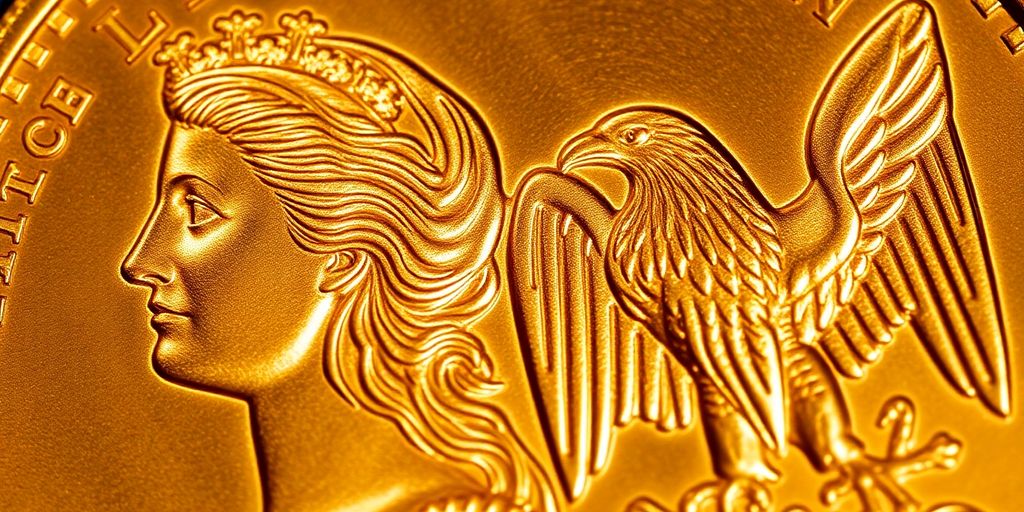
After the Liberty Head era, it's time to take a look at a coin that marked a turning point in the history of American currency: the Liberty Head. You'll discover how James B. Longacre's design gave birth to a true icon, and how the details of its design, from the stars to the motto "In God We Trust," have evolved over time.
James B. Longacre's design
James B. Longacre brought the Liberty Head to life for the $20 coin. He was inspired by earlier depictions of Liberty, particularly those used on lower-denomination coins. On the obverse, you'll find Liberty's profile surrounded by 13 six-pointed stars, symbolizing the original colonies. The minting date is inscribed just below. It's a design that has endured for decades, marking its era with its classicism.
The different variations of the “Liberty Head”
Over the years, the Liberty Head has undergone several modifications. Initially, between 1850 and 1866, the reverse featured an eagle with outstretched wings, an olive branch, and arrows in its talons. Then, in 1866, a significant change took place: the motto “In God We Trust” was added to the reverse, just above the eagle. Another notable development came in 1877, when the inscription “TWENTY D.” was replaced with “TWENTY DOLLARS,” making the coin’s value more explicit.
Here is a small summary table of the main variants:
| Variant | Period | Key Features |
|---|---|---|
| Liberty Head (first version) | 1850 - 1866 | Eagle with outstretched wings, without the motto “In God We Trust” |
| Liberty Head with motto | 1866 - 1876 | Added “In God We Trust” to the reverse |
| Liberty Head “TWENTY DOLLARS” | 1877 - 1907 | Full value inscription on the reverse |
The significance of the stars and the motto “In God We Trust”
The 13 stars on the obverse of the Liberty Head are not merely decorative; they recall the founding of the United States. The addition of the motto “In God We Trust” in 1866, meanwhile, reflects a period when faith and religion were taking a more visible place in American public life, including on currency. It was a response to a popular demand for the divine presence to be acknowledged on coins.
The evolution of these elements, from stars to motto, shows how currency can reflect a nation's social and cultural changes.
The “Saint-Gaudens”: an artistic revolution
La American 20 dollar gold coin, in its “Saint-Gaudens” version, represents a true artistic break. It was President Theodore Roosevelt himself who initiated this change, wishing to modernize the appearance of American coins and drawing inspiration from the masterpieces of Antiquity. He called upon the famous sculptor Augustus Saint-Gaudens for this monumental task. Saint-Gaudens, whose father was French, put all his talent into the design of this coin.
Saint-Gaudens' Vision for the $20 Gold Coin
Saint-Gaudens had a specific idea: to create a coin that would be both a work of art and a symbol of American power. He wanted to move away from the designs of previous coins that were considered too flat and soulless. He drew inspiration from the Winged Victory of Samothrace and his own creations, such as the statue of General Sherman. He envisioned a radiant Liberty, carrying a torch for illumination and an olive branch for peace. The reverse was to feature an eagle in flight, symbolizing the country's strength and freedom. He even considered using Roman numerals for the date, an idea that initially met with resistance but was eventually accepted.
The challenges of producing high relief
What made the Saint-Gaudens coin so revolutionary was its high relief. Saint-Gaudens wanted the details to be very pronounced, almost three-dimensional. However, this posed enormous problems for the Mint. Chief Engraver Charles E. Barber was highly skeptical, believing that this relief was impossible to strike consistently and economically. It took extensive experimentation to find the right balance between Saint-Gaudens's artistic vision and the technical constraints of mass production. Barber even thought Saint-Gaudens was playing a game, but the will of the sculptor and the president ultimately prevailed.
The Eagle in Flight and Radiant Liberty
On the obverse, you will discover a majestic figure of Liberty, marching confidently. She is surrounded by 46 stars, representing the states of the Union in 1907. The rising sun behind her symbolizes a new beginning. The reverse, meanwhile, is dominated by a majestic eagle in full flight, with the rising sun in the background. It is a striking image of dynamism and power. The motto “E Pluribus Unum” is inscribed on the edge, as there was not enough space on the obverses without compromising the aesthetics. This is truly a coin that marked its era with its boldness and beauty.
The end of an era: the suspension of typing
The context of the Great Depression
In the early 1930s, America was going through a very dark economic period, the Great Depression. Faced with this unprecedented crisis, the American government took drastic measures to stabilize the country. One of these measures would have a direct impact on the production of our famous $20 gold coins.
Franklin D. Roosevelt's Gold Requisition
In 1933, President Franklin D. Roosevelt made a landmark decision: he ordered the requisition of nearly all gold held by American citizens. This was a rather radical measure, aimed at controlling the money supply and pulling the country out of the crisis. Gold coins, including Double Eagles, were affected by this measure. You were asked to return your gold to the bank in exchange for paper dollars. It was a bit like being told that your treasure was no longer truly yours.
The 1933 coin, a coveted treasure
And here we come to the 1933 coin. It's a special year. Double Eagles were indeed minted that year, but with the new policy, they were never intended for circulation. The vast majority were melted down. However, a few managed to escape this destruction, often through somewhat... let's say, less official means. These 1933 coins have become incredibly rare and therefore extremely sought-after by collectors. There have even been crazy stories surrounding some of them, coins that have disappeared, been stolen, and then resurface years later. It's a bit of a Holy Grail for numismatic enthusiasts, a true piece of history that's worth a fortune today.
The intrinsic and numismatic value of the 20 gold dollar
When we talk about the American $20 gold coin, we're not just talking about a piece of precious metal. It's also an object that has survived through history, and that has value in itself. You might be wondering why these coins are so sought after, whether for investment or collecting. Well, there are several reasons for that.
A tangible investment and a safe haven
Gold is a bit of a classic safe haven, you know. When times are uncertain, when the stock market is acting up, or when the global economy is coughing, gold sticks around. The $20 coin, with its well-defined gold content (30,1 grams of fine gold for 33,44 grams raw, with a purity of 900 thousandths), is a concrete way to keep part of your wealth safe. It's tangible; it doesn't depend on a company or government that could go bankrupt. Plus, these coins are recognized all over the world, which makes them easy to exchange if you ever need them. It's a bit like having tangible insurance for your wealth.
The appeal for collectors and enthusiasts
Beyond the value of gold, there is the whole historical and artistic aspect. Think of the beauty of engraving work, to the symbolism that each effigy carries within it. The Liberty Head, with its noble profile and its stars, embodies 19th-century America, confident and conquering. Saint-Gaudens, it marks the artistic revival of the early 20th century, with this Liberty on the March, a torch raised towards the future. These pieces are not just gold — they are fragments of history, witnesses to an era and exceptional know-how.
It is precisely this numismatic dimension which attracts collectors: some years of minting are rare, others are distinguished by engraving variations or an exceptional state of preservation. The value of a coin then no longer depends solely on the Gold prices, but also of his historical interest, its rarity and its aesthetics.
In short, the US $20 gold coin is much more than an investment: it is a link between the tangible richness of the metal and the emotion aroused by an object steeped in memory. It fascinates both investors and history buffs, uniting heritage and universal value in a single symbol.
The Legacy of the American $20 Gold Coin
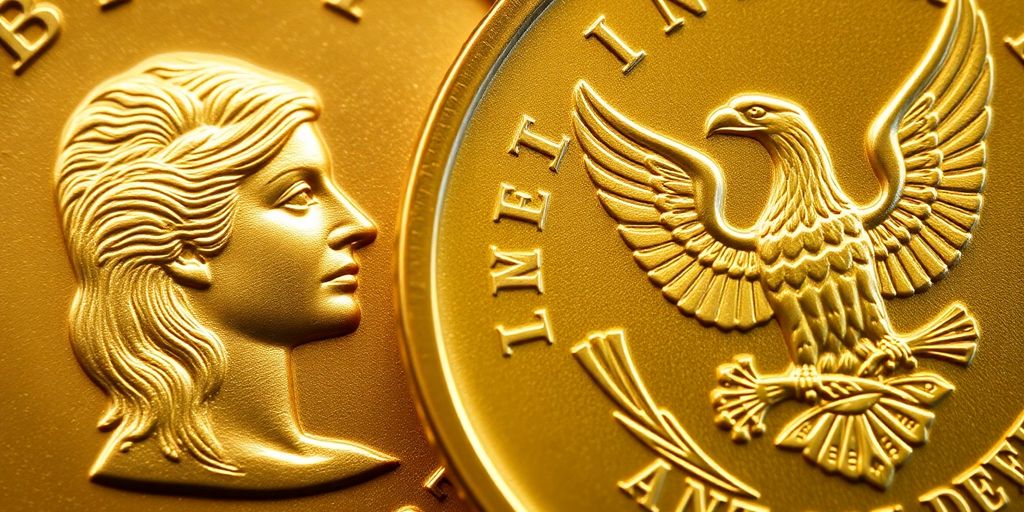
The 20 American gold dollar, whether in the form of the Liberty Head or the Saint-Gaudens, represents much more than just a coin. It is a tangible piece of history, a symbol of the economic power and artistic evolution of the United States. These coins have survived pivotal periods, from the Gold Rush to the Great Depression, and carry within them the stories of those eras.
A symbol of prosperity and history
When you hold a $20 gold coin, you hold an object that has circulated for decades, witnessing commercial transactions, dreams of wealth, and social change. The Liberty Head, with its classic effigy of Liberty, evokes an expanding America, while the Saint-Gaudens, with its bold design, reflects a desire for modernity and artistic excellence. These coins are artifacts that connect you directly to America's past, allowing you to touch a bygone era.
The transmission of monetary heritage
Beyond their intrinsic gold value, these coins constitute a heritage. They can be passed down from generation to generation, carrying with them a family history and a value that goes beyond mere Gold pricesIt's a way to preserve tangible wealth, a legacy that will stand the test of time and economic crises. Think of it as an investment in history, something you can share and be proud of.
The Place of $20 Gold in the Current Market
Even today, the US $20 gold coin retains a prominent place in the precious metals and numismatics market. Its high liquidity, international recognition, and collector appeal make it a popular choice for diversifying an investment portfolio. Whether you're a safe-haven investor or a history buff, these coins continue to offer significant value. Their value can fluctuate, of course, but their status as a classic gold investment remains undeniable.
The "twenty gold dollars“American gold is a fascinating piece of history. It represents a time when gold was more than just a precious metal; it was a symbol of wealth and stability. These coins have survived through time, carrying with them stories of transactions and exchanges. Want to learn more about these treasures or even acquire some? Visit our site to discover our collection and get expert advice.
A legacy that endures
So that's the fascinating journey of these $20 American coins, from the classic Liberty to the dazzling Saint-Gaudens. You've seen how they've traversed history, reflecting the changes in America itself. Whether you're an avid collector or simply curious about monetary history, these gold coins really have a story to tell. They're not just precious metal, but witnesses to their time. It's pretty incredible to think about everything they've seen, isn't it? They continue to attract attention, whether for their beauty or their value, and that's probably how it will continue.

Frequently Asked Questions
Why was the $20 gold coin created?
The American $20 gold coin, often called the “Double Eagle,” was created to be more valuable than regular gold coins. It was first minted in 1849 because gold was plentiful in America at the time.
Who designed the famous “Saint-Gaudens” piece?
In the early 1900s, President Theodore Roosevelt wanted American coins to be more beautiful. He commissioned a famous artist, Augustus Saint-Gaudens, to design a new $20 coin. This is how the “Saint-Gaudens” coin was born, and it is considered one of the most beautiful coins ever made.
What makes the “Liberty Head” piece special?
The “Liberty Head” coin depicts the face of Liberty, a woman who symbolizes America. She often wears a crown and is surrounded by stars that represent the states. There are several versions of this coin, with slight differences in the design or the addition of the phrase “In God We Trust.”
How to recognize the “Saint-Gaudens” coin?
The Saint-Gaudens coin is famous for its artistic design. On one side, Liberty is depicted with a torch and an olive branch, and on the other, an eagle flying in front of a rising sun. It was a new style of coinage, very different from what had come before.
Why did the production of $20 gold coins stop?
Production of these gold coins ceased in 1933. This was during the Great Depression, a period of economic crisis when President Franklin D. Roosevelt demanded that all gold be returned to the government. This is why the 1933 coin has become very rare and valuable.
What is the value of a $20 gold coin today?
These coins are made of gold, so they have a value linked to the gold price. But they are also sought after by collectors because of their history and beauty. The price can therefore be higher than the simple value of the gold they contain, especially for rare coins or those in very good condition.