Wondering how cryptocurrencies are influencing the gold market? It's a very relevant question, especially with all the discussions surrounding digital gold and digital assets. We'll take a closer look at what this means for you, the investor, and for the future of these two types of investments. The goal is to understand whether these new technologies are changing the game for gold, that good old precious metal.
Key points to remember
- Gold, a historical safe haven, faces new competition with the emergence of cryptocurrencies, often nicknamed 'digital gold' by some investors.
- Inflation and monetary policies have a complex impact on the behavior of gold price and cryptocurrencies, with sometimes surprising correlations between these assets and traditional markets.
- Despite their fundamental differences, gold and cryptocurrencies could coexist, or even complement each other in a diversified portfolio, with innovations like gold tokenization blurring the lines.
Gold versus the rise of digital assets
Gold, a traditional safe haven in the face of uncertainty
Gold has always been considered a safe haven when the world around us gets a little chaotic. Think about it: when markets go haywire or geopolitical tensions rise, many people turn to gold. It's a bit like a reliable old safe. It has survived centuries, economic crises, wars, and it's still there, solid. Its value doesn't depend on any particular company or government, which makes it quite unique. It's this history, this consistency, that leads many investors to see it as a hedge against inflation and currency devaluation. You might wonder if, with all these new technologies, gold still has a place. The short answer is yes, and here's why:
- Historical stability: Gold has proven its ability to retain its value over the very long term, unlike many newer assets.
- Diversification: It offers a way to reduce the overall risk of a portfolio, as it often reacts differently from stocks or bonds.
- Global Liquidity: Gold is recognized and traded all over the world, which makes it easy to sell if you need it.
The idea isn't necessarily to get rich quick with gold, but rather to ensure your assets are protected from unforeseen events. It's a kind of insurance for your finances.
The perception of Bitcoin as 'digital gold'
We increasingly hear about Bitcoin as "digital gold." This comparison makes sense to some because Bitcoin, like gold, has a limited supply. There will never be more than a certain amount of Bitcoin in circulation, much like the finite amount of gold on Earth. This scarcity can, in theory, support its value. Furthermore, Bitcoin is decentralized, meaning it is not controlled by any central bank or government. This appeals to those who distrust traditional financial systems and are looking for an alternative. However, it's important to understand that Bitcoin is a much younger and, let's face it, more unpredictable asset than gold. Its value can rise or fall very quickly, much more so than gold's. It's a bit like comparing a reliable classic car to a state-of-the-art sports car: both have their charm and utility, but they don't function in the same way or offer the same level of security.
Here are some points to consider when talking about Bitcoin as "digital gold":
- Limited offer: Like gold, the quantity of Bitcoin is capped.
- Decentralization: It is not controlled by a central authority.
- Volatility: Its price can vary enormously in a short period of time.
- New: It is a relatively new asset compared to gold.
It is interesting to see how these two assets, gold and Bitcoin, are perceived differently by investors. One represents tradition and proven security, the other innovation and potential, but also a higher risk.
Gold and cryptocurrency market dynamics
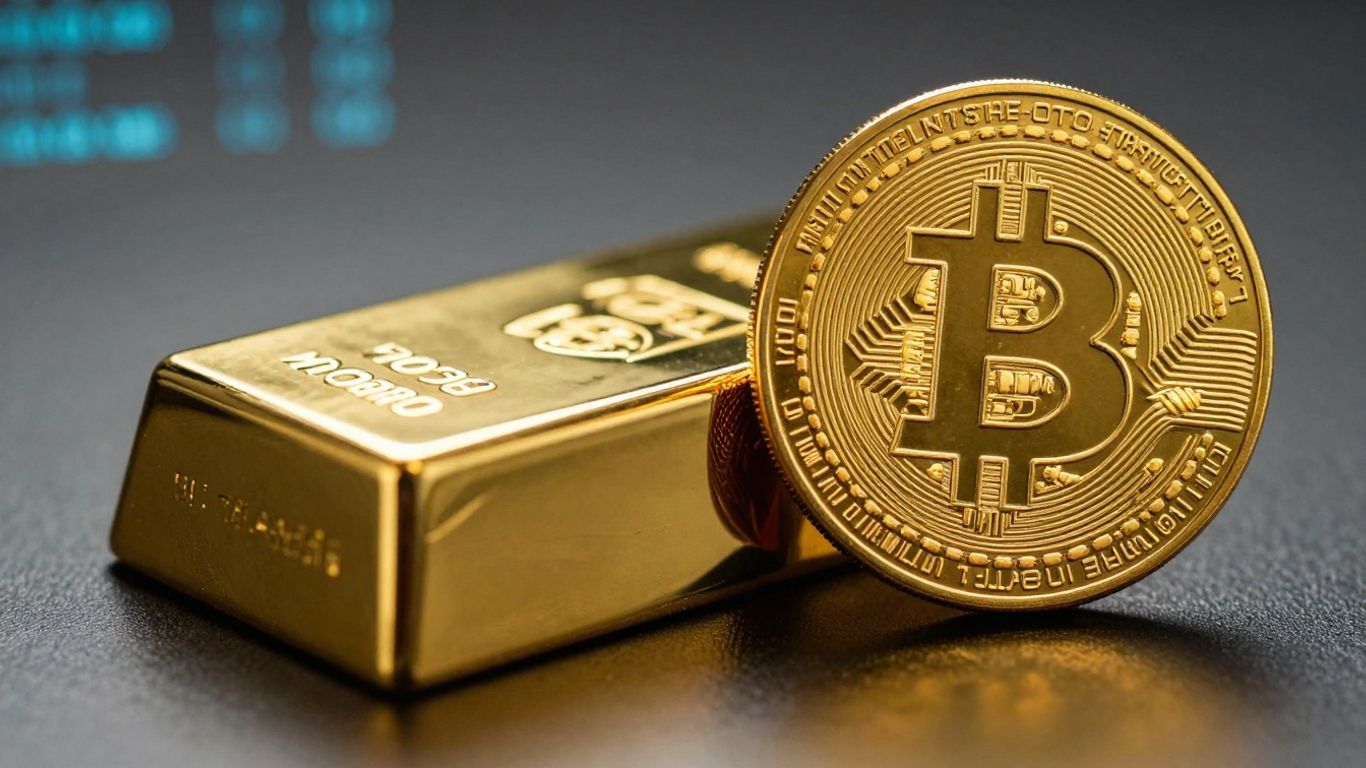
The relationship between gold and cryptocurrencies is constantly evolving. You often observe movements that sometimes seem to align, and other times oppose each other. It's easy to be misled into thinking that the gold market operates like the crypto market, as each has its own distinct internal logic.
The impact of inflation on Bitcoin and cryptocurrencies
It's a fact: inflation worries almost everyone. You see it in your grocery bills, your electricity bill… and also in the markets. When prices soar, you often try to protect your money. Gold has fulfilled this instinct for centuries, but in recent years, Bitcoin has also claimed to play this role. However, their reactions aren't always the same.
- Gold tends to appreciate when there is monetary uncertainty and distrust in fiat currencies.
- Bitcoin initially seems to react positively to inflation, but this is far from systematic: it also depends heavily on the liquidity available in the markets.
- Cryptocurrency volatility remains very high: if there is a massive capital flight, even Bitcoin can fall while gold serves as a safe haven.
| Postman | Or | Bitcoin and crypto |
|---|---|---|
| Inflation | Often bullish | Sometimes bullish, but volatile |
| Market panic | Enjoy | Can pick up |
| Central banks | Massive purchases | Little or no impact |
Gold attracts capital in times of financial turmoil, whereas Bitcoin sometimes takes time to regain investor confidence after periods of sharp decline.
The correlation between gold, Bitcoin and traditional markets
For some time now, you've been hearing about the "correlation" between gold, Bitcoin, and stocks. But frankly, it's not as simple as an on/off switch.
- Gold plays solo: when stocks plummet, gold often rises, because investors want to protect themselves.
- Bitcoin is increasingly behaving like a kind of risky asset: it sometimes follows the movement of the stock markets, especially when liquidity is flowing freely.
- There are periods when Bitcoin and gold rise together (period of high distrust), then their paths diverge as soon as speculation resumes.
Here's how you can summarize, even though reality is constantly changing:
| Market phase | Or | Bitcoin |
|---|---|---|
| Stock market crisis | Rise | Fall or flat |
| Calm, low rates | Stable/increasing | Rise |
| Geopolitical tensions | Rise | Uncertain |
- Gold and Bitcoin are influenced by different signals: gold remains dependent on central bank policies and geopolitics, while Bitcoin reacts to the liquidity cycle and the psychology of new entrants.
- We cannot predict that Bitcoin will replace gold, because you can already see that institutions prefer to keep gold in their vaults for now, while Bitcoin remains, for many, a speculative bet.
- If you invest, keeping an eye on the evolution of these correlations allows you to better understand the sometimes strange movements of one or another asset.
Even though the dominant discourse heralds a new era for cryptos, gold retains almost undiminished popularity when it comes to managing real stress on the markets.
Coexistence or competition between gold and cryptocurrencies
So, are gold and Bitcoin like oil and water, or can they really coexist in your portfolio? It's a question many people ask, especially when Bitcoin is nicknamed "digital gold".
The fundamental differences in risk profile
Let's be clear, gold is the ancestor of safe-haven assets. It has been around for millennia, it's a tangible asset, you can touch it. Its volatility is generally gentler, more predictable. It has survived the ages, wars, economic crises, and it's still there, solid. It's a bit like the wise grandfather of finance.
Bitcoin, on the other hand, is the newcomer, the energetic young wolf. It was born with the internet, it's digital, decentralized, and its volatility can be dizzying. It's sensitive to market moods, new regulations, and influencer tweets. It's a bit like a sports car: fast, exciting, but requiring a firm hand on the wheel.
| Active | Nature | Volatility | History | Tangibility |
|---|---|---|---|---|
| Or | Physical | Low | Millennium | Yes |
| Bitcoin | Digital | Élevée | Recent | No |
Gold tokenization: a new investment approach
What if we combined the best of both worlds? That's where gold tokenization comes in. Imagine having a digital asset, easy to trade and store on a blockchain, but directly backed by physical gold. It's a bit like having a gold bar in your digital wallet, but without the hassles of storage or transportation.
This approach seeks to combine the security and intrinsic value of gold with the flexibility and efficiency of modern technologies. It's a logical evolution for those who want the reassuring aspect of gold with the convenience of digital technology.
It's a way to make gold more accessible and liquid, while preserving its fundamentals. For some, it's the way of the future, a way to modernize an age-old asset to meet the needs of today's investors. It doesn't replace physical gold for everyone, of course, but it certainly opens new doors.
Gold and cryptocurrencies: friends or foes? That's the big question! Some believe they can coexist, each having its place in our wallets. Others see fierce competition. So, who will win? Or perhaps they'll find a way to work together? To learn more about how Gold can be a safe investment, visit our website today!
So, what can we learn from all this?
So, we've covered everything. Gold is a safe investment; it's been around for millennia, and even with the arrival of cryptocurrencies, it remains a cornerstone for securing your assets. Cryptocurrencies, on the other hand, are newer and more volatile, but they're attracting a new generation of investors. Will one replace the other? Probably not. Perhaps the best approach is to consider how these two worlds can coexist within your investment strategy. Diversification is always key, isn't it? Keep that in mind the next time you review your accounts.
Frequently Asked Questions
Are gold and Bitcoin similar?
Bitcoin is sometimes called 'digital gold'. This is because, like gold, there is a limited supply. But be aware that Bitcoin is much newer and its value can change rapidly, unlike gold, which has been known for thousands of years for its greater stability.
Does inflation drive up the price of cryptocurrencies the same way it drives up the price of gold?
When prices rise sharply (inflation), people look for things that retain their value, like gold. For cryptocurrencies, it's more complicated. Sometimes, when inflation is present, central banks raise interest rates, which can cause the price of cryptocurrencies to fall. So, they don't always react like gold.
Will Bitcoin replace gold?
Many people believe that Bitcoin and gold can coexist. Gold has been a safe haven for a very long time, while Bitcoin is newer and more volatile. Many investors hold both in their portfolios for various reasons. They aren't necessarily competitors, but rather offer different ways to protect one's money.