
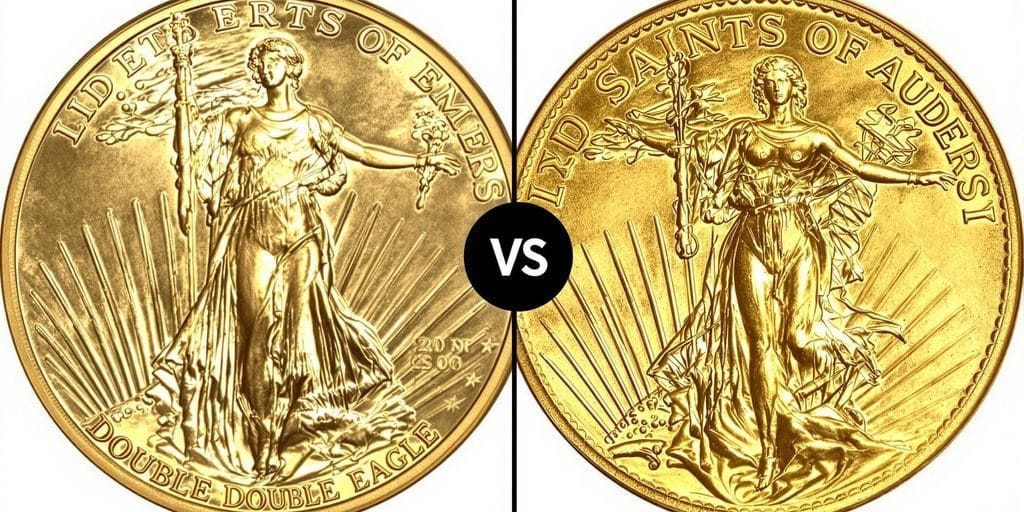
You may be wondering what the differences are between a $20 Liberty gold coin and a $20 Saint-Gaudens coin. These two American coins, although they share the same face value, have distinct characteristics that are worth knowing. Whether you're an experienced collector or a new investor, understanding these nuances will help you make informed choices. Let's dive into the details together to shed more light.
Key Takeaways
- The $20 Liberty Head coin, also known as the “Coronet,” was designed by James B. Longacre and minted from 1850 to 1907.
- The Saint-Gaudens $20 coin, designed by Augustus Saint-Gaudens at the instigation of Theodore Roosevelt, succeeded the Liberty Head from 1907 to 1933.
- Both coins share similar technical specifications: 33,44g of 900‰ pure gold, but their design differs significantly.
- The Saint-Gaudens is renowned for its high relief and artistic aesthetic inspired by Antiquity, while the Liberty Head features a more classical design.
- The Saint-Gaudens $20 coin is often considered more sought after by collectors for its artistic design and colorful history, especially the 1933 examples.
20 Dollar Liberty Head
Key Features
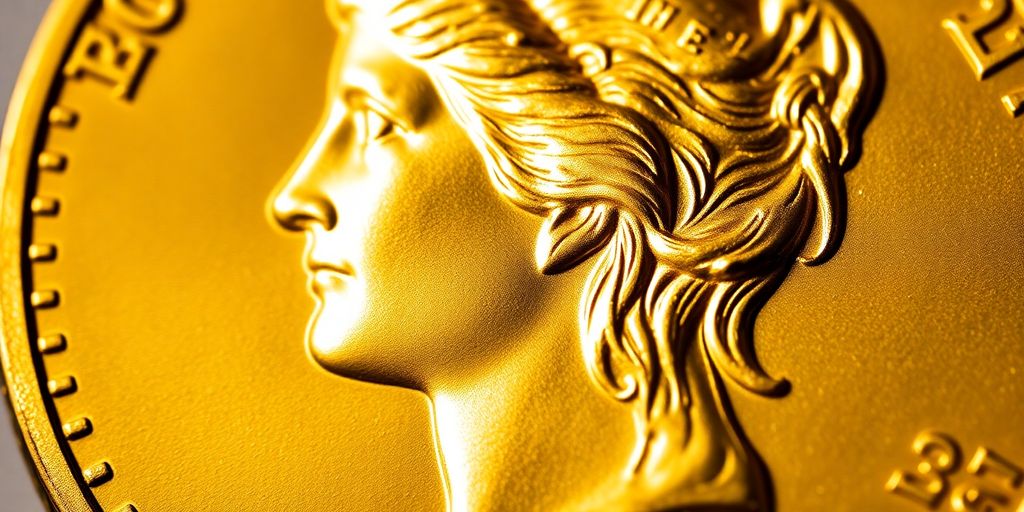
The $20 Liberty Head coin, also known as the "Coronet," is a landmark American gold coin. Designed by James B. Longacre, its obverse features the profile of Liberty, an image already used on $2,5 coins. Surrounding this portrait are 13 six-pointed stars, symbolizing the founding colonies, and the date of minting below the head. The reverse depicts an eagle with outstretched wings, holding an olive branch and arrows in its talons. A halo of stars and rays overhangs the eagle, and the country's name and the face value "TWENTY D." are inscribed.
Over time, this coin has undergone some variations. As early as 1866, the motto "IN GOD WE TRUST" was added to the reverse. Then, starting in 1877, the words "TWENTY DOLLARS" appeared in full below the eagle. These small differences can be important to collectors.
Variations and specificities
There are several variations of the $20 Liberty Head coin, each with its own minting and design specificities:
- Liberty Head (1850-1866) : This is the original version, without the motto "IN GOD WE TRUST".
- Liberty Head with motto (1866-1876) : The motto "IN GOD WE TRUST" is added to the reverse.
- Liberty Head TWENTY DOLLARS (1877-1907) : The face value is written in full.
Here is a summary table of the technical characteristics common to these parts:
| Characteristic | Details |
|---|---|
| Weight | 33,4362 gr |
| Diameter | 34 mm |
| Slice | Serrated |
| Title (Purity) | 900‰ (90% gold) |
| Fine gold weight | About 30,1 g |
These coins are considered investment coins, but their value can be significantly increased by their numismatic interest, especially for rare or mint condition examples. They are highly prized by collectors and investors, particularly in the United States, where they are seen as a safe haven.
Value and investment
The Liberty Head $20 coin is now much more than just a coin; it's a collectible and an investment. Its value far exceeds its $20 face value, reaching hundreds or even thousands of dollars, depending on its condition, rarity, and minting period. It's a coin that combines the intrinsic value of gold with an attractive numismatic premium. If you're looking to diversify your assets with precious metals, this American coin might be of interest to you. You can also find information on other investment formats such as the 20g silver ingot which offers different accessibility.
20 Saint-Gaudens dollars
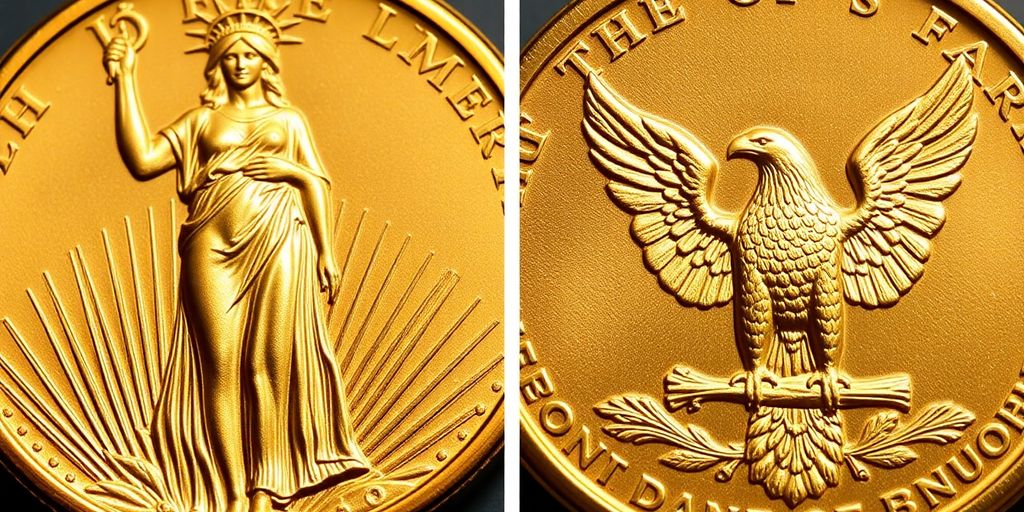
Ah, the Saint-Gaudens $20 coin! It's truly a marvel, frankly. The story behind its creation is quite fascinating. President Theodore Roosevelt, a true lover of art and ancient history, wanted American coins to be as beautiful as those of ancient Greece. So he enlisted the help of the renowned sculptor Augustus Saint-Gaudens. Imagine, a White House dinner leading to a revolution in coin design! Saint-Gaudens rose to the challenge and created this coin, which is now considered a work of art.
Revolutionary Design
The first thing that strikes you is the relief. The first versions from 1907 were in high relief, which gave a dramatic, almost three-dimensional appearance. On the obverse, you have Lady Liberty advancing, a torch in one hand, an olive branch in the other, all against the backdrop of the rising sun and the Capitol. It's quite powerful. The reverse is an eagle in full flight, also against the backdrop of the sun. It is truly a piece that stands out from the ordinary in its aesthetics.
Variants and Minor Defects
Well, things weren't perfect at first. Bankers and businessmen found these high-relief coins difficult to stack. The Mint also had problems with the minting. So they quickly switched to a bas-relief version, which was more practical for everyday use. Another interesting thing is the absence of the motto "In God We Trust" on the first mintages of 1907 and early 1908. Roosevelt found this a bit blasphemous. But the public protested, and the motto was reintroduced in 1908. Amazing how things change, right?
Specifications
To give you a better idea, here are some key figures:
- Gross weight : 33,436 grams
- Fine gold weight: approximately 30,1 grams (for a title of 900‰)
- Diameter: 34 mm
- Alloy: 90% gold, 10% copper
These coins were minted from 1907 to 1933. Production stopped due to the Great Depression and President Franklin D. Roosevelt's gold confiscation. The 1933 coins are particularly rare and sought-after, often due to a somewhat chequered history of a few examples that were allegedly stolen and fraudulently put into circulation. It's a bit like owning a piece of history, really.
The story of the Saint-Gaudens coin illustrates how art, politics, and practical necessity can come together to create something unique. It is a coin that marked its time and continues to fascinate today, both for its design and its history.
If you are interested in gold coins, you might also want to take a look at the 1/20 oz gold coin, which is a smaller but equally good option to start with.
10 dollar Eagle Indian Head
Now let's move on to another well-known American coin, the "10 Dollar Eagle Indian Head." If you're interested in American gold coins, you've probably heard of this one. It was minted between 1907 and 1933, and its name comes from the fact that it features a head of Liberty wearing a Native American headdress on the obverse. That's pretty unique for an American coin, right?
President Theodore Roosevelt wanted to modernize the look of coins, and he commissioned sculptor Augustus Saint-Gaudens to do the work. The result is this $10 coin, also known as the "Indian Head Eagle." It weighs 16,72 grams and is 27 mm in diameter, with a purity of 900‰ gold. It's a beautiful piece, both for its history and its composition.
It should be noted that there have been some variations over the years. Coins minted between 1907 and 1908 are a little rarer, as they did not bear the inscription "IN GOD WE TRUST." This inscription was added later, in 1866 to be precise, on earlier coins, but it is present on the majority of "Indian Head" coins. A small peculiarity is that a first series of this model was stopped very quickly because the relief was too great, so there are only 500 copies. Those from 1933 are also very sought after, a bit like the 20 dollars, because of the ban on gold possession by individuals that year.
This coin is truly a piece of American history. It represents a period when there was a desire to both honor traditions and innovate in coin design. It is this combination that makes it so interesting for collectors and investors.
If you're looking to diversify your assets with precious metals, the $10 Eagle Indian Head is a solid option. It has good market liquidity and is internationally recognized. It's like owning a little piece of American history, while also having a tangible asset. It's a coin that has weathered tough economic times and remains a safe bet. Consider looking at the different series of American gold coins to compare.
20 Francs Marianne Coq
Let's now talk about the 20 Franc Marianne Coq en Or coin. This is a coin that has marked French monetary history, minted mainly between 1899 and 1914. Its name comes from the symbols it represents: on one side, you have Marianne, an emblematic figure of the French Republic, wearing her famous Phrygian cap, a symbol of freedom. On the other side, a proud rooster, which is also a national symbol, representing vigilance and courage.
What's interesting about this coin is that it was re-struck between 1951 and 1960. These re-strikes use the old dies, so they are indeed real gold coins, but the dates given don't correspond to the years of production. They are often called "Pinay re-strikes," named after Antoine Pinay, who launched a national loan in 1952 backed by gold. It's a bit like having a piece of history with a slightly off-date.
Technical characteristics
Here's a quick recap of what you need to know about its specifications:
- Metal : 900/1000 gold (90% pure gold)
- Gross weight : 6,45 grams
- Fine gold weight: 5,805 grams
- Diameter: 21 mm
- Slice : It varies according to the period of minting. Between 1899 and 1906, it bears the inscription "GOD PROTECT FRANCE". From 1907, following the separation of Church and State, it bears the republican motto "LIBERTY EQUALITY FRATERNITY".
Why invest in the 20 Francs Marianne Coq?
Investing in this piece has several advantages. First, it is a tangible asset, which means you own something physical, not just a piece of paper. Gold has always been considered a safe haven, especially in times of economic uncertainty. The coin is also in high demand on the market, which ensures good liquidity, meaning it is relatively easy to buy or sell. In addition, it benefits from favorable taxation in France, which makes it even more attractive to investors. It's a bit like having a small personal treasure that stands the test of time.
The 20 Franc Marianne Coq coin combines history, symbolism, and investment potential. Its high demand and international recognition make it a solid choice for diversifying your assets.
Napoleon 20 Francs Gold
Ah, the Napoleon 20 Francs Gold! It's a coin that speaks to many people, especially in France. It has survived many eras, from Napoleon I to Napoleon III, and even after. It's not just a piece of gold, it's a piece of French monetary history, and even European, since it served as a reference for the Latin Union. When you hold it in your hand, you feel the weight of history, it's quite nice.
What's interesting is that the design has evolved a bit. We find Napoleons with their heads laureate, that is, crowned with laurel, and others with their heads bare. On the reverse, it's often the imperial eagle, the crown, or other symbols of the Empire that are represented. It's quite varied and adds a collectible aspect to the coin.
For investment, it's a safe bet. It's easy to buy and resell, and it has the particularity of having a premium that can be interesting, especially when the Gold prices is rising. Many people see it as a safe haven, a bit like insurance in case of an economic downturn. It's also a coin that's more accessible than others, making it the perfect place to start investing in physical gold.
It's important to note that even though millions of these coins were minted, many have been remelted over time. As a result, those in good condition are becoming increasingly rare, increasing their value to collectors.
Here are some technical details to help you see things more clearly:
- Metal : Or
- Purity: 900‰ (90% fine gold)
- Gross weight : 6,45 grams
- Fine gold weight: 5,81 grams
- Diameter: 21 mm
- Slice : Inscription “GOD PROTECT FRANCE” (for the first strikes) or “LIBERTY, EQUALITY, FRATERNITY” (for the most recent ones).
If you're looking to diversify your assets or simply own a tangible piece of history, the Napoleon 20 Francs Gold is definitely a coin to consider. It's a bit like the Swiss Army knife of investment gold, versatile and always popular. Consider following its price to get the best deals, much like you would for a Belgian coin like the Leopold II.
20 Swiss Francs Gold
Now let's talk about the 20 Swiss Gold Franc, often called the "Vreneli." This coin has a beautiful history behind it, being part of the Latin Union, a monetary agreement that unified several European currencies as early as 1865. Thanks to this, this Swiss coin was accepted in quite a few places, much like the French Napoleon 20 Francs of the time.
The engraver, Fritz Ulysse Landry, did a nice job. On the obverse, we see Helvetia, a sort of allegory of Switzerland, with a crown and a mountain landscape behind. On the reverse, it's the Swiss coat of arms with a cross, placed on an oak branch. There are even 22 stars on the edge, representing the Swiss cantons, and the inscription "AD LEGEM ANNI MCMXXXI".
A little peculiarity is that the 1935 coins were minted between 1945 and 1947 to meet demand. They bear the designation "L1935B," where the "L" stands for ingot and the "B" for the Bern mint. This is pretty cool for collectors.
Technical characteristics
- Metal : Or
- Purity: 900‰ (90% fine gold)
- Gross weight : 6,45 grams
- Fine gold weight: 5,81 grams
- Diameter: 21 mm
- Slice : Engraved with 22 stars and "AD LEGEM ANNI MCMXXXI"
Why choose the 20 Swiss Francs Gold?
- Safe haven: Like any good gold investment, it protects against inflation and crises. Gold doesn't lose value like fiat currency.
- Liquidity: Vreneli is incredibly well-known and in demand, so it's easy to buy or sell. It's like the Swiss Army knife of gold coins, and always comes in handy.
- Diversification: It's an affordable way to start investing in physical gold, especially if you want to diversify your assets without breaking the bank.
- Numismatic appeal: For those who love collecting, the different years of minting and especially the rare vintage L1935B add a little special touch.
The 20 Swiss Franc Gold Coin is a coin that combines history, aesthetics, and good investment potential. Its international recognition and ease of exchange make it a solid choice for many.
20g silver ingot
You might be wondering why we're talking about a 20g silver bar in an article about $20 gold coins. Well, it's simple: silver, like gold, is a precious metal that has stood the test of time and continues to be a safe haven. The 20g silver bar is an attractive option for those new to precious metal investing, or for those looking to diversify their portfolio without committing too much money.
Features and Benefits
This small ingot is typically made with a purity of 999,99‰, meaning it is made of 99,999% fine silver. It is often certified by the London Bullion Market Association (LBMA), a mark of quality and international recognition. Each ingot is numbered and sealed in tamper-evident packaging, accompanied by a certificate of authenticity. It's a bit like having a small, tangible work of art that retains its value.
Here are some key points to remember about the 20g silver bar:
- Accessibility: Its weight makes it more affordable than heavier ingots, ideal for beginners.
- Diversification: It allows you to spread your risk by investing in a metal other than gold.
- Liquidity: Easy to resell, it offers good flexibility.
- Industrial value: Silver is also widely used in industry (electronics, solar energy, medicine), which supports its demand.
Silver, while less expensive than gold, has a rich history as a medium of exchange and store of value. Its growing industrial use and safe haven status make it a valuable investment for diversifying your assets.
Why choose a 20g silver ingot?
Choosing a 20-gram bar is often motivated by its balance between cost and value. It is easier to store and resell than larger gold coins, while offering better purchasing power per gram than some smaller coins. It is a convenient way to acquire a small amount of precious metal, perfect for gifts or to gradually build up a store of value. You can also consult the money course to follow its evolution.
Check out our 20 gram silver ingot, perfect for starting your investment in precious metals. It's a great way to acquire physical silver. Want to learn more about our silver products? Visit our website today to explore our full collection and make your first purchase with confidence.
So which one to choose?
So, now you have a good idea of the differences between these $20 coins. Whether you're drawn to the historical side and classic design of the Liberty Head, or the more modern and artistic aesthetic of the Saint-Gaudens, each coin has its charm. Weigh carefully what matters most to you: the history, the design, or perhaps even the rarity of certain mintages. Either way, you're holding a piece of American history in your hands, and that's priceless. Think carefully before making your choice!
Frequently Asked Questions
What are the differences between the Liberty Head $20 coin and the Saint-Gaudens?
The Liberty Head $20 coin, also known as the “Coronet,” was designed by James B. Longacre. It features the profile of Liberty, surrounded by 13 stars, and on the reverse, an eagle. The later “Saint-Gaudens” version has a more artistic design with Liberty standing upright holding a torch and an olive branch, and an eagle in flight.
Why was the Saint-Gaudens $20 coin created?
The Saint-Gaudens $20 coin was born out of President Theodore Roosevelt's desire to modernize American coins. He commissioned the design to sculptor Augustus Saint-Gaudens, who drew inspiration from ancient art to create a coin that was both beautiful and symbolic.
Is it true that the 10 dollar Eagle Indian Head coin depicts a Native American headdress?
Yes, the $10 Eagle Indian Head coin, designed by Augustus Saint-Gaudens, features Liberty wearing a Native American headdress on the obverse. This was a novelty for the time and a request from President Roosevelt.
What makes the 20 Franc Marianne Coq coin so special?
The 20 Franc Marianne Coq coin is highly valued because it depicts Marianne, the symbol of the French Republic, and a rooster, a symbol of bravery. It was minted between 1899 and 1914, with subsequent reissues.
What is the story behind the Napoleon 20 Francs Gold?
The Napoleon 20 Francs Gold is an important historical coin in France, minted between 1861 and 1870. Its name comes from Napoleon III. It is valued for its history, its gold value, and its ease of exchange.
What do the sides of the 20 Swiss Franc Gold coin represent?
The 20 Swiss Franc Gold Coin, often called the “Vreneli,” features Helvetia, the allegory of Switzerland, on the obverse. The reverse features the Swiss cross. It is an internationally recognized and easily traded coin.