
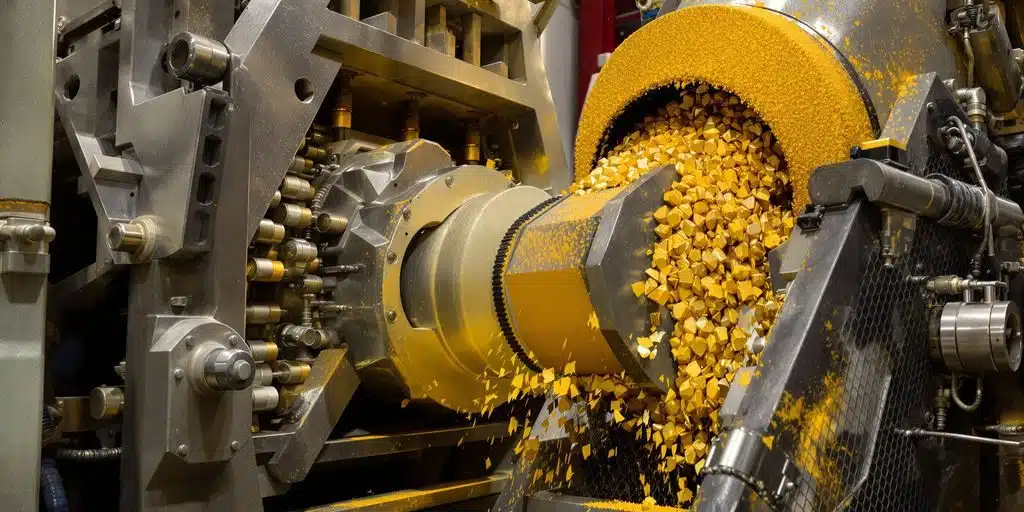
If you're interested in gold ore processing, you've probably heard of crushing and grinding. These are really important steps in obtaining gold. It's a bit like baking a cake: you first have to reduce the large ingredients to crumbs before you can mix them together. Let's take a look at how it works and why it's so necessary to extract this precious metal. You'll see, it's not that complicated once you understand the principle.
Key Takeaways
- Crushing is the first step in reducing the size of large pieces of gold ore, making it easier to handle.
- Grinding then follows to transform the crushed ore into a fine powder, thus releasing the gold particles.
- Ball mills are often used for grinding because they are efficient at obtaining a fine powder, which helps recover more gold.
- Adding water and grinding media (such as steel balls) to the mills improves the efficiency of the process.
- Although often confused, crushing and grinding are two distinct steps with different objectives in ore preparation.
Understanding Crushing and Grinding in Gold Ore Processing
To fully understand how gold is extracted from ore, it is first necessary to understand the role of two fundamental steps: crushing and grinding. These processes, although related, have very distinct functions in preparing the ore before the finer extraction phases.
The essential role of crushing in reducing ore size
Crushing is like the first step where we tackle the big pieces. When ore comes out of the mine, it's often in the form of large blocks, sometimes several meters across. The goal of crushing is to reduce these large pieces into smaller, more manageable sizes. This is done using machines called crushers. Think of it like breaking a large rock into several more manageable pieces. This initial reduction is super important because it prepares the ore for the next step, grinding, and also makes transport and storage easier. If crushing isn't done correctly, it can make the rest of the process less efficient, and we risk losing gold along the way.
Grinding: a crucial step to release the gold particles
After crushing, the ore is already smaller, but the gold particles are still firmly locked within the rock. This is where grinding comes in. Grinding is the art of reducing the ore to a very fine powder, almost like flour. Ball mills are often used for this. The idea is to break the rock so finely that the tiny gold particles it contains are finally released. The finer the grinding, the more these gold particles are exposed, which greatly facilitates their recovery during the subsequent chemical or physical extraction stages. It is this stage that truly 'frees' the gold from its rocky matrix.
Fundamental differences between crushing and grinding
To summarize, the main difference is the particle size you're targeting. Crushing deals with coarse reduction, going from large blocks to pebbles or gravel. Grinding goes much further, transforming these small pieces into a fine powder. Crushing can be said to prepare the ground for grinding, and grinding prepares the ore for final gold extraction. Both are essential and work together to maximize the amount of gold that can be recovered.
Key steps in gold ore crushing
Crushing gold ore is a bit like preparing a large rock to make it easier to handle. You start with pieces straight from the mine, often quite large and irregularly shaped. The idea is to reduce them to smaller, more manageable sizes so they can be moved on to the next stages without any problems.
Primary crushing: the first size reduction
This is the very first step. We use some pretty heavy-duty machines, like jaw crushers or gyratory crushers. Their job is to take these large blocks and break them into smaller pieces. Think of it like breaking a large rock into several pieces that are easier to lift. This is really the foundation for further processing.
Secondary and tertiary crushing for fine particle size
After the first pass, the pieces are already smaller, but there's still room for improvement. This is where secondary and sometimes tertiary crushers, such as cone crushers, come in. They refine the process, further reducing the size of the fragments. The goal is a finer particle size, which is extremely important for more efficient grinding. If the ore is already well prepared, grinding will be less energy-intensive and more efficient.
The importance of efficient crushing for later stages
Frankly, if you don't crush well at the beginning, the entire rest of the process can suffer. Crushing that's done poorly, with pieces that are still too large or not uniform enough in size, will make grinding more difficult, consume more energy, and potentially reduce the amount of gold you can recover at the end. This is truly a step that determines the success of the entire process.
The grinding process and its impact on gold recovery
Grinding is the step that follows crushing. While crushing reduces the ore into smaller pieces, grinding transforms it into a very fine powder, or even a slurry. This is essential for freeing the gold particles that are still stuck in the rock. The finer the grinding, the more accessible these gold particles are for subsequent steps, such as cyanidation or flotation, and therefore the more you can recover.
Ball milling: a preferred equipment for gold ore
When it comes to gold grinding, the ball mill is a bit of a star. It's super efficient at reducing the ore into that fine powder we were talking about. Inside, there are steel balls or rods. As the cylinder rotates, these balls crush the ore, pulverizing it little by little. This is what allows
The equipment needed for crushing and grinding
To properly process gold ore, you need the right equipment. It's a bit like trying to cook a complex dish without the right utensils; it quickly becomes complicated and the result isn't great.
The different types of crushers used
When we talk about crushing, we often think of a single machine, but in reality, there are several, each with its own role. We usually start with primary crushers, such as jaw or gyratory crushers. They handle the large pieces coming out of the mine. Think of them as the first to tackle the heavy lifting. Then, to refine the work, we move on to secondary and tertiary crushers. Cone crushers are often used here. They reduce the ore to a finer particle size, preparing the ground for the next stage.
- Jaw crushers: Ideal for the first stage, they crush the ore between two plates.
- Gyratory crushers: They are larger and handle large volumes, often used in large installations.
- Cone crushers: Perfect for secondary and tertiary stages, they produce a more uniform size.
Crushers suitable for further size reduction
Once crushing has done its job, the ore is still too large to effectively liberate the gold. This is where crushers come in. The most common for gold ore is the ball mill. It's a large rotating cylinder filled with steel balls. As it spins, the balls collide and grind the ore into a very fine powder. It's this powder that will release the gold particles. Water is often added to create a kind of slurry, which aids in the grinding and transport of the material. Grinding time is important; too short, and the gold isn't released; too long, and energy is wasted.
Choosing the right equipment, whether crushers or grinders, is what will truly make the difference in the efficiency of your gold mining. You need to know your ore well to choose the right machinery.
The importance of choosing equipment for ore processing
Choosing the right equipment isn't just a matter of preference. It really depends on the type of ore you're processing. Some ores are harder, others are softer. If you use equipment that's too light for a hard ore, you'll break it or overheat it, and it won't work well. Conversely, equipment that's too powerful for a soft ore can grind it into too fine a dust, which can also cause problems for the recovery stages. So, you need to carefully analyze your ore and the results you expect to achieve to select the most suitable crushers and grinders. It's an investment, and it has to be the right one.
The Importance of Particle Size in Gold Ore Processing
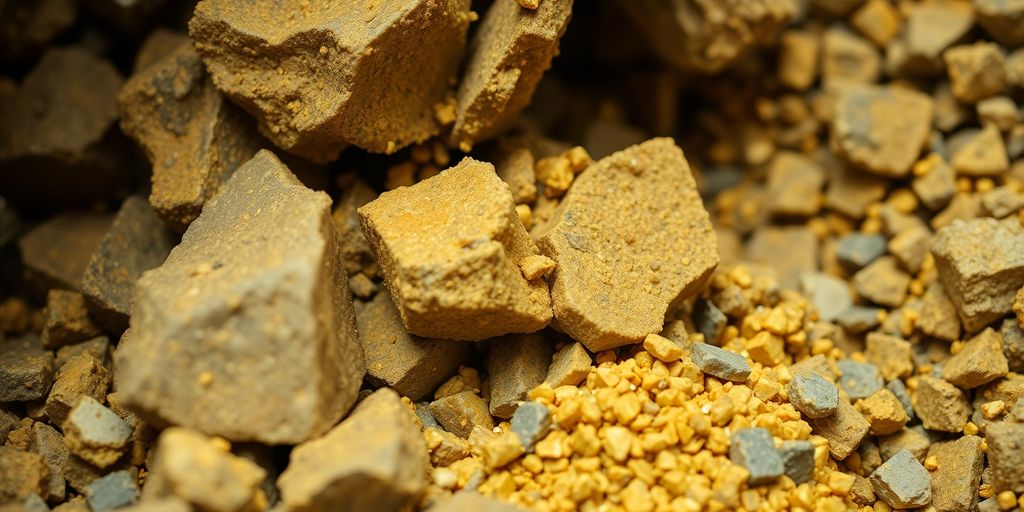
Particle size is really the name of the game in gold ore processing. If you don't reduce the ore to the right particle size, the entire process can be compromised. It's a bit like trying to force a large rock through a narrow pipe; it won't work well.
How screening improves grinding efficiency
Screening is the step where sieves are used to separate particles according to their size. Before moving on to grinding, screening the ore removes larger pieces that could overload or damage the grinding equipment. By only passing reasonably sized pieces through the crusher, its operation is optimized. Less wear, more efficiency, and above all, it ensures that the crusher can do its job properly on the material intended for it. It's a kind of pre-sorting that makes the crusher's work much simpler and more productive.
Classification to sort particles according to their size
After grinding, classification is often used. This is slightly different from screening because it is usually done in a wet environment, often with water. Devices like hydrocyclones or screw classifiers separate particles based on their size and density. The idea is to return the particles that are still too large to the crusher for refining, while those that have reached the right size are sent to the next stages of gold recovery. It's a recycling system that aims to ensure that each gold particle has the best chance of being released and recovered.
The impact of particle size on recovery processes
Particle size is absolutely critical for gold recovery. If gold particles aren't sufficiently freed from the surrounding rock, methods like cyanidation or flotation won't be able to effectively reach them. Imagine a small gold nugget enclosed in a large piece of rock; even if you use chemicals, they won't be able to dissolve or separate the gold. The gold needs to be exposed, with a large surface area in contact with the reagents or flotation agents. This is why well-controlled grinding, which produces particles of the right size, is so important. It ensures that the precious metal can actually be extracted from the ore.
The size of small things matters a lot when processing gold. If the pieces are too big or too small, it can make the job more difficult. You have to find the right size to make sure everything goes smoothly. To learn more about how we do it, visit our website!
To conclude on crushing and grinding
So, now you know why crushing and grinding are so important when it comes to recovering gold. It's not just about breaking rocks, eh. It's a step that requires precision to properly separate the wheat from the chaff, so to speak. Without these steps, the gold would remain stuck in the rock and we wouldn't be able to enjoy it. It's a bit like preparing a good dish; you have to cut the ingredients correctly before cooking them. So the next time you see a piece of gold jewelry, think about all the work that went into making it so beautiful.
Frequently Asked Questions
What is the difference between crushing and grinding gold ore?
Crushing breaks large rocks into smaller pieces, like breaking a large pebble into small gravel. This is the first step in making the ore easier to handle. Grinding takes this a step further by reducing these small pieces to a very fine powder. Imagine turning gravel into fine sand. This is necessary to properly release the gold within.
What types of machines are used to crush gold ore?
Crushing involves the use of machines called crushers. There are several types: jaw crushers for the initial large reduction, then gyratory or cone crushers for further refinement. It's a bit like using a large hammer, then a smaller hammer to break a stone.
How does a ball mill for gold ore work?
The ball mill is the gold ore crusher! It's a large, cylindrical machine that rotates and contains metal balls. As it rotates, the balls impact and crush the ore into a powder. Water is often added to make a kind of slurry, which aids in grinding and transport.
Why is particle size so important for gold recovery?
Particle size is super important! If the ore isn't ground into a fine powder enough, the gold gets stuck in the rock and can't be easily recovered. The ore needs to be very fine so the gold can be extracted cleanly in the next steps.
Does screening help the grinding process?
Yes, screening helps a lot! Before grinding, the ore can be passed through screens to remove even the smallest particles. This prevents overloading the crushers with too-fine particles and makes the job faster and less energy-intensive. It's like sorting your toys before putting them away.
How do crushing and grinding work together to prepare gold ore?
Absolutely! Crushing first reduces large pieces of rock into smaller pieces. Then, grinding takes these pieces and turns them into a very fine powder. It's like going from a large pebble to very fine sand. Each step prepares the ore for the next, to release as many tiny gold particles as possible.
