
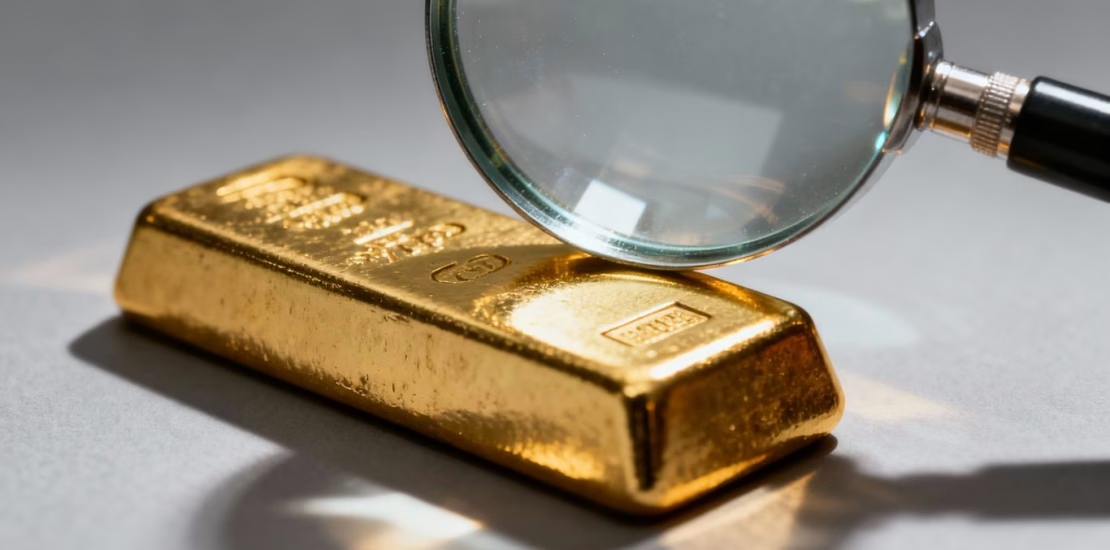
Are you wondering if that gold item is genuine? It's a legitimate question, especially given the abundance of counterfeit goods on the market. Fortunately, there are several ways to test gold at home without needing sophisticated equipment. In this article, we'll explore different methods to help you gain a clearer understanding and distinguish between real gold and imitations. Get ready to become a gold-detecting expert!
Key points to remember
- Several simple tests, such as the magnet or ceramic test, can be carried out at home for an initial check.
- Observing hallmarks and official markings is an important step in identifying the purity and origin of gold.
- For further analysis, tools such as acid tests or touchstones can be used, but with caution.
- If doubt persists, consulting a jeweller or gemologist is the best solution to obtain a reliable expertise.
- It is important to avoid common mistakes, such as relying solely on appearance or using potentially destructive methods.
Simple methods for testing gold at home
Do you have a piece of jewelry that looks like gold, but you're not sure of its authenticity? Don't panic, there are several tricks you can try at home, without needing any sophisticated equipment. These methods don't replace a professional appraisal, but they can give you a good indication.
The magnet test: a first approach
Pure gold, you know, that shiny yellow metal, isn't attracted to magnets. It's a fairly simple property to check. Take a strong magnet—a neodymium magnet, for example, works well—and bring it close to your gold item. If your jewelry moves or is attracted to the magnet, there's a good chance it's not solid gold. Often, jewelry that reacts to a magnet contains other metals, like iron or nickel, which are magnetic. It's a fairly effective first step.
The skin test to detect reactions
This is a test you can do while wearing your jewelry. Put on your bracelet, ring, or necklace and wear it for a while, say a day. Then observe your skin where the jewelry was in contact. If your skin has turned green or black, it's a sign that the jewelry isn't pure gold. Real gold doesn't react with the skin. It leaves no trace, no discoloration. It's a chemical reaction between certain metals and the sweat on your skin that causes these marks.
Using ceramics for a revealing trace
For this trick, you'll need a piece of unglazed ceramic. An old plate, a terracotta tile, something like that will do. Take your jewelry and gently rub it on the ceramic surface. If you get a gold mark, that's a good sign; your jewelry is probably gold. However, if the mark that appears is black, then be wary; it's probably gold-plated, not solid gold.
The white vinegar test, a mild acid
White vinegar, an ingredient we all have in our cupboards, can also be used as a tester. It acts as a mild acid. Soak your jewelry in a small container of white vinegar for a few minutes. If the jewelry doesn't change in appearance and retains its shine, that's a good sign. However, if you notice discoloration, a reaction, or any alteration to the surface, it's likely not pure gold. Be aware that this test is less reliable than others and can sometimes leave a slight odor on the jewelry, which you'll need to rinse thoroughly afterward.
Professional tools for in-depth analysis
While homemade methods can provide a first impression, for absolute certainty, more serious tools are necessary. These techniques require a bit more expertise, or even the intervention of a professional, but they offer much greater precision.
The nitric acid test and its precautions
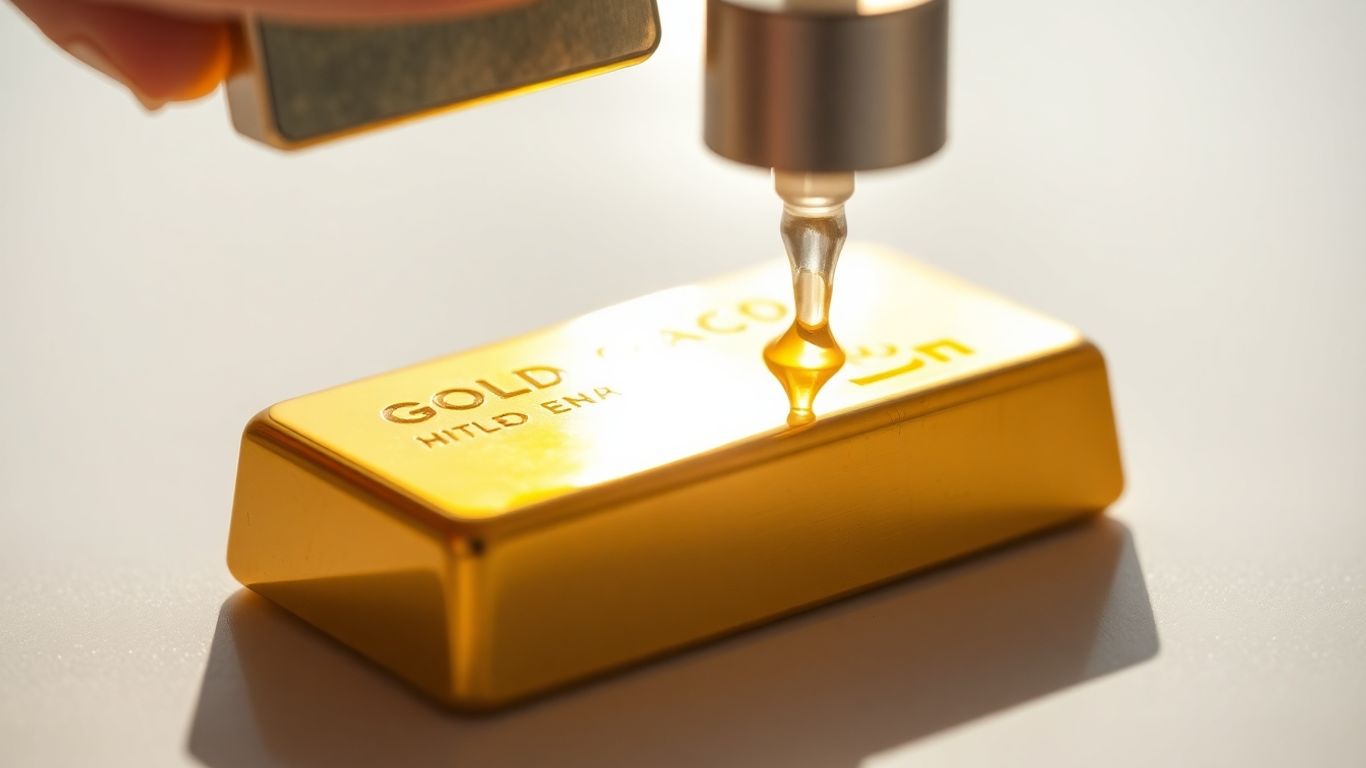
The nitric acid test is a fairly common method, especially among jewelers. The idea is simple: pure gold does not react with nitric acid, while other metals will. To perform the test, a small touchstone is generally used. You rub your gold object on it to leave a thin mark. Then, you place a drop of nitric acid on this mark. If the mark disappears or changes color, your object is not pure gold, or it is plated. If nothing happens, it's a good sign for its purity.
It is really important to be careful with nitric acid, as it is a corrosive product. It must be handled with gloves and safety glasses, and in a well-ventilated area. If you're not comfortable doing this, it's best to leave it to a professional.
The touchstone for an accurate evaluation
The touchstone, often used with acids, is a fairly standard tool in the trade. It's a dark stone, usually chrysolite or slate. When you rub your gold object on it, it leaves a thin line of metal. The color of this line already gives you an indication. Then, as I mentioned, specific acids are applied to this line. Each acid is designed to react with a particular alloy or purity of gold. By observing how the line reacts (or doesn't react) to different acids, the gold's purity can be determined with good accuracy. It's a method that requires some practice to interpret the results correctly, but it's very reliable when mastered.
The X-ray fluorescence spectrometer, a cutting-edge technology
For a truly in-depth analysis without damaging your object, the X-ray fluorescence (XRF) spectrometer is the best tool. This machine uses X-rays. When these rays strike the object, the metal atoms emit more X-rays in return, called fluorescent X-rays. Each chemical element has a unique signature of these X-rays. The spectrometer analyzes this signature to determine exactly which metals compose your object and in what proportions. It's incredibly precise, leaves no trace on gold, and provides a very detailed result on the exact composition. This is the method used by professionals to be 100% certain.
The importance of official hallmarks and markings
When you have a gold object in your hands, the first thing to do, even before thinking about testing it with a magnet or anything else, is to look for small markings on it. These markings are the hallmarks and stamps. They are extremely important because they give you direct information about the purity of the gold and sometimes even its origin. It's a bit like your jewelry's identity card.
Identify the different hallmarks on gold
Hallmarks are tiny engravings, often hidden. On a ring, it will be inside the band, on a necklace, near the clasp, or on the back of a pendant. You really have to look closely. In France, for example, if a gold piece of jewelry weighs more than 3 grams, it must have a hallmark. There are basically two types of hallmarks to know:
- The hallmark or guarantee mark: This stamp is affixed by customs and indicates the gold content. This is where you will see the purity ratings.
- The maker's mark or hallmark of responsibility: This is the jeweler's or importer's mark, often in the shape of a diamond. It allows you to identify who manufactured or imported the piece of jewelry.
Understanding the meaning of the markings
Now, what do these markings mean? This is where it gets interesting. They often use a carat system or numbers to indicate purity. Here are the most common ones:
- 24 carats (or 999, 24K): It's almost pure gold, 99,9% gold. It is sometimes recognized by a hallmark in the shape of a seahorse.
- 18 carats (or 750, 18K): This means that the gold is composed of 75% pure gold. The hallmark may resemble an eagle's head.
- 14 carats (or 585, 14K): Here, we have 58,5% pure gold. The hallmark could be a scallop shell.
- 10 carats (or 417, 10K): It is 41,7% pure gold.
- 9 carats (or 375, 9K): It is 41,7% pure gold.
It's important to know that the absence of a hallmark doesn't necessarily mean it's fake, especially for very old or handmade jewelry. But it should raise a red flag and prompt you to carry out further checks.
Hallmarks are your first clues. They don't lie about the declared purity, but beware, fake hallmarks exist. They're one piece of the puzzle, not the whole picture.
Check for certificates of authenticity
In addition to hallmarks directly on the item, some purchases, especially significant ones (like gold bars or valuable jewelry), come with a certificate of authenticity. This document is like a passport for your gold. It provides precise details about the purity, weight, and sometimes even the origin of the gold. When you buy something new, always ask for this certificate. It adds a layer of security and lets you know exactly what you have. It's further proof that the seller is honest and that the product matches the description.
When to call in an expert to confirm authenticity
After trying a few simple tests at home, you might still have doubts. That's perfectly normal. Gold can be deceptive, and counterfeits are becoming increasingly sophisticated. If you have serious doubts, or if the item in question has significant sentimental or financial value, it's strongly advised to consult a professional.
Consult a jeweler for a visual appraisal
The jeweler is often the first person to turn to, and that's a good idea. They have a trained eye and the basic equipment to examine your jewelry. They can check for hallmarks, examine the color and luster of the gold, and even use tools like a magnifying glass or a touchstone to get an initial assessment.
- Checking the punches: This is often the first clue. A jeweller knows how to recognize official hallmarks and their meaning.
- Visual examination: Consistency of color, absence of traces of corrosion or discoloration are important signs.
- Quick tests: It can perform non-destructive tests to confirm the nature of the metal.
Keep in mind that even a jeweler may not have the most advanced equipment. For definitive confirmation, especially on rare or valuable pieces, they can refer you to a specialist.
The services of a gemologist for a detailed analysis
If your gold coin contains precious stones, or if you are dealing with an antique or particularly complex object, a gemologist is the person to consult. They are experts in gemstones, but also in precious metals. They have more sophisticated tools to analyze the exact composition of your gold.
- Purity analysis: Techniques such as spectrometry are used to determine the exact gold content.
- Alloy identification: Understanding the other metals present and their proportions.
- Stone evaluation: If your gold jewelry is set with a gemstone, the gemologist can also estimate its value.
The benefits of a professional assessment
Consulting an expert, whether a jeweller or a gemologist, offers several significant benefits.
- Reliability: Professionals use proven methods and appropriate equipment, which guarantees accurate results.
- Peace of mind : Knowing for sure if your gold is genuine saves you a lot of trouble, whether for a sale, an inheritance or simply for your collection.
- Personalized advice: An expert can also give you information about the value of your piece, its history, or how to properly maintain it.
In short, if home tests leave you unsure, don't hesitate to entrust your item to a professional. It's the best way to get a clear answer and ensure the safety of your property.
Common mistakes to avoid during authenticity tests
Even with the best intentions, it's easy to fall into certain traps when trying to verify if an object is truly gold. Let's review the mistakes to avoid so you don't get scammed.
Don't rely on appearances alone
It's tempting, I know. A piece of jewelry that shines and looks substantial makes you think it must be gold. But beware, counterfeits are becoming increasingly sophisticated. Metals like brass or plating can be worked to look remarkably like real gold. Relying solely on what you see is a big risk. You should always go further and use other methods to confirm.
Avoid potentially destructive testing
Some tests, like the nitric acid test, can leave permanent marks on your item. If you have a family heirloom or a valuable object, you wouldn't want to mark or damage it, would you? There are plenty of methods that leave no trace. Always choose these, especially if you're unsure of what you're doing. A less precise test that preserves your item is better than a test that leaves no trace.
Understanding the weight and density of gold
Gold is a metal with a certain presence, you know? It's known for being quite dense. That means that for the same volume, gold weighs more than many other metals. It's one of its main characteristics, and it can help us verify if what you have in your hands is indeed gold.
Gold, a dense and heavy metal
Imagine you take a small box filled with feathers and another of the same size filled with lead. The lead box will be much heavier, won't it? It's a similar principle with gold. Its density is about 19,3 grams per cubic centimeter (g/cm³). That's quite high! To give you an idea, iron is around 7,8 g/cm³ and lead, which is already quite heavy, is about 11,3 g/cm³. This difference in weight for the same volume is an important indicator.
The density test with a densimeter
To perform this test at home, you'll need a few supplies, but the idea is simple. Measure the weight of your gold object, then measure its volume in water. The formula is: Density = Mass / Volume. If you have precise scales and a graduated container, you can try it. Weigh your object, then submerge it in water and observe how much the water level rises (this is the displaced volume). Then, calculate the density. If the result is close to 19,3 g/cm³, that's a good sign. Note that this test works best if the object is solid gold and not hollow; otherwise, it will skew the results.
The limitations of weight-based tests
Okay, this density test is pretty good, but it has its limitations. First, you need to be quite precise with the measurements. A small error in weighing or reading the volume can give a misleading result. Also, some alloys or metals have a density close to that of gold. For example, some tungsten alloys can be very dense. So, if your object is hollow or made of a very specific alloy, this test alone might not be enough to give you a definitive answer. That's why it's always a good idea to combine several methods or consult a professional if you have any doubts.
You might be wondering why gold is so heavy for its size? It's a matter of density Gold is a very dense metal, meaning that a small amount weighs a lot. This is one of the reasons why it is so valuable. If you want to learn more about the fascinating properties of gold and how this affects its value, visit our website to discover all our guides!
In short: Is your gold really gold?
There you have it, you now have a few tips to check if the gold you're holding is genuine. Whether you use simple methods at home, like the magnet or ceramic test, or by looking for hallmarks, you have a good starting point. Remember, these tips are helpful, but if you have any doubts whatsoever, it's best to consult a professional. This will save you a lot of trouble and ensure you're dealing with genuine gold. After all, it's better to be absolutely certain when it comes to gold, isn't it?
Frequently Asked Questions
How can I tell if my jewelry is gold without going to a professional?
There are several simple tricks. For example, gold isn't attracted to magnets. If your jewelry sticks to a magnet, it's probably not pure gold. You can also rub the jewelry on unglazed ceramic: a gold mark indicates gold, a black mark, a fake. Wearing the jewelry can also help: if your skin turns green, be wary!
Is the acid test dangerous for my gold?
The acid test is effective, but extreme caution is necessary. It uses chemicals that can damage or discolor your jewelry if it's not pure gold. It's often safer to leave this test to experts who know how to use it safely.
What do the small symbols engraved on the gold mean?
These small symbols are called hallmarks. They're like an ID card for gold. They indicate its purity (how much pure gold it contains) and sometimes its origin. Look for markings like '24K' or '999' for very pure gold. If you don't see them, it doesn't necessarily mean it's fake, but it's worth checking further.
When should I really consult an expert?
If you have any doubts after performing a few simple tests, or if the item is of great value to you, it's always best to seek the advice of a professional. A jeweler or expert will be able to use more precise tools to tell you exactly what you have in your hands.
Can I trust gold based solely on its appearance?
Appearances alone can be deceiving. Counterfeiters have become very skilled at imitating gold. Even if a piece of jewelry looks perfect, it's important not to rely solely on its appearance and to carry out some tests to ensure its authenticity.
Why is gold considered a good investment?
Gold is seen as a safe haven, especially during times of economic crisis. It tends to retain its value when other assets lose it. Furthermore, in some countries like France, purchasing investment gold is not subject to VAT, making it financially attractive.
