
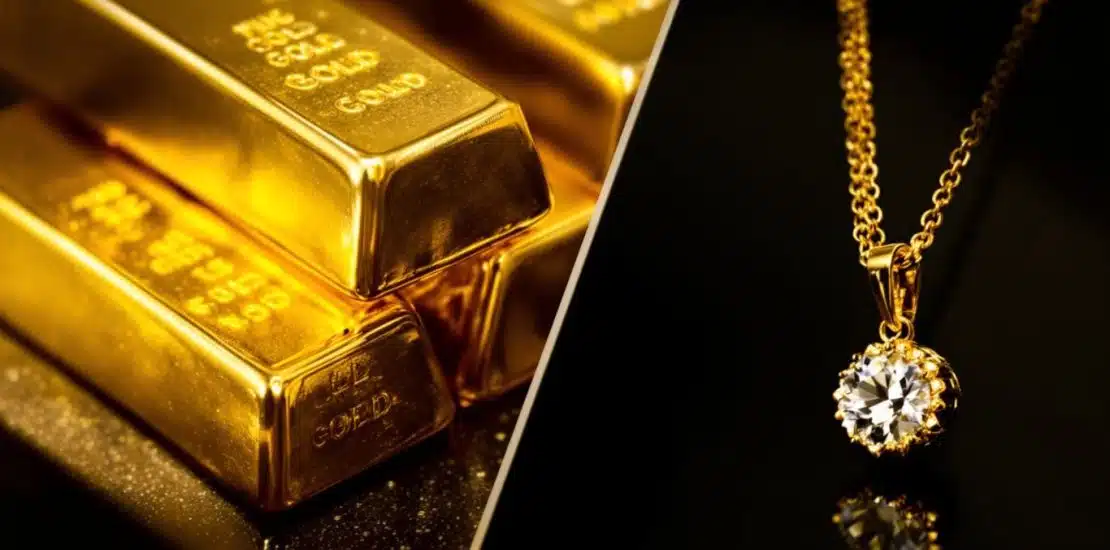
We often think of gold as just gold, but in reality, there are significant differences between the gold we buy as an investment and the gold we use to make jewelry. These distinctions change everything: their value, how they're used, and even how they're taxed. It's a good idea to understand this before deciding where to put your money or which piece of jewelry to choose. Let's take a look at what makes them so different, so you can make the right choice.
What you must remember
- Investment gold is primarily used to make your money grow, while jewelry gold is designed to be worn and appreciated for its beauty.
- The purity of investment gold is very high (often 99,99%), while jewelry gold is usually alloyed with other metals to make it stronger and change its color.
- The value of investment gold is mainly linked to its weight and the world market price, while that of jewelry gold also includes the design, the work of the craftsman and any stones.
- Reselling investment gold is often simpler and faster because its price follows clear standards, unlike jewelry which can be more difficult to evaluate.
- The choice between the two depends on your goals: protecting your capital with investment gold, or owning a beautiful object with jewelry gold.
Understanding the fundamental distinctions between investment gold and jewelry gold
It's easy to think of gold as just gold, but in reality, there are important differences between the gold you buy for investment and the gold you use to make jewelry. These distinctions affect their value, their usefulness, and even how they're treated for tax purposes. Understanding these points is the first step in knowing which one is best for you.
Investment gold: a financial asset dedicated to capital preservation
When we talk about investment gold, we immediately think of gold bars and coins. This type of gold is primarily an investment. Its main objective is to protect your savings, especially when the economy is going through difficult times or when inflation is soaring. It's a bit like tangible insurance for your money. The value of this gold is directly linked to its weight and its purity, which is generally very high, often 99,99%. We are talking here about certified gold, such as gold that meets the standards of the LBMA, guaranteeing a minimum quality of 99,5% pure gold.
- Primary objective : Preserve capital and protect against inflation or crises.
- Common forms: Ingots (from a few grams to several kilos) and recognized investment coins (such as the Napoleon or the Maple Leaf).
- Purity: Very high, usually 999,9‰ (24 carats).
- Value : Mainly determined by the world gold price and weight.
Investment gold is a physical asset that has a globally recognized intrinsic value, independent of fluctuations in traditional financial markets.
Jewelry gold: a consumer good focused on aesthetics and wearability
Jewelry gold is the gold you wear every day or on special occasions. It is designed to be beautiful and durable. To achieve this, it is often mixed with other metals such as copper or silver. This is called an alloy. These mixtures allow for different colors (yellow gold, rose gold, white gold) and, above all, improve the hardness of the metal, which is essential for making jewelry that must withstand normal wear and tear. The value of a piece of gold jewelry depends not only on the weight of gold it contains, but also on the craftsmanship, the design, the possible presence of precious stones, and the brand.
- Primary objective : Aesthetics, decoration, personal wear.
- Common forms: Rings, necklaces, bracelets, earrings, etc.
- Purity: Variable, most often 18 carats (750 thousandths, or 75% pure gold) or 14 carats (585 thousandths).
- Value : Composed of the value of the metal, the craftsmanship, the design and any stones.
Investment gold: characteristics and advantages
Purity and certification: the guarantees of the value of investment gold
When it comes to investment gold, the first thing that matters is its purity. We're looking for the purest gold possible, generally 999,9 thousandths, which means it's made of 99,99% fine gold. It's this purity that guarantees its value on the international market. To ensure you're buying investment-grade gold, you need to look at the certification. Recognized bullion bars and coins are minted by refiners or mints that adhere to strict standards, such as those of the LBMA (London Bullion Market Association). Each bar must have a certificate of authenticity that states its weight, purity, serial number, and the refiner's name. It's a bit like an identity card for your gold, reassuring you that it is what it claims to be.
Liquidity and ease of resale: major advantages for the investor
One of the great advantages of investment gold is that it's relatively easy to resell. Unlike jewelry, which may have sentimental value or a very specific design, gold in the form of bars or recognized coins has a value that depends directly on its weight and purity. There's a well-established global market for these products. You can sell them fairly quickly, whether to specialized professionals, banks, or even other individuals. The price is generally transparent, as it is directly linked to the Gold prices of the moment. This is a significant advantage if you ever need to get your money back quickly. Think of it as having a universal currency in your vault.
Favorable taxation for investments in physical gold
In France, investing in physical gold, whether in the form of ingots or investment coins, benefits from a rather attractive tax system. Simply put, when you buy it, you don't have to pay VAT on investment gold. That's already a significant saving. Then, when you decide to resell it, you generally have the choice between two tax regimes: either a flat-rate tax on precious metals, or taxation on the actual capital gain if you can prove the date and purchase price. This second regime is often more advantageous if you have kept your proof of purchase and the gold has appreciated in value. It's important to find out the exact conditions, as they can change, but overall, it's a positive point for those looking to protect their capital over the long term.
Investment gold is, above all, a tangible asset that serves as a safe haven. Its purity, certification, and ease of resale make it an attractive investment for diversifying one's assets and protecting oneself against economic uncertainties.
Jewelry gold: beyond the precious metal
The added value of craftsmanship and design
When you think about jewelry gold, it's important to understand that you're not just buying a metal. It's a bit like comparing a basic building block to a sculpture. Jewelry gold is first and foremost a story of style, creativity, and craftsmanship. A piece of jewelry can be a work of art. The price you pay depends not only on the weight of the gold, but also on the complexity of the design, the work of the artisan who crafted it, and sometimes even the brand selling it. Think of a finely crafted ring or a necklace with intricate details; all that labor comes at a cost, and it adds significant value beyond just the raw material. It's what makes each piece unique and special.
Alloys and their impact on purity and color
The gold you find in jewelry is almost never 100% pure gold. Why? Because pure gold (24 karat) is very soft and easily deformed. To make it stronger and give it different colors, it is mixed with other metals. This is called an alloy. For example, to obtain yellow gold, pure gold is mixed with copper and silver. To obtain rose gold, the proportion of copper is increased. White gold is often alloyed with palladium or nickel.
Here's how that translates to purity:
- 24 carat gold (99,9% pure gold) : This is the purest gold, often used for investment, but too soft for most jewelry.
- 18 carat gold (75% pure gold) : This is the most common in jewelry. It offers a good balance between purity, strength and color.
- 14 carat gold (58,5% pure gold) : Less expensive, it is also more resistant but contains less gold.
- 9 carat gold (37,5% pure gold) : Less common in some countries, it is more affordable but its gold content is low.
The color of gold therefore depends directly on the metals added to the alloy, and the purity is indicated by the number of carats.
The Limits of Jewelry Gold as a Pure Investment
If you're looking to invest your money, fine gold isn't always the best choice. Its value is much more related to its aesthetic appearance and brand than to its intrinsic value as a precious metal. When you buy a piece of jewelry, you're also paying for the design, the stone (if any), and the craftsmanship. If you decide to resell it, you'll have a hard time recouping the purchase price, as the buyer will often only pay you the value of the gold content, less melting and transaction fees. It's a bit like buying a classic car: you pay for the history and style, but when you resell, you mostly get back the value of the materials. Investment gold, on the other hand, is judged solely on its purity and weight, making it much more liquid and easier to resell at market value.
How to choose between investment gold and jewelry gold
So, how do you make the right choice between these two forms of gold? This is a question many people ask, and the answer really depends on what you're looking to achieve. It's not just a matter of whether you prefer a bar or a necklace, but rather understanding your own goals.
Evaluating your personal goals: savings or pleasure?
The first thing to do is ask yourself the right questions. Is your main goal to set aside money for the future, to protect yourself against inflation, or are you looking for a beautiful object to wear, something with sentimental value? If financial security and the preservation of your capital are what matter most to you, then investment gold, such as bars or certified coins, will probably be your best option. These products are designed to be a store of value. On the other hand, if you have a crush on a piece of jewelry, if you want something that reminds you of a special moment or complements your style, jewelry gold is for that. It's a bit like choosing between life insurance and a work of art: both have value, but not for the same reasons.
Consider purity, liquidity and taxation
When it comes to gold, purity is super important. Investment gold—you know, the recognized bars and coins—is generally very pure, often 99,99%. This purity is what guarantees its value on the global market. Jewelry gold, on the other hand, is often mixed with other metals like copper or silver. This makes it more durable for everyday wear and allows for different colors, like rose gold or white gold. But as a result, its purity is lower. This impacts its intrinsic value as a precious metal.
Liquidity is the ease with which you can resell your gold. Bullion bars and investment coins are generally easier to resell. There's a well-established market for them, and the price is directly linked to the gold price. Jewelry is a different story. You need to find a buyer who appreciates the design and craftsmanship, and often, you'll have to accept a lower price than what you paid. Consider this if you might need to get your money back quickly. In France, buying investment gold also benefits from often more favorable tax regimes, including VAT exemption on purchase. This is a significant advantage for an investment.
The importance of expertise for an informed purchase
No matter your choice, it's always a good idea to seek advice. If you're just getting started with investing, talking to a professional can help you understand the different types of bars or coins, the guarantees to check, and how the market works. For jewelry, a good jeweler can advise you on the quality of the gold, the alloys, and the value of the craftsmanship. Don't hesitate to compare prices and research the reputation of the sellers. Having expert guidance ensures you're making an informed purchase, whether it's to secure your savings or to treat yourself to a beautiful piece of jewelry. For example, you can consult the investment gold coins at the best price to get an idea of the products available.
The gold market and its influence on prices

The gold market is a bit like a large stock exchange, but with a metal that has fascinated humanity for millennia. Its value isn't fixed; it's constantly changing, influenced by many factors. Understanding these mechanisms is already a good step toward knowing whether you're buying gold as an investment or just for fun.
Factors determining the price of gold
Several elements play a role in fixing the gold priceThink of it like a recipe: every ingredient counts.
- Inflation: When the prices of goods and services rise, your money loses value. Gold, on the other hand, tends to hold up well during these times. That's why it's called a safe haven when the economy is booming.
- Interest rates: If central banks lower their rates, investing money in bonds or savings accounts becomes less profitable. As a result, gold may seem more attractive.
- The geopolitical situation: International tensions, wars, or political crises can make investors nervous. At such times, many turn to gold, considering it a safer asset.
- Supply and demand : As with anything, if more people want to buy gold than is available, the price rises. Conversely, if mines produce a lot and demand is low, the price can fall.
The price of gold is fixed twice a day in London, an important meeting for market professionals.
The impact of world events on the value of gold
Gold has the unique characteristic of being recognized all over the world. This means that events happening far away can still have an effect on the price here. Consider the COVID-19 pandemic, for example. Many people sought to secure their wealth, and demand for gold surged, driving up its price. It's truly a barometer of global economic concerns.
Predictions for the future of physical gold
Predicting the future is always complicated, especially with gold. But we can imagine a few scenarios:
- A price increase: If inflation continues to rise or new crises erupt, gold could well increase in value.
- A drop in prices: If the global economy stabilizes and interest rates rise, gold could become less attractive relative to other investments.
- A period of stability: It is also possible that supply and demand will remain balanced, keeping the price of gold relatively constant.
It is therefore important to follow economic and geopolitical news to best anticipate market movements.
Practical aspects of buying and reselling gold
Where to buy investment gold safely
When you decide to buy physical gold, whether in the form of bars or coins, several avenues are open to you. You can turn to your usual bank, which offers some peace of mind, but beware of fees, which can sometimes be a little higher. Another option is brokers specializing in precious metals. They often have in-depth knowledge of the market, but it's really important to check their reputation and reliability before committing. The internet is also full of online platforms, which are useful for comparing prices, but caution is advised to avoid the weak points. Always compare prices and additional fees before making your choice.
- Banks: Appreciable security, but potentially higher costs.
- Specialized brokers: Market expertise, but check their reliability carefully.
- Online platforms: Convenient for comparison, but beware of scams.
Gold resale procedures: simple and quick
Selling your gold may seem complicated, but it's often simpler than you think, especially for investment gold. For bars and coins, transactions are generally straightforward. You can contact professionals like brokers, banks, or specialized counters. They will estimate your gold based on the current price and its purity. For jewelry, it's a little different. Its value isn't just about the weight of the gold. The design, the brand, and the overall condition all count. It's therefore often a good idea to have your jewelry appraised before selling it to ensure you get the best possible price.
It is essential to keep all documents related to your gold purchases safe and sound. These documents greatly facilitate resale and prove the origin of your metal.
The importance of certification and traceability
The certificate of authenticity is like your gold's identity card. It guarantees its purity, its weight, and its origin. Without this document, it can become difficult to prove the value of your gold and resell it under good conditions. Traceability is also an important point, especially for gold you buy as an investment. This ensures that the gold comes from reliable sources and is not linked to questionable activities. Keep these documents safe; they are your best allies.
Here is a brief summary of the documents that are important:
| Document | Utility |
|---|---|
| Certificate of authenticity | Proves the purity, weight and origin of gold. |
| Invoice | Justifies the acquisition and can help with tax calculations. |
| Expertise (jewelry) | Evaluates the value of the jewelry's design, brand, and overall condition. |
To successfully buy or sell gold, you need to know the basics. It's like learning to ride a bike: a little practice and you'll get there! We'll explain how it works, so you're comfortable. Want to know how? sell your old jewelry or coins It's easy! Come discover on our website how to quickly and safely turn your gold into cash. Don't wait any longer, visit our website to find out everything!
So, which gold should you choose?
So, now you know what really distinguishes investment gold from jewelry gold. One is designed to protect your assets, the other to enhance your daily life. The choice will therefore depend on your personal goals. If you're looking to secure your savings, investment gold, with its purity and liquidity, will be your ally. If it's pleasure, a symbol that you're looking for, then jewelry will satisfy you. Think carefully before making your purchase, and don't hesitate to ask for advice if necessary.
Frequently Asked Questions
What is the main difference between investment gold and jewelry gold?
Investment gold, such as bars and coins, is primarily purchased for investment purposes. It is generally very pure. Jewelry gold, on the other hand, is used to make jewelry. It is often mixed with other metals to make it stronger and come in different colors. Its value also depends on the style and craftsmanship of the craftsman.
Is investment gold a good way to invest your money?
Yes, investment gold is often considered a safe bet, especially during times of economic instability or rising prices (inflation). It can help protect your money over the long term and balance your other investments.
How do you calculate the value of a gold jewel?
The value of a piece of gold jewelry isn't based solely on its weight. It takes into account the purity of the gold (indicated in carats, for example, 18 carats means 75% pure gold), but also the design of the jewelry, the craftsmanship of the craftsman who created it, and whether it contains precious stones. This is more complex than for investment gold.
Are there different taxes for investment gold and jewelry gold?
In France, purchasing investment gold is often exempt from VAT, making it more financially attractive. Gold jewelry, on the other hand, may be subject to various taxes, including standard VAT.
Is it easier to resell investment gold or gold jewelry?
Generally speaking, yes, it's easier to resell investment gold. Its price is set by the global market, and it's easy to determine its value. Reselling jewelry can be more complicated because you have to find a buyer who appreciates its style and craftsmanship, and its price can vary more.
How do I know if I should buy investment gold or gold jewelry?
It depends on what you want to do! If your main goal is to grow and protect your money, investment gold is more suitable. If you're looking for a beautiful piece to wear, with sentimental and aesthetic value, then gold jewelry will be a better choice. Think carefully about what's most important to you.
