
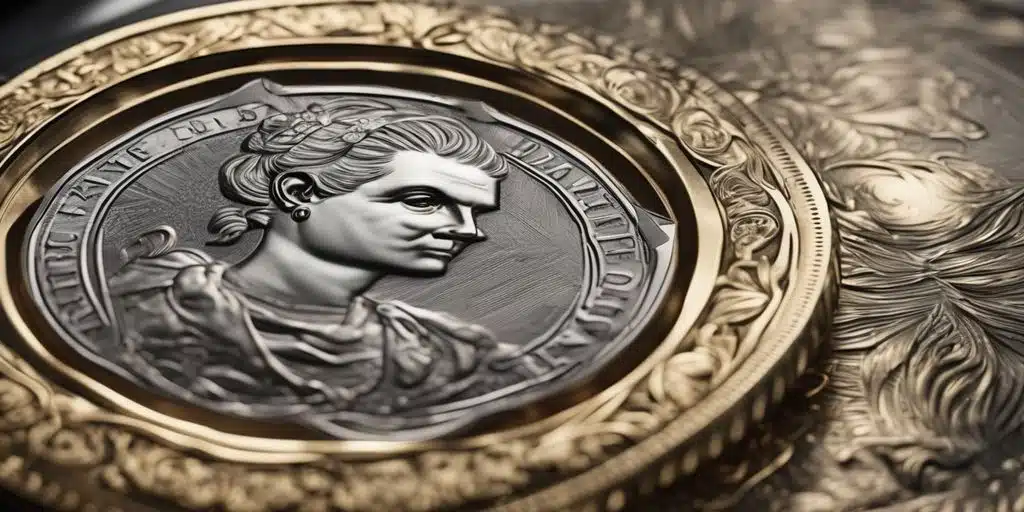
The art of coin engraving is a centuries-old tradition that has withstood the ravages of time and industrialization. At the Monnaie de Paris, master engravers perpetuate a unique know-how, combining ancestral techniques and modern innovations. This article explores the fascinating world of these exceptional artisans and their heritage.
Key points
- The Paris Mint has managed to preserve the art of engraving despite industrialization.
- Master engravers use traditional tools to create unique pieces.
- Each engraver leaves his personal mark, a distinctive signature on the pieces.
- Engraving errors, often due to working in negative, can have significant consequences.
- The transmission of know-how is essential to maintain the quality and authenticity of the engraving.
The engraving workshop of the Paris Mint

A place preserved despite industrialization
Despite industrialization and mechanization, the Monnaie de Paris has been keen to preserve the art of engraving. A workshop is dedicated to master engravers whose mission is to make and develop tools that will subsequently be used to strike coins, medals, but also decorations and jewelry. Over the years, thanks to its coins and punches, the Paris Mint was able to create the “Paris Mint style”.
The Master Engraver's Tools
The tools used by master engravers are varied and specialized. They include burins, chisels, and gravers, each with a specific function in the engraving process. These tools allow for extreme precision, essential for creating detailed designs on coins.
The Paris Mint style
The “Monnaie de Paris style” is renowned for its finesse and elegance. This unique style has been developed over the years thanks to the expertise of master engravers and the use of traditional techniques. Each part produced in this workshop is a testament to the know-how and heritage of the Monnaie de Paris.
The iconic master engravers

Joaquin Jiménez: A Living Legacy
Joaquin Jimenez is undoubtedly one of the master engravers the most influential of our time. His work at the Monnaie de Paris is recognized worldwide, and he continues to pass on his expertise to new generations. His creations are often marked by unparalleled finesse and precision, making him a true artist in the field of coin engraving.
Jean-Luc Maréchal: the father of the 10 franc genius
Jean-Luc Maréchal is famous for having designed the 10 franc coin known as the “genius”. This coin, emblematic for many numismatists, is a perfect example of the art of engraving. Maréchal was able to capture the essence of the era while adding his own personal touch, making it a work of art in its own right.
Jean-Pierre Gendis and his career
Jean-Pierre Gendis had an exceptional career as an engraver. He worked on numerous coins, each bearing his single signature. His distinctive style and attention to detail made him a fixture in the world of printmaking. Gendis was also a mentor to many young printmakers, generously sharing his expertise and techniques.
Engraving techniques

The art of reverse inculpation
Before embarking on the engraving of his punches, the engraver, cautiously, drew marks on the smooth end of the future die with a compass and ruler. Circles and straight lines, called guide lines, thus allowed the engraver to determine in advance the exact position of each element placed according to a well-balanced composition. The engraving of these marks was shallow, so that they would quickly disappear with the programmed wear of the die. However, it may happen that the marks of these marks are still visible on certain old and collectible French coins.
Punches and corners
Punches and dies are essential tools in the art of engraving. The engraver uses punches to create raised designs on the die, which is then used to strike the coins. Each punch is meticulously crafted to ensure maximum precision. The dies, on the other hand, are made of hardened steel to withstand the pressure of striking. The importance of these tools cannot be underestimated, as they determine the final quality of the part.
Direct cutting in steel
Direct steel carving is a demanding technique that requires great skill. The engraver works directly on a block of steel, carving the design in reverse so that it appears right side up on the struck coin. This method allows for great precision and an exceptional level of detail. However, it is also very risky, as a mistake can be difficult to correct. This is why this technique is often reserved for the most experienced engravers.
Coin engraving is an art that combines tradition and innovation. Each technique, whether ancient or modern, contributes to the richness and diversity of this unique craft.
Engraving errors

The challenges of working in the negative
To add to the difficulty of the engravers' work, let us recall that the punches had to be engraved upside down! Yes, the die had to be engraved in hollow and upside down, like a sort of negative, in order to print the metal in relief and on the right side: the coin was, so to speak, the positive print of the die. The engraver's attention had to be constant, any relaxation was inevitably punished by an error…
The consequences of mistakes
Rare engraving defects presented above are still too often neglected. However, they can offer the most observant collectors a range of sometimes colorful oddities. Above all, they constitute revealing clues to the gestures and know-how of yesteryear, essential to fans of the history of techniques, experts in experimental archaeology or fans of living history...
Anecdotes of engravers
The bunch, receiving the hammer blows, was damaged more quickly. This is why engravers often had to make four or five, or even six bunches for a pile. A faulty die was rejected and had to be redone by the engraver (at his own expense!). Then, the attention of the guards is not the only reason for the rarity of engraving errors observed today. Indeed, in some cases, engravers could correct their error without having to recast the die and start all over again. To do this, they reheated the dies and inscribed the correct punch on the incorrect one. This was the same technique used for updating the vintages.
The symbols and signatures of the engravers

The Evolution of Personal Brands
From the Renaissance onwards, coins no longer bore only the symbols of the king. Behind each of these small metal works lies an artist, who is less and less discreet. Engravers began to add personal symbols constituting their signature. These personal marks have evolved over the centuries, reflecting the individuality and style of each master engraver.
The differences between workshop masters
The master or engraver's marks initially took the most varied locations and forms, sometimes combining with the workshop mark. From the 16th century, they were generally placed at the end of the reverse legend, before the possible year. Since 1880, the cornucopia symbolizing the Paris Mint has replaced the director's mark. These practices are still in force today.
The cornucopia and other symbols
Since 1880, the cornucopia symbolizing the Monnaie de Paris has been engraved on the exergue of the coins. In addition, the signature of the engraver who created the type imprinted on the coin is also reproduced. These symbols provide a visual guarantee of the authenticity of the coins, a bit like the watermarks on our current banknotes.
Engravers play a vital role in the long technical process of monetary production. They bear personal responsibility to ensure the quality of their work.
The transmission of know-how

Advice from the Elders
Training engravers and passing on their know-how is a bridge between the past and the future. It is not just about transmitting skills; it is also a transmission of passion. Elders share their tips and secret techniques, often passed down from generation to generation.
Interview with the General Engraver
The interview with the General Engraver is a special moment for young engravers. They can ask questions, get personalized advice and understand the subtleties of the profession. It is a unique opportunity to immerse themselves in theexperiment and the wisdom of the masters.
The influence of predecessors
Predecessors have left an indelible mark on the art of engraving. Their works and techniques continue to inspire new generations. The Monnaie de Paris has set up a program to transmit and teach these trades to younger people, thus ensuring the sustainability of this ancestral know-how.
Conclusion
Ultimately, the art of coin engraving is much more than just a craft; it is a true tradition that is passed down from generation to generation. Despite technological advances and industrialization, the Monnaie de Paris has preserved this unique craft, allowing master engravers to continue to express their talent and creativity. Each coin, each medal, each decoration is the result of meticulous and passionate work, where every detail counts. When visiting the engraving workshop, one cannot help but be amazed by the richness of this heritage and by the passion that drives these artists. It is this passion and know-how that have made the Monnaie de Paris famous and that will continue to inspire future generations.
Frequently Asked Questions
What is the Paris Mint engraving workshop?
The engraving workshop of the Monnaie de Paris is a preserved place where master engravers make tools to strike coins, medals, decorations and jewelry.
Who is Joaquin Jimenez?
Joaquin Jiménez is the General Engraver of the Paris Mint, recognized for his legacy and significant contributions to the art of engraving.
What tools do master engravers use?
Master engravers use dies and punches to create raised designs on coins.
What are common mistakes in engraving?
Common errors include flaws in the reverse insculpation, which can result in incorrect designs on coins.
What symbols are used by engravers?
Engravers use personal marks, such as the cornucopia, to sign their works and guarantee their authenticity.
How is know-how transmitted at the Monnaie de Paris?
The know-how is transmitted through the advice of elders, interviews with the General Engraver, and the influence of predecessors. /vc_column_text] stm_sidebar sidebar=”16284″] /vc_column] vc_column width=”1/4″]
