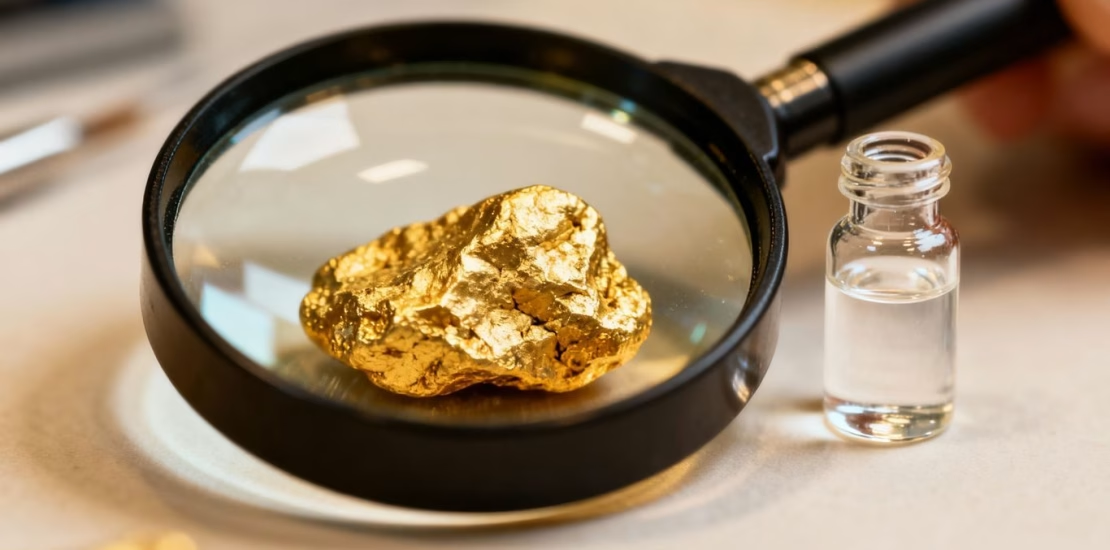
Perhaps you have an antique piece of jewelry lying around in a drawer, or you're considering investing in gold. In any case, you're probably wondering: How can I check the purity of gold at home? It's a legitimate question, as the value of gold depends directly on its purity. Fortunately, there are several methods, from the simplest to the most technical, to help you get a clearer picture without necessarily going through a professional.
Key Takeaways
- Use simple methods like the acid test or density test for a first idea of the purity of your gold.
- More advanced techniques such as X-ray fluorescence or mass spectrometry exist for more in-depth analysis, often used by professionals.
- For home testing, acid kits and precision scales are useful tools.
- If you have any doubt or if the value is significant, consulting a certified expert remains the best guarantee.
- Understanding the different grades of gold (carats) helps you to better interpret the results and assess the true value of your asset.
Traditional methods for assessing the purity of gold
Before embarking on complex analyses, be aware that there are fairly simple ways to get a first idea of your gold's purity. These techniques, used for a long time, don't require sophisticated equipment and can often be performed at home. They give you an indication, but keep in mind that they don't replace a professional appraisal for absolute certainty.
The acid test for an initial check
This is a fairly well-known method that relies on the chemical reaction of gold with various acids. The idea is to rub a small part of your gold object on a touchstone (an unpolished black stone). This will leave a thin trace of metal. Then, you apply a drop of a specific acid, chosen according to the gold content you suspect. If the trace remains intact and doesn't change color, that's a good sign. If it disappears or changes hue, it indicates that your gold isn't as pure as you thought, or that it's another metal.
- For 10 carat gold: Use diluted nitric acid.
- For 14 carat gold: Use nitric acid mixed with antimony chloride.
- For 18 carat gold: Use nitric acid mixed with hydrochloric acid (aqua regia).
- For 22 carat gold: Use pure nitric acid.
Be careful with acids; they can be corrosive. Wear gloves and work in a well-ventilated area.
Understanding the gold density test
Gold is a very dense metal. Its density is approximately 19,3 grams per cubic centimeter for pure gold (24 karats). This physical property allows it to be distinguished from other metals that may resemble it but are less dense. To perform this test, you will need a precision scale and a container filled with water.
- Weigh your gold object in the air. Note this weight.
- Next, submerge the object in water (without it touching the sides) and weigh it again. It will feel lighter due to Archimedes' principle.
- Calculate the density using the formula: Density = Weight in air / (Weight in air – Weight in water).
If the result is close to 19,3 g/cm³, there's a good chance you're dealing with pure gold. If the density is significantly lower, this suggests the presence of other, less dense metals.
Use household products for a quick test
Some everyday products can provide a quick indication, although less reliable than the previous methods. For example, white vinegar. Apply a few drops to your object. If the color changes rapidly, it's likely not pure gold. Another trick is to observe the reaction with bleach. If the object turns black, it's a sign of poor quality or the presence of other metals. These tests are very basic and mainly serve to eliminate the most obvious fakes.
These traditional methods are a good starting point to get a general idea. They are accessible and don't require expensive equipment. However, for an accurate appraisal, especially if you have valuable items, it's always best to use more modern techniques or consult a professional.
Modern techniques for precise gold analysis
While traditional methods can give you a general idea, to truly know what you have, you sometimes need to take things to the next level. Fortunately, technology offers some truly impressive tools for analyzing gold with remarkable precision. Forget about tests that risk damaging your item; these techniques are designed to give you clear answers without causing any harm.
X-ray fluorescence analysis for non-destructive evaluation
It's a bit like taking a picture of your gold's composition, but with X-rays. The device shines these rays onto the object, and in return, it receives a signal telling it which elements are present and in what quantity. The main advantage? It's completely non-destructive. No need to scrape or cut. In just a few minutes, you get a fairly accurate analysis of your gold's purity. It's incredibly convenient for checking jewelry or small coins without any risk. The results are usually displayed as a percentage, giving you a clear idea of the pure gold content.
Mass spectrometry, a detective's tool for gold
Imagine a highly sophisticated, yet miniaturized, analytical laboratory. Mass spectrometry is a bit like that. A tiny sample is taken (truly minuscule, invisible to the naked eye), transformed into ions, and then sorted according to their mass. It's like a highly selective sorting process that allows for the identification of each element present and its exact concentration. It's an extremely reliable method, often used to confirm the purity of large batches of gold or for very precise analyses. It can detect minute impurities that other methods might miss. It's truly the detective's tool for gold.
Using a spectrometer to measure purity
When we talk about spectrometers in this context, we often think of portable devices that analyze the surface of gold. They work a bit like optical readers. You apply a conductive gel to the area to be tested, then you pass the device's probe over it. The metal reacts to an electric current, and the device interprets this reaction to give you a purity reading. It's quick and fairly easy to use, but be aware that it primarily measures the composition of the surface layer. For in-depth analysis, you need to combine this with other methods or use more advanced techniques like X-ray fluorescence. It's a good intermediate step for a quick check at home or in a small shop.
These modern technologies are incredible because they allow you to obtain precise information about the composition of your gold without having to degrade it. This is a real advantage for those who want to be sure of the quality of what they own or are about to buy. Remember to check the hallmarks on your coins, but these modern methods will give you a much more reliable confirmation.
Choosing the right tools to test the purity of gold
To determine if your gold is truly pure gold, you need to use the right tools. It's not that complicated, but you need to know what you're looking for.
Acid kits and their applications
Acid testing kits are a fairly classic method, the kind you often see in movies or old shops. They're quite affordable and can give you a good idea of the purity, especially if you're dealing with jewelry or small items. The idea is to rub your object on a special stone, called a touchstone, to leave a small mark. Then, you apply a drop of acid to this mark. Each acid in the kit corresponds to a different gold purity (for example, 10 karat, 14 karat, 18 karat, etc.).
- If the trace remains intactThis means that your gold is at least of the purity corresponding to the acid used.
- If the mark disappears or changes colorThis means that your gold is of a lower purity or that it is not gold at all.
- If you use acid for 24-karat gold and the trace does not changeCongratulations, you probably have very pure gold!
You have to be careful with acids, of course. Wear gloves and work in a well-ventilated area. It's a method that requires a little practice to interpret the results correctly, but it's effective for an initial check.
The importance of precision balances
When it comes to purity, weight is extremely important. That's where a good precision scale comes in. We're not talking about kitchen scales; no, you need something much more precise, capable of measuring to the milligram. Why? Because the density of gold is very specific. By weighing your object in air, then in water, and using a simple formula, you can calculate its density. If this density is close to that of pure gold (approximately 19,3 g/cm³), that's a good sign. A precise scale is therefore essential for density tests and to verify the exact weight of your gold.
Here's what it looks like:
| Tool | Main utility |
|---|---|
| Precision scale | Measure the exact weight (to the milligram) for density calculations or weight verification. |
| Touchstone | Allows a trace of gold to be left for the acid test. |
| Acid kit (various compounds) | Testing the resistance of gold to specific acids. |
Professional spectrometers for in-depth analysis
If you want to be absolutely certain, or if you have significant quantities of gold to test, spectrometers are the way to go. These are more sophisticated devices, often used by professionals. They work by analyzing how gold reacts to different forms of energy, such as X-rays (this is X-ray fluorescence) or other types of light. They can identify the metals present and their proportions with great precision, without even having to touch or damage the object. It's a non-destructive method, which is a major advantage, especially for collectibles or valuable jewelry. It's an investment, certainly, but for complete peace of mind, it's worth considering.
Using the right tools is like having the right keys to open a door. Without the right keys, you risk getting stuck or, worse, damaging the lock. With gold, the right tools give you certainty about its value and purity.
Call on an expert for a reliable assessment
Even if you've tried several methods at home, there comes a time when you need professional confirmation. That's where the expert comes in.
How to find a certified precious metals expert
Finding the right person to appraise your gold is a bit like looking for a needle in a haystack, but it's doable. First, check with reputable jewelers in your area. They often have the tools and expertise for this. You can also look for gemologists or precious metals experts with recognized certifications. Sometimes, banks or companies specializing in buying gold also offer this service. Don't hesitate to ask around; a friend or family member may have already used a professional.
- Check the certifications (for example, those recognized by professional associations).
- Read online reviews to get an idea of customer satisfaction.
- Ask for recommendations from trusted individuals.
The benefits of professional expertise
Why pay someone when you can do it yourself? Well, an expert makes all the difference. They have equipment you don't have at home, like spectrometers, which give incredibly precise results. This prevents you from being ripped off with low-quality gold or fakes. Basically, you have the assurance that what you have is what you think it is. It saves you time and gives you peace of mind, especially if you have valuable coins or jewelry.
Hiring an expert ensures an honest and accurate assessment, without having to invest in expensive equipment yourself.
Understanding the costs associated with an expert assessment
Well, let's be honest, it comes at a price. Prices can vary quite a bit, depending on what you request. A simple, quick check can cost between 20 and 50 euros. If you need a more in-depth analysis, with more complex tests, expect to pay between 100 and 300 euros, or even more if it's for very rare items or collections.
| Type of evaluation |
|—|—|
| Simple evaluation |
| In-depth analysis |
| Approximate cost |
|—|—|
| €20 – €50 |
| €100 – €300 |
It may seem expensive, but if it saves you from losing much more by buying or selling impure gold, it's often worth it. Don't hesitate to get several quotes before making a decision.
Understanding the different grades of gold
When we talk about gold, we often hear terms like 18 karat, 24 karat, or 750 parts per thousand. But what does this actually mean for you and the value of your gold? It's quite simple once you understand the system.
The meaning of 24 carat gold
24-karat gold is something of a holy grail of purity. It's considered pure gold, with a purity level of 99,99%. It's the highest purity you can find. You'll often see this gold used for investment bars, as its value is directly linked to its purity. However, it's quite rare for jewelry. Why? Because pure gold is a very soft, very malleable metal. Imagine a 24-karat gold bracelet; it would bend or deform at the slightest pressure. Not very practical for everyday wear, then.
What is 18-karat gold and what is its value?
This is where things get more interesting for jewelry. 18-karat gold is an alloy. It contains 75% pure gold, and the remaining 25% is other metals, such as copper, silver, or sometimes zinc. These added metals make the gold stronger and more durable, while still maintaining a beautiful color and good value. It's the most common choice for quality jewelry because it offers a good balance between the beauty of gold and the strength needed for everyday wear. To identify 18-karat gold, look for the hallmark "750" or "18K," which is usually engraved on the piece.
Other gold standards and their purity
There's more than just 18 and 24 karat gold. Other purities exist, and they simply indicate a lower percentage of gold. Here's a small table to help clarify things:
| Title (Carats) | Percentage of Pure Gold | Current Punch |
|---|---|---|
| 24 Carats | 99,99% | 999 or 999.9 |
| 18 Carats | 75% | 750 or 18K |
| 14 Carats | 58,5% | 585 or 14K |
| 9 Carats | 37,5% | 375 or 9K |
As you can see, the lower the karat number, the less pure gold there is in the alloy. Fourteen-karat gold, for example, is quite common in the United States. It's less expensive than 18-karat gold, but also slightly less durable. Nine-karat gold, on the other hand, is often used for more affordable jewelry. It contains less than half the amount of pure gold. So, when you're looking at a piece of jewelry or inquiring about the value of a gold item, checking its purity (expressed in karats or parts per thousand) will give you a direct idea of its pure gold content and therefore its intrinsic value.
Understanding these different classifications is the first step to knowing what you truly own. This helps you assess the quality and value of your gold holdings, whether for purchase, sale, or simply out of curiosity.
Guarantees offered by certified ingots
When you invest in gold, especially in the form of bars, you want to be sure of what you're buying. That's where certified gold bars come in, and frankly, they're a game-changer. They're designed to give you complete peace of mind.
The importance of the certificate of authenticity
Every gold bar worthy of the name comes with its own certificate of authenticity. It's a bit like your gold bar's identity card. It tells you everything: the exact weight, the purity (often 999,9‰, meaning almost pure gold!), the name of the refiner who made it, and even the date of manufacture. It's concrete proof that you own quality gold. Without this document, a gold bar is just a piece of metal. With it, it's a secure investment. Think of it as a guarantee of quality and traceability.
Unique numbering for guaranteed traceability
In addition to the certificate, each ingot is marked with a unique number. This number is engraved directly onto the metal. This is extremely important because it allows the ingot to be traced from its manufacture to you. If there were ever a problem, it can be traced. It also makes resale simpler, as the buyer can verify that the number on the ingot matches the one on the certificate. It's an extra layer of security that avoids a lot of hassle.
Sealing the ingots to preserve their integrity
Finally, most investment gold bars, especially smaller ones like 1g or 10g, are delivered in sealed packaging, often called a blister pack. This seal serves several purposes. First, it protects the bar from scratches, oxidation, or any other damage that could diminish its value. Second, it proves that the bar has not been opened or tampered with since leaving the foundry. It's a bit like a security seal that assures you the product has remained intact. It's a small detail, but it matters a great deal when it comes to value and trust.
Buy certified gold barsInvesting in these bars ensures a safe and high-quality investment. They are recognized worldwide, and their purity is guaranteed by experts. It's a simple and reliable way to grow your wealth. To learn more about the benefits and how to buy, visit our website today!
To conclude
There you have it, you now have a few tips for checking the purity of your gold without needing to go to a professional right away. These home methods, whether traditional or more modern, can already give you a good idea. Remember that for absolute certainty, especially if you plan to sell or make a significant investment, an expert opinion remains the safest option. But for a quick check, you have plenty of options! Always remember to keep your certificates of origin safe; they're always helpful.
Frequently Asked Questions
How can I check the purity of my gold at home without special tools?
For a simple initial check, you can use tricks like the white vinegar test. If you put a little vinegar on your jewelry and its color changes, it's probably not pure gold. Another method is to rub your jewelry on an un-enameled stone: if it leaves a black mark, it's not gold.
You can also try the density test. If your object sinks quickly in water, that's a good sign, because gold is very dense.
What are the most common tools for testing gold at home?
To test gold at home, you can get an acid test kit. This kit contains different types of acids and a touchstone. You rub your object on the touchstone, then apply a drop of acid corresponding to the suspected gold purity. If the trace reacts, you can determine if your gold is pure or not. A precision scale is also very useful for calculating density.
Why is it important to know if my gold is pure?
The purity of gold is what determines its value. The purer a piece of jewelry or a gold bar, the more expensive it is on the market. If you want to sell your gold, knowing its purity allows you to determine the asking price and avoid being ripped off. It's also important to know if you've made a good investment.
Where can I have the purity of my gold checked by a professional?
If you want to be sure of your gold's purity, it's best to consult an expert. You can go to a trusted jeweler or a professional specializing in precious metals. They have more sophisticated equipment, such as spectrometers, which give very precise results. Don't hesitate to ask for recommendations.
What is a 'carat' and how does it influence the value of gold?
The carat is a unit of measurement that indicates the proportion of pure gold in an alloy. 24-carat gold, for example, is considered 99,9% pure. 18-carat gold contains 75% pure gold, with the remainder composed of other metals. The higher the carat number, the purer the gold and therefore the more valuable it is.
Do I absolutely have to have a certificate to sell my gold?
Having a certificate isn't always mandatory for selling gold, but it's a significant advantage! This document proves the authenticity and purity of your gold. If you're buying gold bars or jewelry, always try to request a certificate. It gives you peace of mind and makes the sale easier later on, as it builds trust with the buyer.