
In the face of growing uncertainty, asking "How can I protect my money in the event of war?" is becoming a legitimate concern. Conflicts and economic crises can quickly destabilize our finances, so it's wise to take steps to secure your assets. This article guides you through essential strategies for preserving your savings and investments during difficult times.
Key points
- Anticipate potential crises by diversifying your assets and maintaining a cash reserve. Don't leave all your money in a single bank account.
- Gold and silver are traditional safe havens that can help preserve your purchasing power in the face of inflation and currency instability.
- Diversify your investments by spreading your savings among different banks and stable jurisdictions to limit the risks of seizure or freezing.
- In times of uncertainty, favor tangible assets such as real estate in safe areas, agricultural land, forests or government bonds from stable countries.
- In the stock market, focus on defensive sectors (defense, energy, healthcare) and avoid panic selling. Diversification remains your best ally.
How can I protect my money in case of war?
In the face of growing uncertainty, considering how to protect your money in the event of war is a prudent approach. Major crises, whether military or economic, can have rapid and severe repercussions on your finances. Markets can become unpredictable, the value of your currency can plummet, and access to your funds may even be restricted. Therefore, it is essential to adopt a thoughtful strategy to preserve your wealth.
Anticipating crises: reflexes to adopt
The best approach is to act before the situation becomes critical. Don't leave all your money in a single checking account or savings account, as these funds could be frozen or withdrawn in the event of a crisis. It's wiser to spread your savings across several banking institutions. In France, for example, deposits are guaranteed up to €100 per bank per person. If your assets exceed this amount, diversifying your accounts allows you to benefit from this protection across several institutions. Also, consider keeping a small cash reserve at home for everyday expenses in case of immediate need.
Why does a war or crisis threaten your money?
A war or major economic crisis can trigger a cascade of financial problems: market panic, banking restrictions, runaway inflation, and even currency depreciation. These events can quickly erode years of savings. Risks include blocked bank withdrawals, a plummeting currency, runaway inflation, stock market collapse, and extraordinary government measures such as tax hikes or asset seizures. Therefore, planning ahead is your best friend.
How to prepare an emergency financial package?
To deal with a crisis situation, it is recommended to set up a
Traditional safe havens: gold and silver
When times become uncertain, many turn to what has stood the test of time: gold and silver. These precious metals aren't just pretty; they have a long history of protecting against financial worries.
Gold, a timeless symbol of wealth
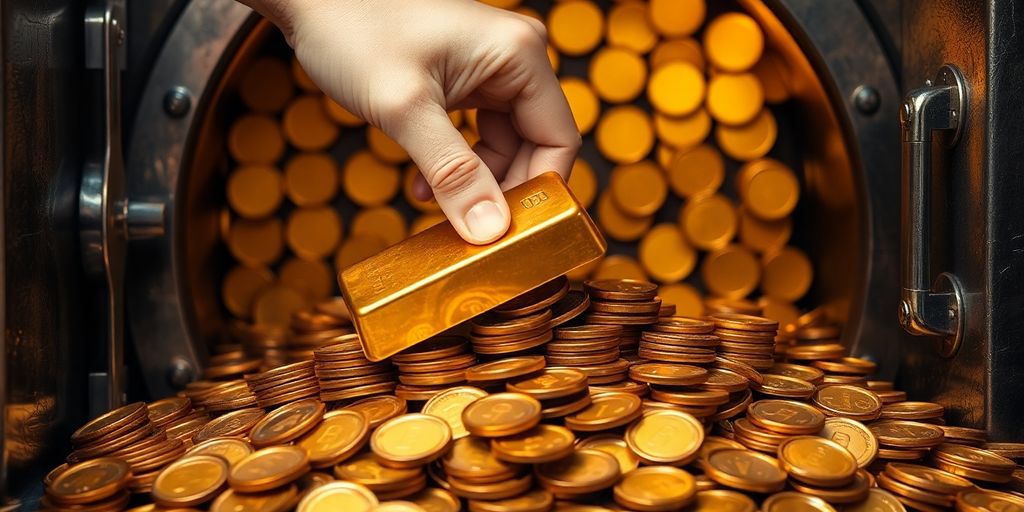
Gold is a bit of a classic safe haven. We've been talking about it forever, and for good reason: it has this ability to retain its value, even when everything else is in turmoil. Think of it as a solid anchor when the markets are going crazy. Its scarcity is a major asset; unlike money that can be printed, the quantity of gold is limited. That's why it retains its intrinsic value. Historically, during crises, the gold price has often climbed as people seek to secure their savings. It is also a good way to protect against inflation, because when the currency loses its value, gold can become more expensive. It should not be seen as a miracle solution, but as an important element to diversify and secure your assets.
Silver, a metal of history and future
Silver is also a metal with a rich history. Since ancient times, it has served as currency, facilitating trade. It has been the metal of the people, of merchants, and has even served as the basis for many currencies. Today, silver has a dual role: it remains a store of value, but it is also extremely important for industry, particularly in new technologies such as photovoltaics and electronics. This constant industrial demand gives it interesting potential for the future. In addition, it is more accessible than gold, which allows you to acquire larger quantities to diversify your assets. It is a tangible asset, easy to trade, and recognized worldwide.
Why invest in precious metals?
Investing in gold and silver is a bit like building up an insurance policy for your savings. Here's why it's a good idea:
- Protection against inflation and currency devaluation : When prices rise or currency loses value, gold and silver tend to maintain or even increase their purchasing power.
- Diversification of assets : They don't always react like stocks or bonds. Adding them to your portfolio can reduce overall risk.
- Tangible and universally recognized asset Unlike numbers on a screen, you can hold gold and silver in your hands. They are recognized and traded all over the world.
- Stability in times of crisis : Historically, they have proven their ability to retain their value during periods of economic or geopolitical uncertainty.
It's important to remember that precious metals don't generate regular income like bank interest. Their value fluctuates with the market. Therefore, it's important to be well informed and not to invest all of your money in these assets.
Diversify your assets for increased security
In the face of uncertainty, it's wise not to put all your eggs in one basket. Diversifying your assets is a key strategy for strengthening the security of your wealth. This means spreading your money and investments across different vehicles and institutions. It's a bit like having several strings to your bow, so you're better prepared if one of them fails.
Divide your savings between several banking establishments
We often tend to centralize everything in our usual bank. However, if a major banking crisis were to strike, it's safer not to have all your funds in one place. The Deposit Guarantee protects up to €100 per customer and per institution. If you have more than this amount, or if you simply want more peace of mind, opening accounts at several banks is a simple and free process that can save you a lot of hassle. Also consider online banks, which often offer attractive terms and good accessibility.
Keep a cash reserve at home
It's not about turning your home into a giant safe, but having a small amount of cash on hand can be very useful in a pinch. Imagine a prolonged power outage, a bank computer system crash, or simply the need to run some quick errands when your cards no longer work. A few hundred euros, well hidden, can make a real difference in these situations. You just need to find the right balance so that this money is accessible without being too exposed to the risk of theft or loss.
Open an account in a stable jurisdiction
For added protection, you might consider opening a bank account in a country known for its political and economic stability. This may seem complex, but it offers geographic diversification of your assets. In the event of major unrest in your home country, having funds in a safer jurisdiction can give you valuable breathing room. It's important to research the regulations and taxes in these countries before taking the plunge.
Investments to favor in times of uncertainty
When times get uncertain, it's only natural to look for investments that hold up. We don't want our money to disappear or lose all of its value. Fortunately, there are proven options available when things get tough.
Real estate in a stable area
Real estate is tangible. But be careful, not just any real estate. In times of crisis or war, it's best to avoid large cities, which are often more exposed. Instead, consider rural areas or quiet suburbs. A property that can be rented can continue to bring you a regular income, even when everything else is failing. It's a bit like having an annuity that keeps flowing.
Farmland and forests
Investing in land is a bit like going back to basics. It's an asset that doesn't move, is productive, and can't be relocated. You can cultivate farmland, rent it to farmers, or resell it. Forests, in addition to being a sustainable investment, can offer attractive tax benefits in some countries, and they're generally immune to stock market fluctuations or inflation. It's a bit like owning an asset with intrinsic value.
Government bonds of stable countries
If the crisis is more localized, looking at bonds issued by countries considered very solid, such as Germany, Switzerland, or the Nordic countries, might be an idea. The yield isn't huge, it's true, but the main idea here is security. It allows you to keep your capital safe, especially if you need that money in the medium term. It's a bit like putting your money in a government safe.
Managing your stock market investments in times of crisis
Should you sell your shares during wartime?
Faced with uncertainty and volatility in stock markets during times of crisis or war, the first instinctive reaction may be to sell shares to limit losses. This is a common mistake. History shows that financial markets tend to recover after disruptive events. For example, in many cases, markets have shown gains in the year following major conflicts or terrorist attacks. Crises, while challenging, can also represent opportunities. Buying stocks when their value is low can lead to significant gains in the medium to long term.
Instead of panicking and liquidating your portfolio, it's wiser to assess your situation. If you have a long investment horizon, it's often better to hold on to your investments, even if the market fluctuates. If, on the other hand, you need the money in the short term, it may be worth moving it to less volatile investments designed for shorter horizons.
Investing in defensive sectors
In times of uncertainty, some sectors of activity prove more resilient than others. These are the so-called
Limit the risks of seizure or freezing of your assets
In the face of a crisis or war, it's natural to worry about your money. In extreme situations, governments can implement measures that directly affect your assets. These include tax increases, forced borrowing, or even freezing or limiting access to your bank accounts. These actions, while often legally regulated, can occur quickly. The best defense against these risks is a smart diversification strategy for your assets, currencies, and the jurisdictions where you hold funds.
Do not exceed the bank guarantee ceilings
To limit your risk in the event of bank failure, it's wise to limit your deposits to €100 in a single account at a single institution. This is the maximum amount guaranteed by the Deposit Guarantee and Resolution Fund (FGDR) in France. If your savings exceed this threshold, it's advisable to spread your funds across several banks to benefit from this protection for each account.
Diversify your investments and media
Don't put all your eggs in one basket. This adage takes on added meaning in times of uncertainty. Instead of concentrating all your savings in current accounts or bank books, which can be more easily frozen or drained in a crisis, consider diversifying. This could include investing in real estate in areas considered stable, purchasing physical gold, or holding accounts and contracts in foreign jurisdictions known for their stability.
Favor solid financial institutions
When choosing where to invest your money, the financial strength of the bank is an important factor. Research the financial health of the banks where you hold accounts. Choosing well-capitalized banks with a good reputation can reduce the risk of encountering problems in the event of economic or financial turmoil. It's also a good idea to keep some of your cash in easily accessible assets in case of immediate need.
To avoid having your assets seized or frozen, it is important to be well informed. Know how protect your savings is essential for your peace of mind. We help you understand the steps to take to secure your assets. Don't wait any longer to discover our practical advice on our website!
So, what should you remember to protect your money?
Ultimately, preparing for uncertain times is a bit like packing an emergency bag. It's not about panicking, but rather being smart and forward-thinking. Diversification is really the key. Don't put all your eggs in one basket, whether that's in terms of banks, currencies, or types of investments. Consider keeping a small cash reserve at home, but not too much. And if you're wondering where to put the rest, physical gold or silver, for example, have shown they can hold up well when things get tough. The important thing is to stay informed, think calmly, and act thoughtfully, not emotionally. Your peace of mind is priceless.
Frequently Asked Questions
Is it safe to withdraw all my money from the banks in case of war?
In the event of a major crisis or war, it's advisable not to leave all your money in a single account. Diversifying your investments across different banks, and even different countries if possible, is a good strategy. Also, keep a small amount of cash at home for everyday expenses if banks are temporarily inaccessible.
How can gold help protect my money in a crisis?
Gold is often considered a safe haven because it tends to maintain its value, or even increase, when other investments like stocks or real estate decline. It's a way to protect your savings against inflation and economic crises.
Where and how can I buy physical gold?
To purchase physical gold, you can visit specialist stores, certain banks, or use reliable websites. It is important to choose bars or coins that are recognized and accompanied by a certificate of authenticity to guarantee their value.
How is the price of gold determined?
The price of gold is constantly changing. It depends on demand, supply, and global events. For example, if a crisis breaks out, more people want to buy gold, which drives up its price. It's helpful to track these changes to know when it's more profitable to buy or sell.
How to prepare an emergency financial kit in case of a crisis?
It's a good idea to prepare an 'emergency financial kit'. This includes a cash reserve (in euros and, if possible, in hard currencies like dollars or Swiss francs) to cover your expenses for 1 to 3 months. You should also have copies of your important documents such as your identity papers, bank statements, and property titles.
Is physical cash also a good option to protect my savings?
Yes, silver is also a safe haven and has the advantage of being cheaper than gold, making it more accessible. It's also widely used in industry (electronics, solar energy, medicine), ensuring constant demand. Investing in silver bars can therefore be a good idea to diversify your assets.