Silver coin production is a fascinating process that combines tradition and innovation. Each coin, whether intended for circulation or collection, undergoes a series of rigorous steps to ensure its quality and authenticity. In this article, we will explore the different phases of silver coin production, from initial design to final minting, highlighting the techniques and standards that govern this age-old craft.
Key points
- The production of silver coins involves several essential steps, from design to minting.
- The blanks, which are the metal discs, must be carefully prepared to ensure the quality of the parts.
- Die engraving is crucial to achieving precise and detailed designs on coins.
- The minting process can be manual or mechanical, each method having its own advantages.
- Certification standards guarantee the purity and authenticity of silver coins.
The stages of manufacturing silver coins
Making silver coins is a bit like following a recipe, but with precious metal! There are several key steps, each requiring special attention. We're not just talking about churning out coins on an assembly line, but about creating objects that have both monetary and historical value. Each step is crucial to ensure the quality and authenticity of the currency.
Model design
It all starts with an idea, a drawing. Whether it's a portrait, a symbol, or an inscription, the initial design is the basis for everything. In the past, everything was done by hand, with sketches and drafts. Today, the computer has become an indispensable tool, allowing the creation of ultra-precise 3D models. It's a bit like the storyboarding stage in a film, except here, we're working with metal.
Creation of the mold
Once the model is validated, the mold, or rather the dies, must be created. These are the tools that will be used to strike the coins. Hardened steel is often used, engraved with great precision. This is a goldsmith's job, because the slightest defect will be found on all the coins struck. The engravers master techniques ancestral to ensure impeccable quality.
Making the blanks
The flan is the metal disc that will become the coin. It must be perfectly round, flat, and have the right weight. Preparing the flans is a delicate step, as it directly influences the quality of the coinage. Pure silver ingots are used, which are cut into discs. These flans are then cleaned and polished to be ready to receive the die impression.
The production of silver coins is a complex process that combines art and technique. Each step is essential to ensure the quality and authenticity of the coins. It is a legacy of expertise passed down from generation to generation.
Preparing the flans
Before you can mint a silver coin, you have to prepare the groundwork, and that starts with the blanks. You can't just take a piece of raw silver and magically transform it into a coin. There's a whole process involved, and that's what we're going to look at here. This is a crucial step, because a poorly prepared blank can ruin the entire minting process. Imagine all that work for nothing because of a poor-quality blank!
Casting of ingots
The first step is casting the ingots. We start with silver, of course, and we melt it. Then, we pour this molten silver into molds to form ingots. These ingots are, in a way, the basic building blocks of our future coins. The purity of the silver is super important at this stage. We want the purest silver possible to guarantee the value of the currency. It's a bit like choosing the best ingredients for a recipe: if you start with poor-quality products, the end result won't be great. silver bars are then analyzed to verify their composition.
Cutting the blanks
Once we have our ingots, we need to cut them into blanks. Blanks are the small metal discs that will become the coins. This cutting is done with special machines, a bit like giant cookie cutters. The thickness and diameter of the blanks must be super precise, otherwise, we risk having coins that aren't the right weight or size. It's a bit like cutting diamonds: every millimeter counts! The consistency of the blanks is essential to ensure a uniform strike.
Cleaning and processing of blanks
After cutting, the blanks are far from ready. They are often dirty, with cutting residue and impurities. Therefore, they must be thoroughly cleaned. Chemical baths and special machines are used to make them clean and shiny. Then, they can be surface treated to protect them from oxidation and improve their appearance. It's a bit like giving an old car a good clean before repainting it: it makes all the difference!
Preparing the flans is an often underestimated step, but it is absolutely essential to ensure the quality and durability of silver coins. A well-prepared flan is the key to a successful coin, with crisp details and a beautiful shine. It's a bit like the foundation of a house: if it's solid, the rest will follow.
Engraving the corners
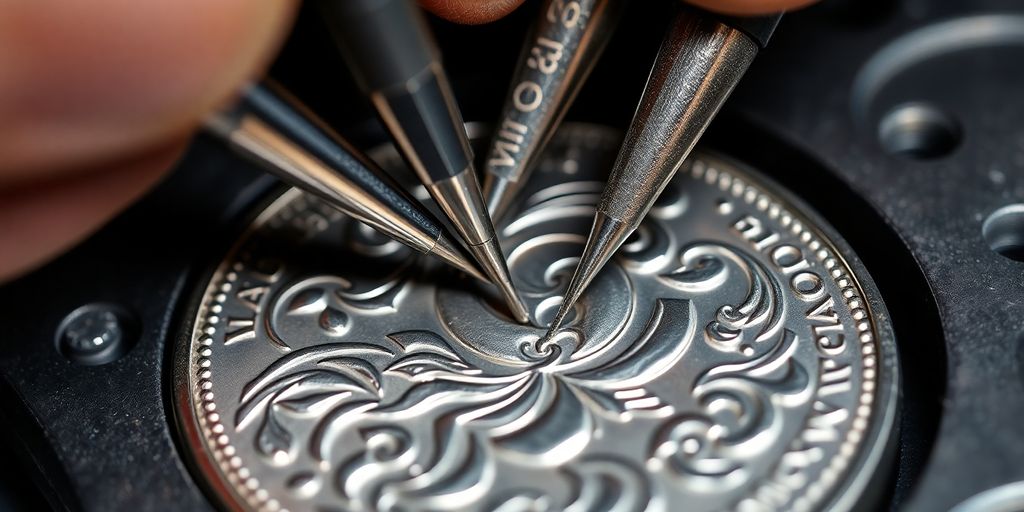
Die engraving is a crucial step in the production of silver coins. This is where the design comes to life, transforming an idea into a physical tool that will be used to mint thousands of coins. Without well-engraved dies, the coin would have no artistic or historical value. It's a bit like having an amazing recipe but not the right molds to make the cake!
Engraving techniques
In the past, die engraving was an entirely manual art. Engravers, true artists, used burins and other tools to carve the metal directly. It was a long and meticulous job, requiring great skill and a thorough knowledge of metals. Today, the techniques have evolved. While some ancestral methods persist, they coexist with modern technologies such as digital engraving, mechanical reduction, and electrical discharge machining. The "reduction" technique, developed in the 24th century, uses a reduction lathe to reproduce the relief of a resin on a block of steel, with a cutter that hollows out the block following the movements of a metal probe. This operation can last from 48 to XNUMX hours for complex tools.
Used materials
Dies are usually made from steel or a metal containing steel. The choice of material is essential because it must withstand the enormous pressure exerted during striking. Poor-quality steel would wear quickly, resulting in a loss of detail on the coins. The durability of the corner is therefore essential to guarantee quality mass production.
Importance of accuracy
Precision is absolutely essential in die engraving. The slightest flaw, the smallest imperfection, will be reproduced on every coin struck. Imagine a small scratch on the die: it would become a visible mark on thousands of coins! This is why engravers must be extremely meticulous and attentive to the smallest detail. The use of magnifying glasses is sometimes discussed, although archaeological evidence is limited. Some believe that rock crystal lenses or glass globes filled with water may have been used to magnify details.
Die engraving is an artistic craft that requires patience, precision, and a deep understanding of materials. It's a delicate balance between tradition and innovation, where time-honored techniques blend with modern technology to create tools that bring silver coins to life.
The typing process
Manual typing
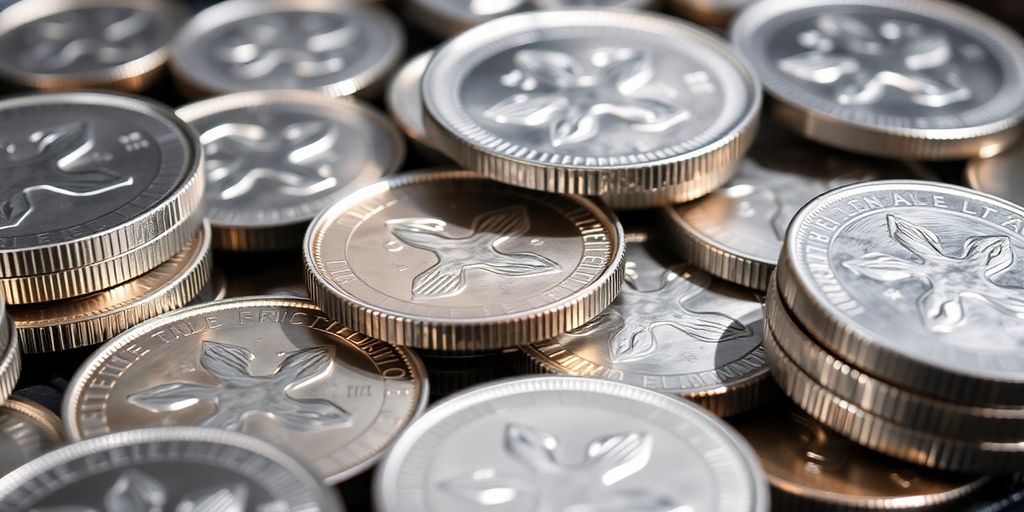
Hand-stamping has a bit of old-fashioned charm. Imagine a craftsman holding a die (a sort of stamp) in one hand and a hammer in the other. He places a blank (the future coin) between two dies, and bam! A well-aimed hammer strike, and voilà, the coin takes shape. It's simple, but it requires a great deal of precision. In fact, there's still debate over whether or not the blanks were heated before striking. Some believe the heat made the metal more malleable, making it easier to imprint designs.
Mechanical strike
With the arrival of the Renaissance, things began to change. Machines, such as the pendulum, appeared, which allowed more coins to be struck more quickly. The pendulum was a kind of press operated by men, with heavy weights to give force to the blow. Aubin Ollivier even invented the broken ferrule, a ring that kept the blank still during striking, improving the quality of the result. Up to thirty coins could be struck per minute, but it was backbreaking work. Today, modern factories can strike up to 800 coins per minute thanks to automated presses. It's a different era!
Quality control
Whether by hand or machine, quality control is essential. We check that the patterns are clear, and that the weight and dimensions are correct. In modern factories, cameras analyze each blank to detect defects before it's even struck. And even afterward, we continue to check. It's a bit like buy ingots: We want to be sure of what we have in our hands. This is important because even a small defect can affect the value of the piece, especially for collectors.
Minting a coin, whether by hand or machine, is a delicate process that requires great attention to detail. Every step, from the positioning of the planchet to the strength of the strike, influences the final result. Rigorous control is therefore essential to ensure the quality and value of each coin.
Characteristics of silver coins
Purity and weight
The purity of the silver used in coins is a determining factor in their value. Historically, coins were often made from near-pure silver, but alloys were sometimes added to increase their durability. Weight was also carefully controlled, as it was directly linked to the value of the coin.
- Purity is expressed in thousandths (‰). For example,pure silver at 999‰ is considered fine silver.
- Weight is usually given in grams or ounces.
- Even small variations in weight can affect a coin's value, especially for collectors.
Dimensions and design
The dimensions of silver coins, particularly their diameter and thickness, are important characteristics. The design, meanwhile, often reflects the era and culture of its issuance. It features symbols, portraits of leaders, or coats of arms. These elements contribute to the identification and aesthetic appeal of the currency.
Conservation state
Condition is an essential criterion for collectors. A well-preserved coin will be worth much more than a worn or damaged coin. Several levels of preservation are used to assess a coin's condition, ranging from "Fair Uncirculated" (perfect condition) to "Fair" (very worn).
Condition is subjective, but there are standardized grading scales to help objectively assess a coin's condition. It is important to handle coins carefully to avoid further damage.
Certification standards
Certificates of purity
When it comes to silver coins, purity is paramount. Purity certificates are official documents that attest to the percentage of fine silver contained in the coin. It's a bit like your currency's ID card; it tells you exactly what you're holding. These certificates are often issued by independent organizations or reputable refiners. They guarantee that the currency meets established standards. Without this certificate, it's difficult to prove the currency's true value, especially if you plan to resell it or use it as an investment.
Foundry marks
Founder's marks are a bit like the artist's signature on a work of art. Each founder has their own mark, their own hallmark, which they affix to the coins they produce. These marks help identify the origin of the coin, to know who made it. This is important for several reasons. First, it allows us to trace the history of the coin. Second, it can influence its value, as some founder's marks are more sought-after than others. Finally, it guarantees a certain quality, as reputable founders have high manufacturing standards.
International regulations
International regulations are a bit like the highway code for silver coins. They define the rules of the game, the standards that must be met for coins to be recognized and accepted worldwide. These regulations cover several aspects, such as silver purity, coin weight, founder's marks, and so on. They are established by international organizations, such as the LBMA (London Bullion Market Association), which sets standards for precious metals. Compliance with these regulations is essential to ensure investor and buyer confidence.
International regulations are important because they help harmonize practices and prevent fraud. They ensure that silver coins meet internationally recognized quality and authenticity standards. It's a bit like a quality label, reassuring buyers and investors.
Here are some key points regarding international regulations:
- They define the purity standards of silver.
- They regulate the practices of smelters and refiners.
- They facilitate international trade in silver coins.
The Historical Impact of Silver Coins
Economic role
Silver coins have played a central role in the global economy for centuries. They facilitated trade, enabled the accumulation of wealth, and served as the basis for monetary systems. Silver has been a reliable and widely accepted form of currency, contributing to the economic stability of many civilizations.
- Money enabled the development of international trade, facilitating exchanges between different regions of the world.
- Silver currencies served as a store of value, allowing individuals and states to store their wealth.
- The money was used to finance wars, construction and other large-scale projects.
The importance of silver in economic history is undeniable. Its availability, malleability, and intrinsic value have made it a preferred choice for minting coins, influencing trade and financial policies around the world.
Cultural symbolism
Beyond their economic value, silver coins often held important symbolic significance. They could represent the power of the state, the wealth of a nation, or the cultural values of a society. The designs and inscriptions on the coins reflected the beliefs and ideologies of the time. It is important to note that limited series can influence the value of the coins.
- Silver coins were often used as symbols of power and prestige by rulers.
- The patterns and inscriptions on the coins could convey political or religious messages.
- Silver coins were sometimes used as ritual objects or as offerings to the gods.
Evolution of striking techniques
Silver coin minting techniques have evolved considerably over time. From rudimentary manual methods to sophisticated machines, each era has brought its share of innovations. This evolution has improved the quality, accuracy, and productivity of minting, while reflecting technological advances in society. Initially, minting was done manually, requiring multiple hammer blows, which could lead to double strikes.
| Période | Technique de frappe more information sur les techniques de frappe.
- Hand-struck, where each coin was struck individually with a hammer.
- Mechanical typing, which made it possible to automate the process and increase production.
- The use of pendulum machines, which provided greater accuracy and better striking quality.
Silver coins have played an important role throughout history. They have been used as a means of exchange and have influenced economies throughout time. If you want to learn more about the impact of silver throughout history and how to invest in silver coins, visit our website!
Conclusion
In short, silver coinage is a complex process that combines tradition and technology. Every step, from design to minting, is essential to ensuring the quality and authenticity of the coins. Although methods have evolved over the centuries, the essence of minting remains the same: creating an object of value that tells a story. Whether you're a collector or an investor, understanding this process allows you to gain a greater appreciation for the money we use every day.
Frequently Asked Questions
How are silver coins made?
Silver coins are made through several stages, including designing the pattern, creating the mold, and making the blanks.
What is a flan?
A flan is a piece of metal prepared to be struck into currency. It is cut from a silver ingot.
What is the purity of the silver in the coins?
Silver coins typically have a purity of 92,5% or higher, meaning they contain 925 parts pure silver per 1000.
How are the patterns engraved on the coins?
The designs are engraved on dies using precise engraving techniques, often with modern tools to ensure quality.
What are the quality control steps?
After striking, the coins are inspected to ensure that the designs are well defined and the flan is uniform.
Why are silver coins collected?
Silver coins are often collected for their historical value, beauty, and investment potential.