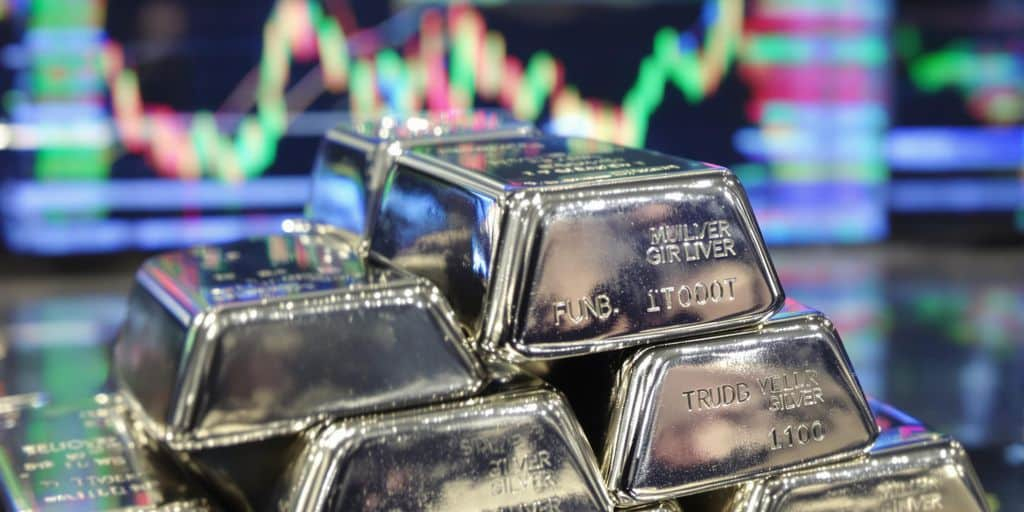
So, how is the price of silver determined? This is a question many people ask, and the answer is more complex than you might think. The price of this precious metal doesn't just fall out of the sky. It's influenced by many different factors, such as global market exchanges, the amount of silver available and needed, and what's happening in the economy and even the world. It's a bit of a puzzle, but we'll try to explain it all simply.
Key points
- The price of silver is mostly set in major markets like London, where supply and demand meet to set a reference price each day.
- As with any commodity, the price of silver depends largely on the quantity available (supply) and what buyers want (demand).
- Economic factors, such as interest rates or the value of currencies, can move the price of money, sometimes quite dramatically.
- In times of global crises or uncertainty, silver is often seen as a safe haven, which can cause its price to rise.
- The price of silver often follows that of gold, as they both share a safe-haven status, even though silver can be more volatile.
The Basics of Silver Quotation
Understanding how the price of silver is determined is a bit like analyzing how a Swiss watch works: there are lots of little cogs that interact. The price of silver is determined by a combination of factors, ranging from global stock exchanges to supply and demand dynamics. It is a global market, but with critical points where decisions are made.
The central role of global stock exchanges
The world's stock exchanges are like the marketplaces where silver is traded wholesale. London, New York, Zurich, Hong Kong... these are names that come up often. Each exchange has its own specificities, but all contribute to establishing a reference price. The LBMA (London Bullion Market Association) plays a leading role, especially in fixing. It's a bit like each exchange being an actor in a major play, each influencing the unfolding of the story.
The daily fixing process
The fixing is a bit like the key moment of the day. Imagine an auction where buyers and sellers meet to determine an equilibrium price. The LBMA organizes this fixing twice a day, and this price then serves as the reference for all transactions. It's a bit like resetting the counters every morning and afternoon. money course is thus established.
Real-time quoting
In addition to the fixings, there is a real-time quote, available 24/24. It's a bit like a thermometer that continuously measures the market temperature. This quote fluctuates based on news, rumors, and buy and sell orders. It's a nervous market, constantly on the move.
Fixing and real-time quoting complement each other. Fixing gives an indication of the price at a specific time, while real-time quoting allows you to track price changes continuously. It's a bit like having a photo and video of the market.
The influence of supply and demand
The price of silver, like that of many assets, is fundamentally determined by the laws of supply and demand. Understanding these forces is essential for anticipating market fluctuations. It's a bit like a constant balancing act, where every change on either side has a direct impact on the price.
Sources of money supply
The supply of money comes from several main sources:
- Mining: This is the most important source. Silver mining, often associated with the extraction of other metals such as lead and zinc, contributes massively to the overall supply. It should be noted that mining money is a process that can be affected by geopolitical factors, production costs and discoveries of new deposits.
- Recycling: Silver from old jewelry, electronic waste, and industrial products is recovered and remelted. Recycling plays a significant role, especially with growing environmental awareness.
- Government reserves: Some governments hold reserves of silver that they may choose to release into the market, although this is less common than with gold.
The multiple facets of demand
The demand for money is diverse and comes from various sectors:
- Industry: Silver is used in many industrial applications, including electronics, photography, batteries, and solar panels. It is an essential metal for many modern technologies.
- Investing: Investors buy silver in the form of bars, coins, or exchange-traded funds (ETFs) to diversify their portfolios or hedge against inflation. Silver is often considered a safe haven, although less so than gold.
- Jewelry and silverware: Silver is used to make jewelry, cutlery, and other decorative items. Demand in this sector can fluctuate depending on fashion trends and economic conditions.
The impact on prices
The interaction between supply and demand determines the price of silver. An increase in demand, combined with limited supply, leads to an increase in prices, and vice versa. Speculators also play an important role, as their expectations and trades can amplify price movements. Government policies related to precious metals can also influence the price of silver.
It's important to note that the silver market can be more volatile than the gold market due to its smaller size and greater reliance on industrial demand. This means investors should be aware of the risks and opportunities associated with this precious metal.
Economic and monetary factors
The price of silver, like that of many assets, is heavily influenced by economic and monetary factors. These factors can create both opportunities and risks for investors, so it's important to understand them.
The effect of interest rates
Interest rates have a significant impact on the price of money. Generally, when interest rates rise, the price of money tends to fall. This is because higher interest rates make bonds and other fixed-income investments more attractive, thus reducing the appeal of money that does not generate a direct return. Conversely, low interest rates can stimulate demand for money.
Currency volatility
Currency volatility, particularly that of the US dollar, plays a significant role. Since silver is typically priced in dollars, fluctuations in that currency can affect its price for investors using other currencies. A weak dollar makes silver cheaper for foreign buyers, which can increase demand and drive up prices. Conversely, a strong dollar can weigh on the price of silver.
The role of central banks
Central banks wield considerable influence through their monetary policies. Decisions regarding interest rates, quantitative easing, or other measures can impact investor confidence and, consequently, the price of silver. For example, expansionary monetary policy can lead to a depreciation of the currency, making assets like silver more attractive. Central banks may also choose to diversify their reserves and buy money, which has a direct impact on demand.
It's important to note that economic and monetary factors often interact, making silver price analysis complex. A thorough understanding of these dynamics is essential for making informed investment decisions. Government policies related to precious metals should also be monitored.
Money in the face of geopolitical uncertainties
Silver, like gold, is often viewed as a safe haven, but its response to geopolitical uncertainty is more nuanced. Investors turn to assets perceived as safe when the economic climate is uncertain.
Its function as a safe haven
Silver has a dual personality. On the one hand, it's a precious metal, sought after in times of crisis. On the other, it's an industrial metal, whose demand can decline if the global economy slows. This duality makes its role as a safe haven less obvious than that of gold. When tensions rise, silver may initially benefit from an influx of investors looking to secure their capital. However, if these tensions lead to a global economic slowdown, industrial demand for silver may fall, putting downward pressure on its price.
International crises
International crises have a direct impact on the price of silver. For example, armed conflicts or major political crises can lead to an increase in demand for silver, which is seen as a way to preserve the value of one's assets.
Speculation on the markets
Speculation plays a significant role. Investors and speculators take positions in silver futures contracts, betting on price fluctuations. These speculative movements can amplify the volatility of the silver price, especially in times of uncertainty. It is important to monitor the geopolitical tensions because they can affect the demand for silver metal.
The global economic outlook plays a major role in silver demand. Robust economic growth and positive indicators can encourage investors to seek out riskier assets, which can reduce the demand for silver as a safe haven.
Here are some factors that can influence the price of silver during times of crisis:
- The scale and nature of the crisis
- The reaction of central banks
- Investors' expectations
Correlation with the price of gold
People often wonder if silver and gold are related. The answer is yes, but it's more complicated than it seems. They share similarities, but also important differences that influence how investors perceive and use them.
The similarities between the two metals
Gold and silver are both considered precious metals, and they have historically served as safe investment in times of economic uncertainty. They are used in industry, jewelry, and as a store of value. Generally, when one rises, the other follows, and vice versa. This correlation is partly due to the perception that they are both tangible assets, unlike fiat currencies which can be devalued by central banks.
Behavioral differences
Despite their similarities, gold and silver do not always react in the same way to economic events. Silver is more volatile than gold, meaning its price can fluctuate more quickly and significantly. This is partly because silver has a greater industrial use than gold, making its price more sensitive to changes in industrial demand. Additionally, the silver market is smaller than the gold market, making it more susceptible to price manipulation.
The impact on investment strategies
The correlation and divergence between gold and silver have a significant impact on investment strategies. Some investors use silver as a way to diversify their gold investment portfolio, while others prefer to focus on one metal or the other depending on their outlook on the global economy and financial markets. It is important to understand the unique characteristics of each metal before making an investment decision.
Investing in gold and silver may seem simple, but it's important to understand the ins and outs. Just because gold is rising doesn't mean silver will necessarily follow the exact same trajectory. You need to analyze the specific factors of each metal to make informed decisions.
Here are some points to consider:
- Industrial demand for silver is a key factor.
- The volatility of money can offer opportunities, but also risks.
- Central bank decisions can affect both metals, but not always in the same way.
The specificities of silver products
Determining the price of bullion
The price of a silver bar is a little more complex than it seems. It's not just a matter of following the money course displayed on the markets. Several factors come into play, and it is important to understand them to make an informed purchase.
- Spot price: This is the price of pure silver, quoted on global stock exchanges. It fluctuates constantly based on supply and demand.
- Premium: This is a surcharge applied to the spot price. It covers manufacturing and distribution costs, as well as intermediary margins. The premium can vary considerably from one ingot to another, depending on its size, manufacturer, and distributor.
- VAT: In France, investment silver is subject to VAT, which increases the final price for the buyer.
It's crucial to compare prices from different suppliers before purchasing a silver bar. Carefully consider the premium and additional fees to avoid overpaying.
The value of investment coins
Silver bullion coins, such as Canadian Maple Leafs or American Eagles, have a value that exceeds that of the silver they contain. This value is influenced by their rarity, their state of preservation and their premium. Here are some things to consider:
- Premium: As with bullion, coins carry a premium over the value of the silver they contain. This premium is often higher than for bullion because it includes higher minting and distribution costs.
- Rarity: Some coins are produced in limited quantities, making them rarer and more sought-after by collectors. Their value can then increase considerably.
- Condition: The condition of a coin has a major impact on its value. Coins in perfect (uncirculated) condition are more valuable than those that are worn or damaged.
The importance of premium and purity
Premium and purity are two essential elements to consider when purchasing silver products.
- Premium: This represents the additional cost over and above the intrinsic value of money. Too high a premium can make an investment less profitable, so it's important to monitor it closely.
- Purity: This indicates the amount of pure silver contained in the product. Pure silver (99,9% or higher) is generally preferred for investment because it is more easily tradable and its value is more directly linked to the price of silver.
- Supply and demand: The premium is also influenced by supply and demand. If a product is in high demand, its premium will tend to increase.
In summary, buying physical silver, whether in the form of bars or coins, requires a good understanding of the factors that influence prices. price volatility can be significant, so it is crucial to be well informed before investing.
Silver is a precious metal with unique characteristics. It is often used for coins and bars, and it has a rich history. To discover all the special features of silver and see our silver coins and ingots, do not hesitate to visit our website.
What you must remember
So, how is the price of silver ultimately set? It's a little more complicated than you might think. There are several factors that come into play. Of course, supply and demand are the basis. But we also have to take into account its use in industry, because silver is used for a lot of things. And then there's its role as a safe haven when the economy is a bit turbulent. The financial markets, with their movements, also have a lot of influence. Basically, it's a mixture of all of these things that move the price of silver on a daily basis.
Frequently Asked Questions
How is the price of silver set every day?
The price of silver is set on major exchanges around the world. Every day, at specific times, professionals meet to find a price that balances what people want to buy with what people want to sell. This is called “fixing,” and this price serves as the benchmark.
What influences changes in the price of silver?
The price of silver fluctuates greatly depending on supply and demand. If many factories or jewelers need silver (high demand) and there isn't much available (low supply), its price rises. Conversely, if there is more silver to sell than there are buyers, the price falls. Its use in industry plays a major role.
Why is silver seen as a safe investment in times of uncertainty?
Silver is considered a “safe haven.” This means that when there are problems in the world, such as economic crises or political tensions, people tend to buy silver. They do this because they believe its value will be more stable than other investments and that it will help protect their money.
Do geopolitical and economic events have an impact on the price of silver?
Yes, world events can significantly influence the price of silver. For example, a war, a financial crisis, or even major central bank decisions can make investors nervous. At such times, they often turn to silver, which drives up its price.
Does the price of silver move in the same way as the price of gold?
The price of silver often follows that of gold. Both are precious metals and safe havens, so their prices often rise and fall together. However, silver can sometimes move more strongly than gold because it is also widely used in industry, which further influences its price.
What determines the price of silver bars and coins?
The price of silver bars and coins is based on the world price of silver. Added to this is a small difference called the "premium." This premium depends on several factors: whether the coin is rare, whether it is in very good condition, or whether many people want to buy it. The purity of the silver, or its quality, is also very important.