
You might wonder how this lustrous metal, synonymous with wealth and power, has survived the ages to reach us. The story of the discovery of gold is a fascinating adventure that stretches back to the dawn of time. Let's delve into this golden past together to understand how humanity was captivated by this unique element.
Key points
- Gold, discovered at the end of prehistory, was initially used for adornment and rituals.
- The Lydians minted the first gold coins, marking the beginning of its monetary use.
- Great gold rushes, like the one in California, shaped entire regions and influenced the global economy.
- The gold standard long structured international monetary systems before being abandoned.
- Today, gold retains an important place in jewelry, industry, medicine and as a safe haven for investors.
The ancient origins of gold
The discovery of gold in prehistory
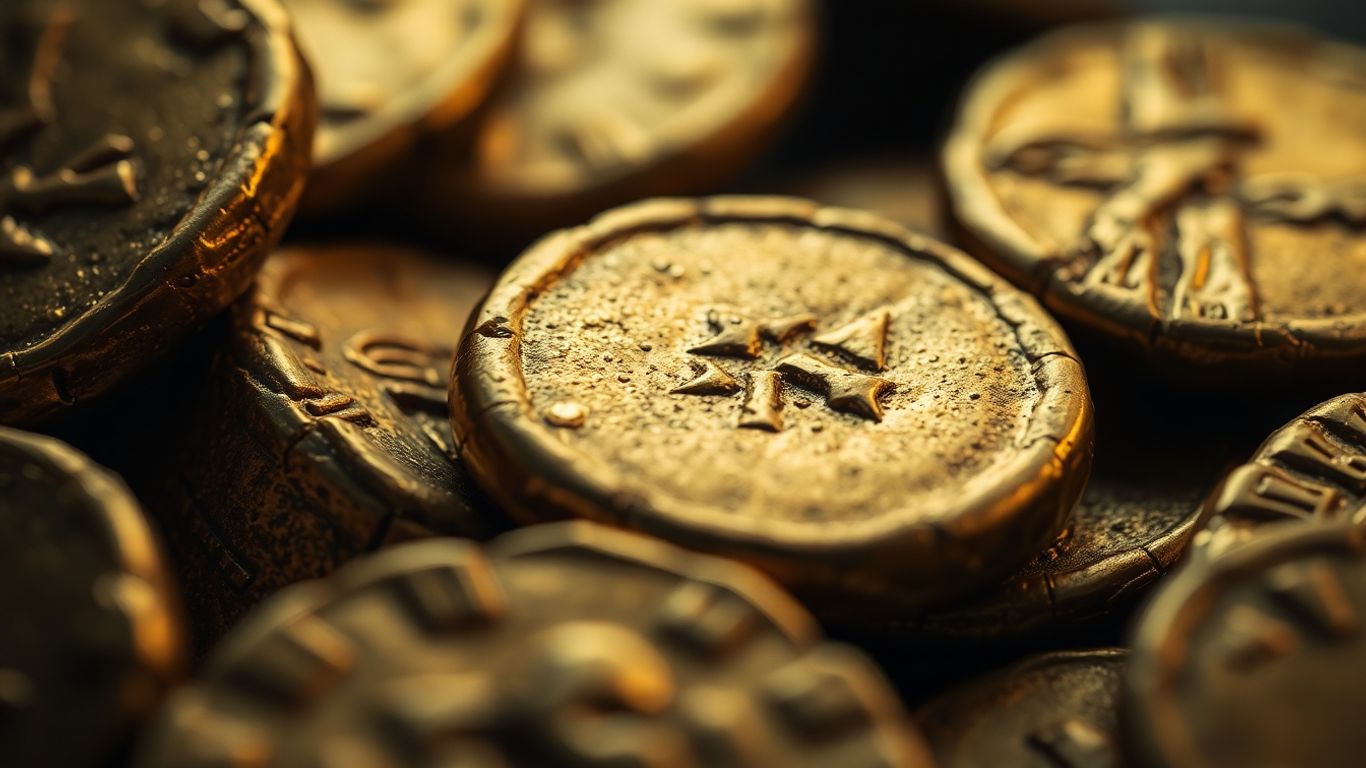
You know, gold, that shining metal that has always captivated people, its history begins long before us, long before the civilizations we know. Archaeologists have unearthed gold objects dating back to the end of prehistory, more precisely to the Chalcolithic period. The oldest gold object ever found is a type of jewelry from a necropolis in Bulgaria, near the Black Sea. It dates back to around 4600 to 4200 BC. Just imagine, more than 6000 years ago! At that time, gold wasn't used to buy things, no. It was mainly used to make ornaments, jewelry for chiefs or important people, and objects for religious rituals. It was already a symbol of status and spirituality.
The use of gold in ancient civilizations
When we talk about ancient civilizations, gold takes on an even more important role. The Egyptians, for example, were obsessed with gold. They used it for their jewelry, their offerings to the gods, and even to line their sarcophagi, like Tutankhamun's, you know the type. For them, gold was the metal of the gods, the symbol of light and eternity. The Greeks and Romans were no exception. They used it for their adornments, their crowns, and to represent wealth and power. It was also around this time, around the 8th century BC, that the Lydians in Asia Minor had the idea of minting the first gold coins. It was a mixture of gold and silver, called electrum. This marked the beginning of the use of gold as currency, even if it took time for it to become widespread.
Gold as a symbol of power and wealth
Over time, gold became much more than just a precious metal. It transformed into a universal symbol of power, wealth, and social status. Think of the crowns of kings, the scepters, the treasures amassed by empires. Gold was tangible proof of the power of a ruler or a nation. Ancient civilizations often associated it with sunlight, perfection, and the divine. That's why it was used in temples and for sacred objects. Even today, when we talk about
Gold through the ages: from currency to reserve
You know, gold isn't just a shiny metal used to make jewelry. Over time, its role has completely changed. It's gone from being used for simple objects to something much more serious: a medium of exchange.
The invention of gold coinage by the Lydians
Just imagine: it's around 600 BC in Lydia, a region roughly corresponding to modern-day Turkey. This is where things get interesting. King Alyattes, and later his son Croesus (yes, the one they say was as rich as Croesus!), had a brilliant idea: to mint gold coins. Before that, they mostly used ingots or nuggets, and it was a bit of a mess trying to assess their value. These Lydian coins, often adorned with a lion's head, were among the very first standardized coins in the world. This changed everything for trade. Silver was also used, creating a system where one gold coin was worth about ten silver coins. This was the beginning of bimetallism, and it worked extremely well, to the point that the Persians and Greeks adopted the same system.
Gold as a pillar of monetary policy
Later, when gold deposits became scarcer in Europe, silver took over for everyday transactions. But gold remained a safe haven, almost like a hidden reserve. The Crusades and the increase in trade brought gold back to Europe, and its value continued to climb. In the 14th and 15th centuries, it was a frenzy: gold was so precious that coin production plummeted. Then, with the discovery of America, the influx of gold gave the market another boost, even if it came at the expense of local populations, such as the Aztecs.
The role of gold in great discoveries and conquests
The search for gold has been a huge driving force behind the exploration and conquest of new territories. Think of America, for example. Spain and Portugal amassed incredible wealth from the gold they extracted, before other European countries followed suit. Later, in the 19th century, the California Gold Rush completely transformed the region, triggering incredible population and economic growth, and giving rise to cities like San Francisco. It's fascinating to see how one metal could shape so much of human history, isn't it?
The great gold rushes and their impact
Ah, the gold rushes! Those times when the hope of striking it rich drove thousands of people around the world to leave everything behind and venture into distant and often hostile lands. It's a fascinating chapter of history, isn't it? We often picture these gold seekers, armed with their shovels and pans, scrutinizing every pebble in the hope of discovering the precious metal.
The California Gold Rush in the 19th Century
The most famous is undoubtedly the California Gold Rush of 1848. Imagine: James Marshall discovers gold nuggets in Sutter's sawmill. The news spreads like wildfire, and just like that, hundreds of thousands of people descend upon the city from all corners of the world. It was a bit of a frenzy, a veritable migration to the American West. Many dreamed of becoming rich, but reality was often harsher. Some did find gold, yes, but most returned empty-handed, or even poorer than when they left. This is the myth of the Gold Rush, a short but intense period that left its mark on history.
The economic and demographic consequences of the gold rushes
These population movements had a tremendous impact. Think about it: suddenly, entire cities grew at breakneck speed, like San Francisco. The local economy exploded, but not always sustainably. Infrastructure struggled to keep up, and the massive influx of people also created tensions. It was a bit like the Wild West, with prosperity for a few and hardship for many others. Gold transformed entire regions, attracting people and capital, but it also left behind depleted areas once the veins ran dry.
The emergence of mining towns and ghost towns
This is where it gets really interesting. When a promising gold vein was discovered, a town would spring up overnight. Shacks, saloons, shops… everything needed to accommodate the gold seekers. But the problem was that gold doesn't last forever. Once the vein was exhausted, the town emptied as quickly as it had appeared. And that's how the famous ghost towns were born, these deserted places where the wind blows through the empty streets. It's a bit of a symbol of the ephemeral nature of easy wealth, a reminder that the gold rush was an adventure, but not always a success.
The lure of gold has always been a powerful driving force, capable of displacing entire populations and transforming landscapes in record time. These periods of gold rush have left indelible marks on history, shaping economies and societies, while creating legends and myths that persist to this day. It is a story of dreams, disappointments, but also progress and development, often at a high price.
Gold and modern monetary systems
Having been a symbol of power and wealth for centuries, gold has played a central role in how we've managed our economies. You might be wondering how we got here, right? Hang on, because we're going to explore that together.
The gold standard and its abandonment
Imagine a world where the value of each currency was directly linked to a fixed quantity of gold. That was the gold standard. This system, adopted by many countries, including the United Kingdom, aimed to stabilize exchange rates and facilitate international trade. The idea was simple: if you had a certain amount of currency, you could theoretically exchange it for an equivalent amount of gold. This provided a kind of guarantee, a sense of confidence in the value of paper money.
But wars are expensive. The First World War dealt a severe blow to this system. States had to spend enormous sums, and maintaining the convertibility of their currency into gold became increasingly difficult. The gold standard was suspended, then, after an attempt to return in a modified form with the Bretton Woods Agreements in 1944 (where the US dollar was the only currency directly convertible into gold), it was finally abandoned. The United States, facing significant expenses, suspended the convertibility of the dollar into gold in 1971. Then, in 1976, with the Jamaica Accords, gold was officially demonetized. Gone are the days when your banknote entitled you to a small amount of gold.
The end of the gold standard marked a major turning point, paving the way for fiat currencies, whose value is based on trust in the state that issues them, rather than on a tangible metallic reserve.
The role of central banks and their gold reserves
So, if gold is no longer the basis of our currencies, why do central banks still hold so much of it? Well, gold hasn't lost all its importance. It remains a kind of ultimate store of value, a tangible asset that can help stabilize economies in times of crisis. Central banks, like the United States Central Bank (with its famous reserve in New York, not just Fort Knox!), hold enormous quantities of gold. In 1995, it was estimated that banks worldwide held approximately 910 million ounces of gold, which represents a cube roughly 12 meters on each side. That's no small amount!
These reserves serve as a guarantee, a safety net. They can be used to stabilize exchange rates, bolster confidence in the national currency, or simply as a diversified asset that is independent of other countries' monetary policies. It's a bit like having comprehensive insurance for a country's economy.
The demonetization of gold and its current price
As we have seen, gold was officially removed from its direct monetary role in 1976. Since then, we have lived in a system of fiat currencies, where value is determined by supply and demand, and above all by the trust placed in central banks and governments. But that does not mean that gold has become useless.
On the contrary, gold is still traded on the world's major stock exchanges (London, New York, Tokyo). Its price is closely monitored, as it is often considered a barometer of the global economy, especially during times of uncertainty. When financial markets falter, many turn to gold as a safe haven. Its price can therefore fluctuate considerably, influenced by many factors: central bank reserves, demand for jewelry (especially in India and China), industrial needs, and of course, speculation. Physical gold, however, has limited inflation because it is impossible to produce more than is extracted each year, which makes it quite unique compared to traditional currencies. This is also why some believe that we should one day return to a form of gold standard, but that's another story!
Gold in industry and daily life
We often think of gold in terms of jewelry or investment, but did you know that it also plays a super important role in many other areas? It's quite amazing when you think about it, this yellow metal that we associate with wealth has much wider applications.
The use of gold in jewelry and goldsmithing
It's still the main market, isn't it? About 70% of the gold produced worldwide ends up in jewelry. It's often mixed with other metals like copper or silver to make it more durable or to obtain different colors. Pure gold is incredibly soft, so to make rings or bracelets that last, it needs to be worked. And then there's goldsmithing, for luxury items, watches, pens… even for gilding woodwork or antique books, they use super-thin gold leaf. It's a skill that has endured; it's quite fascinating.
Gold as a conductor in electronics
Now, things get technical. Gold is an excellent conductor, second only to silver and copper. But what makes it special is that it doesn't oxidize, even under normal conditions. As a result, it's used for electrical contacts in our electronic devices. Think of your smartphones, tablets, computers… some of their components contain gold, often in the form of a very thin plating. This ensures that everything works properly and that the connections don't degrade over time. Just because it's expensive doesn't mean we'll pass it up when it provides such reliability!
Gold in medicine and dentistry
Yes, even in the healthcare field, gold has its place. In dentistry, for example, it's used to make high-end dental prostheses. It's a biocompatible and durable material. It has also been used, and sometimes still is, in the form of compounds for certain medications. It's not the most common use, but it demonstrates once again the versatility of this metal. It's not just for show; gold has real practical applications that affect us daily, even if we don't necessarily think about them.
Investing in gold today
So, you're wondering how to invest your money and whether gold is still a good idea in 2025? Frankly, it's a question many people ask, especially when you see the financial markets going on such wild swings. Gold has always had this reassuring quality, a bit like an old friend you can count on when things get tough. Central banks hold enormous quantities of it, and even we in France have quite a bit in our vaults, which puts us in a pretty good position globally.
Gold bars: a preferred investment format
If you're thinking about investing in physical gold, a gold bar is often the first thing that comes to mind. It's quite simple: the larger the bar, the lower the price per gram. But be aware that a large bar is also more difficult to resell if you need to withdraw a small amount. This is where intermediate sizes, like 250g or 500g bars, become attractive. They offer a good balance between cost and flexibility. And it's worth noting that in France, buying investment gold is quite advantageous tax-wise, as it's exempt from VAT. That's a significant benefit when you want to grow your wealth.
Historical gold coins as a safe haven asset
Beyond gold bars, there are gold coins. You've surely heard of Napoleons, for example. These coins have a history; they've weathered crises and always retained a certain value. That's what makes them such a safe haven. When markets falter, gold, in the form of coins or bars, tends to hold up well, or even appreciate in value. It's almost as if gold is saying, "Don't panic, I'm here." And for collectors, it's also a way to combine passion and investment. Some coins, like the 20 Francs Marianne Rooster, are even restruck, which means they have a history but are also available on the current market.
The advantageous taxation of gold in France
Let's talk a little about taxes, because they do matter. In France, buying physical gold, whether in bars or coins, benefits from a rather favorable tax regime. There's no VAT on the purchase itself, which is already good news. For resale, you have a choice between two systems: either a flat tax or a tax on the actual capital gain if you've held your gold for more than 22 years. This leaves some room to optimize your profits. This is one of the aspects that makes gold attractive for those looking to secure their money for the long term, far from the volatility of the stock markets.
Buying gold today is a smart idea. It's a safe way to grow your money, especially when things are uncertain. Gold has always held its value. If you want to learn more about how invest in gold, visit our website to discover all the options.
Gold, a story that continues to shine
So, here's a brief overview of the fascinating history of gold. From its distant origins, when humans found it in rivers, to today, where it symbolizes wealth and security, gold has never ceased to captivate us. You've seen how it has traversed the ages, shaped civilizations, and influenced our economy. It's a material that has truly stood the test of time and continues to interest us, whether for its beauty or its value. Who knows what the future holds for this precious metal?
Frequently Asked Questions
Where does gold come from and when was it first discovered?
Gold comes from space, formed in stars billions of years ago. On Earth, it is found in the Earth's crust. Archaeologists believe that humans discovered gold toward the end of prehistory, around 6,000 years ago. The oldest gold objects, such as jewelry, have been found in Bulgaria.
How did gold become money?
Initially, gold was mainly used to make beautiful jewelry and ceremonial objects. But around the 8th century BC, the kings of an ancient country called Lydia had the idea of minting the first gold coins. This made trade easier, and gold became a form of currency.
What is the gold rush?
A gold rush is when many people flock to a region because a large quantity of gold has been discovered there. The most famous one took place in California in the 19th century. Thousands of people came to search for gold, hoping to get rich quickly. This greatly changed the lives of people in those areas.
Why is gold considered a safe bet?
Gold is seen as a safe haven because its value doesn't fluctuate much, even when the economy falters or currencies lose value. It's like a treasure that retains its value through the ages. That's why people, and even central banks, hold onto it.
Is gold still used today in things other than jewelry?
Yes, absolutely! Gold is excellent at conducting electricity, so it's found in our phones and computers. It's also used in medicine, for example in some dental prostheses, and even sometimes in medications.
Is it a good time to buy gold today?
Many people believe so. Gold can protect your money if the economy is unstable. In France, buying physical gold, such as bars or coins, is not subject to VAT, which is an advantage. Furthermore, it's quite easy to resell it if you need to.