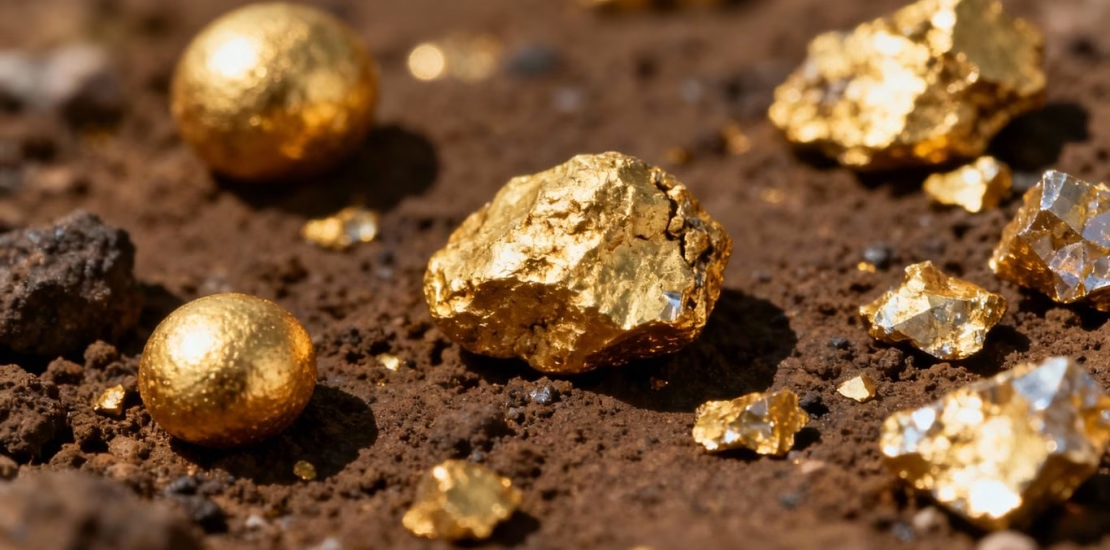
You might be wondering what the difference is between alluvial gold and vein gold. That's an excellent question, especially if you're interested in prospecting or simply the origin of this precious metal. Basically, it all depends on where the gold is found and how it got there. One is extracted directly from the rock, while the other has traveled and been deposited elsewhere. Let's take a closer look to understand this better.
Key Takeaways
- Vein gold is found directly in the source rock, where it was originally formed.
- Alluvial gold, on the other hand, was transported by water (rivers, streams) from its original rock and was deposited in riverbeds, gravels or beaches.
- Alluvial gold often appears in the form of flakes, fine grains or small nuggets, because it has been worn down by transport.
- Extracting vein gold requires more complex techniques because the rock containing it must first be broken.
- Finding alluvial gold is generally simpler because it is already free in loose sediments, and its location is often indicated by the presence of black sand and the characteristics of the watercourse.
Understanding the origin of gold: vein or alluvial?
So, you're wondering where all this gold we find comes from? It's a really interesting question, and the answer leads us to two main categories: vein gold and alluvial gold. Basically, it's a story of origin and journey.
The formation of primary gold in the source rock
Imagine gold as a treasure hidden deep within the Earth. It is there, in the rock, that it originates. This is called primary gold, or vein gold. It forms under very specific geological conditions, often linked to volcanic activity or tectonic plate movements. This gold is then trapped within the rock, like a jewel set in its case. Geological processes lasting millions of years are required for these deposits to form. It's almost as if the Earth itself patiently works to create these riches.
Transporting and storing gold by water
Now, how does this gold, safely encased in its rock, reach us? That's where water comes in. Over time, erosion, caused by rain, wind, and streams, attacks these source rocks. The gold particles, even though they are heavy, are eventually released. Rivers then become veritable natural conveyor belts. They transport these nuggets and flakes of gold over long distances. It's a bit like nature sorting things out: lighter materials are carried further, while the denser gold tends to settle as soon as the current slows down.
The distinction between primary gold and alluvial gold
The main difference, as you've probably gathered, lies in the origin and location of discovery. Vein gold is gold at its source, still attached to its original rock. Extracting it requires more complex techniques. Alluvial gold, on the other hand, has already traveled. It has been detached from its parent rock, transported by water, and deposited in riverbeds, gravel pits, or on beaches. It's often found in the form of flakes or small nuggets. This is why extracting alluvial gold is generally simpler, because the gold is already free and separated from the hard rock. Think of it like the difference between extracting a rough diamond from a mine and finding it already polished on a beach.
Gold, whether vein-based or alluvial, is the result of natural processes that unfold over geological timescales. Understanding these origins helps us better understand where and how to look for it.
In short, vein gold is the 'baby' gold that is born in the rock, while alluvial gold is the 'traveling' gold that has been transported and deposited by water. This distinction often guides prospectors in their searches. If you want to learn more about gold purity, look into... fine gold.
Here is a small table to help you see things more clearly:
| Gold Type | Origin | Typical location | Extraction method | Form found |
|---|---|---|---|---|
| Filonian | Source rock (vein) | In solid rock, primary deposits | Complex (drilling, etc.) | Embedded in the rock |
| Alluvial | Transported by water from the parent rock | Riverbeds, gravel, beaches, alluvial terraces | Simpler (washing, sieving) | Glitter, tiny nuggets, gold dust |
The distinctive characteristics of alluvial gold
When we talk about alluvial gold, we immediately think of those tiny, shiny flakes or minuscule nuggets found in rivers. It's a bit of a stereotypical image of the gold prospector, isn't it? But what exactly makes this gold so special?
The presence of glitter and small nuggets
Alluvial gold is primarily gold that has been detached from its parent rock and has traveled. During this journey, it has worn down, rounded, and fragmented. Consequently, it is rarely found in large pieces. Instead, it is more often found in fine forms: flakes, which are like very thin two-dimensional sheets, or grains, which are small three-dimensional fragments, generally less than 2 millimeters in size. Nuggets, on the other hand, are larger, but they are rarer in alluvial gold, especially far from the original source. The size and shape of these gold particles tell us a story about their journey. The rounder and smaller they are, the more they have traveled.
Location in riverbeds and gravel
Alluvial gold, by definition, is found where water has deposited it. Think of riverbeds, riverbanks, areas where the current slows. It's often sought in gravel, beneath a layer of more recent sediment. Imagine a river that has been carrying gold for millennia. Over time, gold, being very dense, has accumulated in places where the water could no longer transport it. This could be at the bottom of gravel, trapped in cracks in the bedrock, or behind natural obstacles. It's a bit like searching for hidden treasure in a riverbed.
The influence of density and current on the deposition
This is where physics comes in! Gold is incredibly dense, much denser than ordinary sand or pebbles. When river water flows, it carries all sorts of things. But when the current slows down, or when there's an obstacle, the heaviest materials, like gold, sink first. That's why we often find alluvial gold.
- In the inner bends of rivers, where the water flows more slowly.
- Behind large rocks or other obstacles that create areas of calm water.
- At confluence points, when one stream flows into another larger and slower-moving one.
- In the cracks and crevices of the rocky bed, which act as natural traps.
Black sand, which is actually a mixture of other heavy minerals like magnetite, is often a good sign. If you see black sand accumulating, there's a good chance that gold, being even heavier, is also present. It's a bit like a natural indicator for the prospector.
The specific characteristics of vein gold
Unlike its alluvial cousin, vein gold, that is, primary gold, remains firmly anchored in its parent rock. Imagine it as a treasure still imprisoned in its natural setting. It has not yet been freed by the forces of erosion to be transported and redeposited elsewhere.
Gold embedded in solid rock
Vein gold is found directly in veins of quartz or other minerals, often at considerable depths. It is intimately linked to the geological structure from which it originated. It can be found as fine particles scattered throughout the rock, or sometimes in more concentrated clusters, forming what are called veins. These deposits are the source of all gold found, whether alluvial or not. The rock containing this gold is often hard and compact, making its extraction more difficult.
Complex extraction methods
Extracting vein gold requires far more sophisticated techniques than extracting alluvial gold. This involves large-scale mining, often requiring the digging of tunnels or shafts to reach the gold veins. Once the rock is extracted, it must be crushed, ground, and then processed chemically or physically to separate the precious metal. This work demands significant investment in equipment and expertise. Think of the large gold mines you may have seen in documentaries; that's where vein gold is found.
The relationship with primary deposits
Vein gold is, by definition, primary gold. It is the original source. Alluvial deposits are merely the result of the erosion and transport of this primary gold. Understanding the geology of the site is therefore essential to locating these vein deposits. Geologists study faults, rock structures, and mineralogy to identify the most promising areas. It is a quest that requires patience and a thorough understanding of geological processes. Vein gold is tangible proof of gold's formation deep within the Earth, before the elements carried it out into the atmosphere. If you are interested in investing in gold, it is good to know that physical gold, whether in the form of bars or coins, is a recognized safe-haven asset, and its taxation in France is advantageous.
Vein gold is gold as it was formed in the rock, before it has been transported by water. Its extraction is therefore more technical and expensive, as it requires separating the metal from the solid rock that contains it.
The training and transportation processes
The erosion of primary deposits
You know, the gold we find in rivers, the kind we call alluvial, doesn't just appear out of thin air. It comes from a much older source: so-called "primary" or "vein" gold. This gold is trapped in rock, often quartz, in what we call primary deposits. These deposits have been there for millions of years, formed during major geological events, like continental collisions that created mountains and faults. Think of periods like the Variscan or Caledonian orogenies, times when the Earth was very active. It was during these periods that hot fluids, laden with minerals including gold, circulated through the rocks. When pressure and temperature conditions changed, the gold was deposited, forming those famous veins. But these veins don't stay in place forever. Nature does its work of erosion. Erosion is the great architect that will slowly but surely dismantle these rocks. Rain, wind, frost—all of these contribute to breaking down the bedrock. This is the beginning of the journey to gold.
The role of rivers in sedimentation
Once gold is freed from its rocky matrix by erosion, it begins a long journey. And it's often water that leads the way. Rivers, in particular, play a huge role in transporting and depositing this gold. Imagine a mountain torrent rushing down, carrying with it pebbles, sand, and of course, those tiny gold particles. The water acts like a natural conveyor belt. But gold has a particular characteristic: it's super dense. Really very dense, much more so than ordinary sand or gravel. It's this density that makes all the difference. When the river current slows down, for example in bends, at the foot of a waterfall, or where the river widens, the water no longer has the strength to carry everything away. The heaviest materials, like gold, will then settle. It's a bit like a natural sorting process. The lighter sediments continue on their way, while the gold sinks and accumulates at the bottom. This is how placer deposits are formed, these areas where alluvial gold concentrates.
The concentration of gold by gravity
The secret to finding alluvial gold lies in understanding how nature concentrates this precious metal. As mentioned, gold is incredibly heavy. Its density is around 19,3 g/cm³, while that of quartz, a very common rock, is around 2,7 g/cm³. This enormous difference is key. When a river carries a mixture of sediments, the current acts as a natural sieve based on weight. Gold particles, even small ones, tend to sink faster and stop more easily than pebbles or sand. Think of a stream of water flowing over a bed of gravel: the heavier elements will stay behind, while the lighter ones will be carried further. This is the principle of gravity at work. Gold will seek out areas where the current is weakest, where it can settle undisturbed. It is often found in the hollows of the riverbed, behind large rocks, or in fissures in the bedrock. These places are veritable natural traps for gold, where it accumulates over time, forming exploitable concentrations.
Identify areas suitable for gold prospecting
So, how do you know where to look? It's not just a matter of luck, you know. You have to learn to read the terrain, to understand where gold likes to hide. It's a bit like being a nature detective.
Natural indicators in waterways
Water is your best guide. When a river flows, it carries all sorts of things, including gold. But gold is heavy, so it won't just stay anywhere. It tends to settle where the water slows down or changes direction.
- The inner curves of rivers: Imagine the water swirling. Inside the curve, the current is weaker, and that's where heavy particles, like gold, will settle. It's a bit like a natural trap.
- Behind the obstacles: A large rock, a fallen tree trunk, or even a rocky outcrop can create a calm zone just behind them. Gold, tired from its journey, readily stops there.
- The points of confluence: When a small stream joins a larger river, the water suddenly changes speed. This change can cause the gold it was carrying to fall.
- Cracks and crevices: The rocky bottom of rivers is never perfectly flat. Small cracks, holes, and irregularities are perfect places for gold to settle and accumulate.
The importance of black sand as an indicator
You'll often see "black sand" in areas where gold might be found. It's not just ordinary sand. It's a mixture of heavy minerals, like magnetite and hematite. These minerals are dense, a bit like gold, but not as dense. They tend to settle in the same places as gold. So, if you find lines of black sand, it's a very good sign that you're in the right place to look for alluvial gold. It's a bit like a natural treasure map.
Natural traps for gold
Basically, gold gets trapped in places where it can no longer be carried away by the current. Think of these places as pockets or natural barriers. Gold, being denser than most other sediments, will sink and settle to the bottom. It seeks the line of least resistance, where it can rest. Areas where the current slows down or changes direction are your best leads. You really need to try and imagine the flow of the water, especially during floods, to understand where the gold might have been deposited. Don't forget to thoroughly scrape the bottom, in cracks and crevices, because that's where the treasure is often hidden. If you're looking to buy gold, it's important to know how to avoid scams by performing simple tests. to verify its authenticity.
Extraction and processing methods
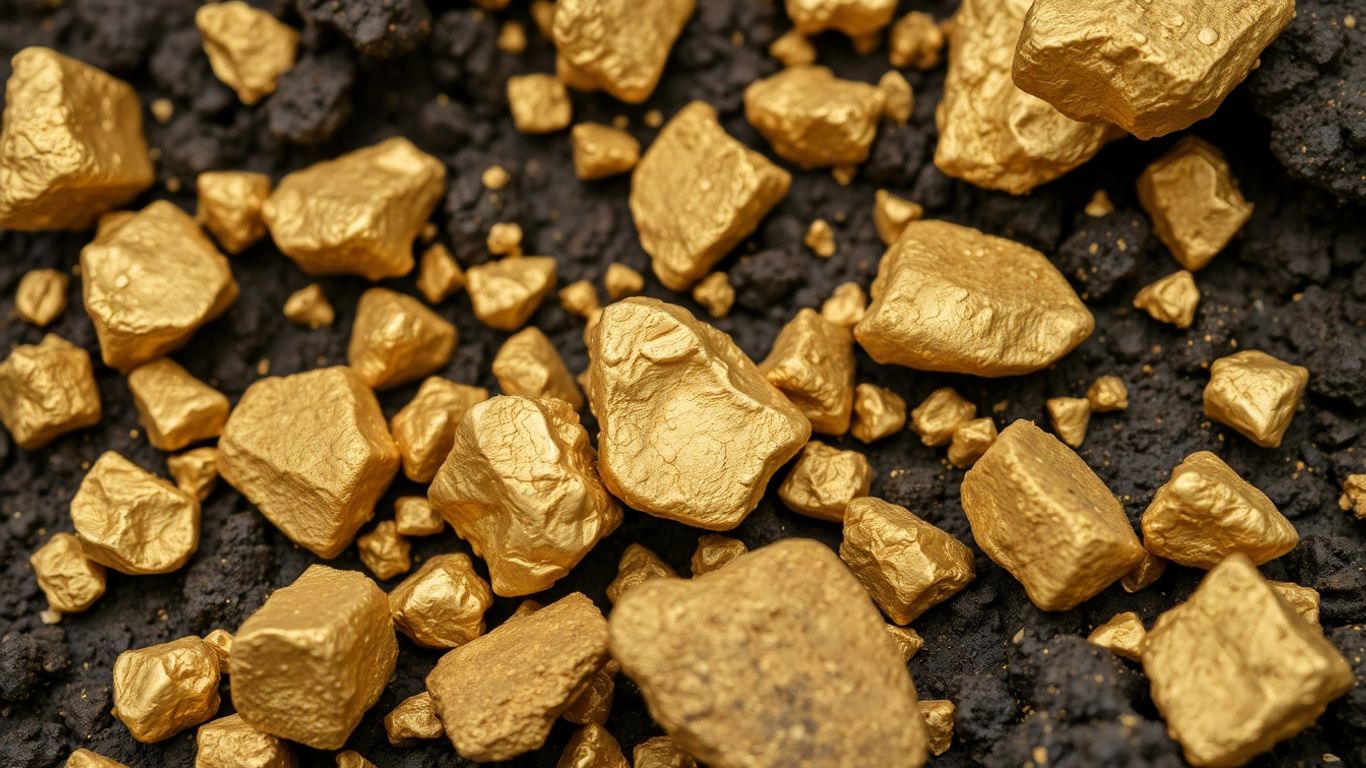
The simplicity of alluvial extraction
Alluvial gold mining takes place directly in or near rivers, often using methods that don't require sophisticated machinery. Here's what you could use if you decide to try it:
- The gold pan: a simple pan for washing gravel and isolating gold by circular motion.
- Sluice boxes: larger, they use slabs to retain heavy gold particles.
- Shovel, buckets and sieves: for collecting and sorting the materials that will eventually be washed.
It's a fairly direct, rather manual activity, and you could get your first gold flakes in an afternoon of prospecting.
Even without extensive experience, you can manage with simple tools and a lot of observation. Patience and curiosity are what make the difference.
The complexity of processing vein gold
When you move on to vein gold, the game changes radically. The gold is trapped in solid rock (often quartz) and it must first be extracted:
Here are the main steps:
- Excavation and blasting to access the vein in the rock.
- Crushing: the rock is pulverized to release the small particles of gold.
- Chemical treatment, for example with cyanide or mercury, to extract gold from ore.
- Refining to obtain pure gold.
It requires machinery, technical knowledge and above all, the management of a considerable amount of chemical waste.
| Method | Necessary tools | Difficulty | Performance |
|---|---|---|---|
| Alluvial extraction | Hand tools, sluices | Low | Medium |
| Vein extraction | Drilling, explosives, factories | Élevée | High |
Gold washing and concentration
For all types of gold, it must be separated from the rest. In alluvial deposits, washing is often sufficient, but for vein gold, a series of operations is necessary:
- Gravity separation (vibrating tables, jigs)
- Amalgamation (often abandoned for environmental reasons)
- Electrostatic or magnetic separations for heavy minerals
The final concentration aims to obtain a metal that is as pure as possible, regardless of the process used.
In the end, regardless of the method, the thrill remains the same: seeing a flake of gold appear, seemingly from the depths of time. That moment is truly what makes gold panning so captivating.
In the "Extraction and Processing Methods" section, we explore how gold is unearthed and prepared. It's a fascinating process that requires considerable expertise. Want to learn more about how we obtain the gold we sell? Visit our website for full details and how you can invest in this precious metal.
So, what are your takeaways?
There you have it, you now know how to distinguish between gold that comes directly from the rock, vein gold, and gold that has been transported by water, alluvial gold. It's quite fascinating to think that these two forms of gold, although originating from the same source, have very different paths and methods of extraction. Whether you're an amateur prospector or simply curious, understanding this difference gives you a better idea of how this precious gold is found. It's a bit like comparing an apple that fell from a tree to an apple that rolled in a stream: they come from the same tree, but their journey has made them slightly different. I hope this has shed some light on the subject!
Frequently Asked Questions
What is the main difference between alluvial gold and vein gold?
Vein gold is gold that is still trapped in the rock where it formed, like in a vein. Alluvial gold, on the other hand, has been detached from its original rock by water and deposited elsewhere, often in rivers, in the form of flakes or small nuggets.
How is alluvial gold found?
To find alluvial gold, you look in riverbeds, gravel deposits, and places where the water has slowed down. That's where gold, being heavier, tends to settle. Black sand, which is a mixture of other heavy minerals, can also be a good indicator.
Is vein gold more difficult to extract?
Yes, absolutely. Vein gold is trapped in solid rock. Therefore, more complex techniques, such as drilling and crushing, are required to extract it. Alluvial gold, on the other hand, is already separated and found in looser materials, making its extraction simpler.
Where does alluvial gold come from?
Alluvial gold comes from the erosion of primary (vein) gold deposits. Rainwater and rivers transport the detached gold over long distances. Over time, it accumulates in places such as riverbeds or floodplains.
Does the shape of gold tell us where it comes from?
Often, yes! If the gold has well-defined edges and appears to have moved little, it is probably close to its source (vein or recent alluvial deposit). If the gold is very rounded, it means it has traveled a long way in water, which is typical of older alluvial gold.
Why is gold easier to find in certain parts of rivers?
This is due to the density of gold and the current of the water. When the water slows down, for example in the bends of the river, behind large rocks, or where a small stream joins a larger river, the gold, being very heavy, settles there rather than being carried further away.