
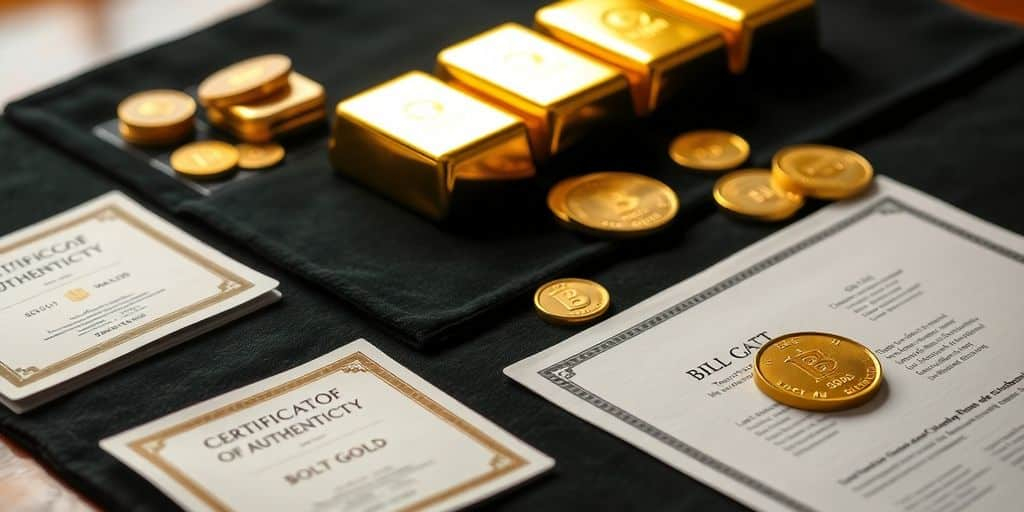
Selling gold bars or coins may seem simple, but it requires following certain rules and providing specific documents. Whether you're a novice or experienced seller, it's crucial to know exactly what paperwork is required to ensure a secure and legally compliant transaction in France. This article guides you through the essential documents for selling gold, so you can proceed without hassle.
Key points
- Identification is essential for any gold sale.
- A purchase certificate is recommended to prove the origin of the gold.
- The sales contract must include details of the items and parties involved.
- Payments must be made by crossed check or bank transfer, not cash.
- A certificate of authenticity, although not mandatory, can increase the sale value.
Essential Documents for Selling Gold
When you think about selling gold, whether it's bars or coins, you often imagine it's super complicated. In reality, it's quite simple, but you need to prepare your paperwork carefully. Here's a quick guide to the important documents to ensure everything goes smoothly.
Mandatory ID
This is the basis. It is impossible to sell gold without a valid ID. It could be your ID card, your passport, or even your driver's license. The goal is simply to prove that you are the person selling the gold. This is a legal requirement to avoid problems, such as money laundering. Remember to check that your ID is still valid; it would be a shame to have to postpone the sale because of this. At GOLDMARKET, our experts examine your ingots. with or without certificate meticulously.
Recommended Purchase Certificate
If you still have your gold purchase certificate, that's a big plus. It proves you bought the gold legally, and it reassures the buyer about its provenance. This is especially useful if you're selling bars, but it can also help with coins. If you don't have it anymore, don't panic; it's not always mandatory, but it makes things much easier. Plus, it can help you justify the selling price, especially if you bought it at a higher price than the current market price.
Customs Declaration If Necessary
If you bought your gold abroad, you absolutely must have a customs declaration. This document proves that you imported the gold legally and that you paid the necessary taxes. Without it, you risk big problems with the authorities. So, if your gold comes from elsewhere, search your papers carefully to find this declaration. It's a bit like proof of origin for your gold, and it's super important for selling with peace of mind. Don't forget that the gold resale, whether antique jewelry or ingots, requires compliance with certain legal requirements.
Importance of Certificate of Authenticity
What is this ?
So, what exactly is a certificate of authenticity? Think of it as the identity card for your gold bar or coin. It's a document that certifies that your gold is what it claims to be. It details important information like the purity of the gold, its precise weight, the origin (where it comes from, who made it), and sometimes even the date of manufacture. It's a bit like having the pedigree of your precious metalIt's not mandatory, but it helps a lot.
Why is it useful?
Why bother with a certificate, you might ask? Well, it reassures the buyer. When you sell gold, especially if it's a bar, the buyer wants to be sure that he's not being ripped off. A certificate of authenticity is concrete proof that your gold is of good quality. It can also influence the sale price, because a buyer will be more inclined to pay the right price for gold whose authenticity is proven. It's a bit like selling a car with its service book up to date: it inspires confidence. Besides, if you want sell gold with a certificate it's always better.
How to Get It?
Okay, convinced? Now, how do you get this famous certificate? Generally, when you buy a gold bar or coin from a reputable dealer, they'll already provide you with the certificate. If you don't have one, you can have your gold appraised by a professional. There are experts specializing in the evaluation of precious metals who can issue you with a certificate of authenticity. Of course, it comes at a cost, but it can be worth it if you want to sell your gold at the best price. It's a bit like having your house inspected before selling it: it can reveal flaws, but it also helps increase its value.
The Sales Contract: An Essential
What is this ?
The sales contract is a bit like a pact that we sign when we sell gold. It is an official document that proves that the transaction took place. Imagine, it's like a super-detailed receipt, but for gold. It's mandatory, in fact, for any sale or purchase of gold in France. Without it, it's a bit like buying a baguette without paying: not very fair!
Information to Include
A good sales contract is a contract that says it all. It must include:
- A precise description of what you are selling (ingot, coin, etc.).
- Your full contact details and those of the buyer (name, address, etc.).
- The exact price you agreed upon.
- The date and place where the sale took place.
It's a bit like a cooking recipe: if you forget an ingredient, it might not be good. And then, if you forget a piece of information, it could cause problems later. Remember to double-check the Documents to provide for sale.
Why is it important?
The sales contract protects you and the buyer. It prevents misunderstandings and serves as proof in the event of a dispute. It's also important for the traceability of the gold, so that everything is clear and transparent. Basically, it's a bit like insurance for your sale: it's better to have it, even if you think you don't need it.
Without a contract, you're open to trouble. Imagine the buyer saying they didn't pay the right price, or you saying you didn't sell what they claimed to have bought. With a solid contract, there's no problem: everything is written in black and white!
Accepted Payment Methods
So, what happens when you sell your gold bars or coins? This is an important question, because money is no joke, especially when it comes to gold!
Cash Ban
Forget the idea of leaving with a wad of cash. In France, cash transactions are very limited, or even prohibited, for this type of sale. It is a security and traceability measure. We cannot buy gold bars in Paris cash.
Crossed Checks
Crossed checks are an option, but they're becoming less and less popular. Why? Because you have to wait for the check to clear, which can take time. Plus, there's always the risk of a bounced check, even if it's rare. Personally, I'm not a fan; it involves too much waiting and uncertainty.
Bank transfers
This is the most common and secure payment method. The money is transferred directly to your bank account, usually within a few days. It's fast, secure, and leaves a record of the transaction. This is what I recommend.
Bank transfers are the best way to avoid any hassle. Make sure you provide the correct banking information (IBAN, BIC code) to ensure the transfer goes through smoothly. And always double-check that the amount received corresponds to what was expected!
Here is a brief summary of the accepted payment methods:
- Bank transfer: ✅ (Highly recommended)
- Crossed check: ⚠️ (Possible, but less practical)
- Species: ❌ (Prohibited or very limited)
Selling Bullion or Coins: The Differences
Ingots: Specificities
So, the ingots are a bit like black when we talk about gold. We usually think of large, shiny bars, but they come in all sizes, from one-kilo bars to small ingots weighing a few grams. Their value is directly linked to their weight and the purity of the gold they contain. No fuss, it's raw. For sell a gold bar, you need to know the current market price.
Coins: Numismatic Value
Coins are another story. In addition to the value of the gold they contain, they can have a numismatic valueThat is, their rarity, their state of preservation, and their history can make their price rise well beyond their simple weight in gold. Napoleon can be worth more than an ingot, it's crazy, right?
Specific Documents for Each Type
For ingots, you don't need any specific documents beyond those already mentioned (ID, etc.). However, if you have rare coins, a certificate of authenticity or any document proving their history can really help justify their value and facilitate the sale.
Basically, for bullion, we focus on weight and purity. For coins, we also look at history and rarity. It's a bit like comparing a hamburger to a fine wine.
Estimating the Value of Gold
How's it going?
So, how do you estimate the value of your gold? It's not that complicated, but you have to be careful. Basically, we watch the price of gold in real time, which changes all the time. This rate is expressed in ounces of gold (about 31,1 grams) and in dollars. Then, we take into account the weight of your bar or coin, and its purity (that is, the amount of pure gold in it). The purer it is, the more expensive it is, obviously.
Factors That Influence Price
Several factors can affect the price of your gold. The world gold price is the basics. But there are also:
- Gold purity: a 99,99% gold bar is worth more than a 90% gold bar.
- Weight: the heavier it is, the more expensive it is.
- The condition of the coin or ingot: if it is damaged, it can lower the price.
- Demand: If many people want to buy gold, the price goes up.
You should know that the gold price can also be influenced by economic or political events, such as inflation, interest rates, or international crises. This is why the price changes all the time.
Free Estimate: Where to Go?
There are several options available to you for obtaining a free estimate. You can consult precious metal experts, specialized jewelers, or even agencies specializing in the gold buybackThe important thing is to compare several offers to be sure you're getting the best price. Don't hesitate to shop around and ask for quotes. And above all, be wary of offers that sound too good to be true; they're often a scam. You can also find online estimation tools, but they're not always very accurate. For a reliable estimate, nothing beats the advice of a professional.
Tax Obligations When Selling
When selling gold, whether it's bars or coins, there are tax rules to know. It's not always easy, but we'll try to make it clear. Basically, in France, you have two options for taxes on the sale of precious metals, and the choice depends mainly on how long you kept your gold and whether you kept the paperwork.
Precious Metals Tax
The first option is the flat rate tax on precious metals (TFMP). This is often the simplest, especially if you don't have the purchase invoice. This tax is 11,5% of the total sale price (including a contribution to the repayment of the social debt, the CRDS). No need to justify the initial purchase price, which can be convenient. To declare this tax, you must fill out a special form (Cerfa n°2091-SD) and send it within one month of the sale. It's a fairly straightforward process.
How does it work?
If you choose the TFMP, it's quite simple: the gold seller (if they're a professional) takes care of collecting the tax and paying it to the state. You receive the net amount. If you sell to an individual, it's up to you to declare and pay the tax. It's important to do this on time to avoid problems. Remember to: prepare all documents required.
Tips to Avoid Surprises
The best advice is to do your research before selling. Look at how much you'll actually earn after taxes and compare the two options (TFMP and capital gains tax). If you have any doubts, don't hesitate to seek expert advice. This can help you avoid unpleasant surprises and help you choose the most advantageous option for you.
Selling in an Agency: Simplified Process
Honestly, selling gold through an agency is often the easiest option. No stress, experts who take care of everything, and a secure transaction. Let's see how it goes.
How does it work?
Basically, you show up at the agency with your bars or coins. They check the authenticity, assess the weight and purity, and make you an offer. If you're happy with it, you sign the papers, and hey presto, it's done! They even take care of the precious metals tax if it applies. It's still easier than dealing with online ads and potential buyers.
Advantages of Using an Agency
- Security: You avoid scams and unpleasant surprises. The agencies are licensed professionals, so you're sure not to get ripped off.
- Speed: Estimates and payments are often very fast. No need to wait days to receive your money.
- Expertise: They know the gold market inside out and can give you an accurate estimate of the value of your assets.
At the agency, you benefit from personalized support. Experts are there to answer all your questions and provide you with the best advice. This is a real plus, especially if you don't know much about gold.
Documents to Prepare
To sell through an agency, you'll still need some paperwork. Generally, an ID is sufficient. But if you have a certificate of authenticity or a purchase invoice, it's always better. It makes the transaction easier and proves the origin of your gold. Here's a short list:
- Identity document (ID card, passport, etc.)
- Certificate of Authenticity (if you have one)
- Purchase invoice (if you have kept it)
Tips for a Successful Sale
Prepare All Documents
Before you start selling your gold bars or coins, make sure you have all your paperwork in order. We're talking about your ID, of course, but also the purchase certificate if you still have it. This can really make things easier and reassure the buyer. Having these ready documents Before the sale, it's a bit like preparing your bag before a trip: you avoid unpleasant surprises!
Choosing the Right Time
The gold market is constantly changing. Prices can go up and down depending on a variety of factors (the global economy, geopolitical tensions, etc.). So, before you sell, take the time to see how things are going. Is there a better time than others? Are experts predicting a rise or a fall? Staying informed is key. optimiser your sale.
Avoiding Scams
Unfortunately, there are also dishonest people in the world of gold. So, be careful! Don't rush into buying the first offer you come across. Compare prices, check the buyer's reputation, and above all, never give your personal information to just anyone. Beware of offers that sound too good to be true, this is often a sign of a scam. If you have any doubts, don't hesitate to seek expert advice or contact specialized organizations.
Selling gold can be a great opportunity, but it requires a little preparation and caution. By following these tips, you increase your chances of getting a good deal and avoiding problems. So, take your time, do your research, and everything will go smoothly!
Proper preparation is essential for a successful sale. Make sure you know the value of your items and choose the right time to sell. Don't forget to present your items in an attractive way. For more tips and tricks, visit our website and discover how to maximize your sales!
In Summary
So, now you know what documents you need to sell your gold bars or coins. Don't panic, it's not that complicated! Just a piece of ID and possibly a certificate of authenticity if you have one. Also, remember to keep your purchase receipt; it can help. And above all, don't forget that the sale must be completely legal, so no cash; a check or wire transfer is better. Basically, get your paperwork ready, and you'll be ready to sell without stress!
