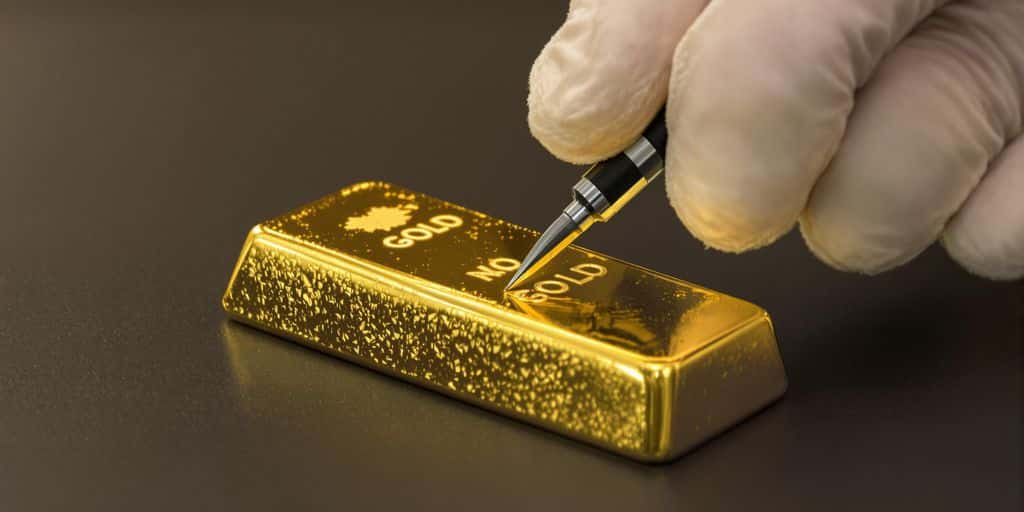
Want to buy a gold bar, but aren't sure how to check its purity? This is an important question, as the value of your investment directly depends on the quality of the gold. In this article, we'll take a look at how to ensure the bar you have in mind is what it claims to be. We'll cover several methods, from the simplest to the most technical, so you can make your purchase with complete confidence. Ready to become a gold purity expert?
Key points
- Gold purity is the amount of pure gold in a bar; it is super important for its value.
- There are simple ways, such as touchstone, and more advanced techniques, such as spectrometry, to verify this purity.
- Always ask for a certificate of authenticity and buy from reputable sellers to avoid scams.
- A good quality gold bar has specific markings: a hallmark, a serial number, and good overall condition.
- International standards, such as those of the LBMA, guarantee that your gold will be recognized worldwide.
What is the purity of gold?
Gold purity is a bit like the concentration of fruit juice: the more pure gold there is, the more "concentrated" it is and therefore, the more valuable it is. But pure gold is soft, too soft to make jewelry or ingots that we handle every day. So, we mix it with other metals. This is where it becomes interesting to understand what purity is.
Definition of purity
When we talk about the purity of gold, we are talking about the proportion of fine gold (pure gold) in an alloy. This proportion is generally expressed in carats or thousandths. A "pure" gold bar is never 100% gold, but rather 99,99% (or 999,9 thousandths). This is called "four nines" gold. The rest is traces of other metals, unavoidable during the refining process.
Pure gold and its alloys
Pure gold is 24 karat. But because it's super malleable, it's often alloyed with other metals like silver, copper, or zinc to make it stronger. For example, 18 karat gold is 75% pure gold and 25% other metals. This changes its color, its hardness, and, of course, its price. gold bar of 100 grams with a purity of 999,9 is an excellent investment.
Importance for investment
When investing in gold, purity is paramount. The purer the gold, the more valuable it is. It's simple. Investment bars must be of high purity (often 99,99%) to be easily tradable on the international market. In jewelry, you can afford to have less pure gold, because durability is more important than the intrinsic value of the metal.
Imagine buying a bar thinking it's pure, only to later discover it's filled with other metals. That's a dead loss. That's why you should always check the purity before buying. It's the basis of any gold investment.
Here is a comparative table of the different purities of gold:
| Carats | Thousandths | Percentage of pure gold | Typical use |
|---|---|---|---|
| 24 carats | 999,9 | 99,99% | Investment bullion |
| 22 carats | 916 | 91,6% | gold coins |
| 18 carats | 750 | 75% | High-end jewelry |
| 14 carats | 585 | 58,5% | Common jewelry |
| 9 carats | 375 | 37,5% | Entry-level jewelry |
Why testing the purity of a gold bar is essential
This is a question every gold investor should ask themselves. This isn't just a matter of curiosity, but a crucial step in protecting your investment. Imagine buying a car without checking the engine... that would be risky, wouldn't it? Well, it's the same with gold.
Ensure the value of the investment
The purity of a gold bar is directly related to its value. An ingot advertised as 99,99% pure is obviously worth more than one whose purity is uncertain. If you buy an ingot without checking its purity, you risk paying too much for what it is actually worth. It's a bit like buying a Counterfeit Rolex at the price of a real one. Nobody wants that!
Protect against fraud
Unfortunately, the gold market is not exempt from fraud. Bars can be counterfeit, containing less gold than advertised, or even filled with other, less precious metals. Testing the gold bars for purity helps thwart these scams and ensure you really own what you think you do. It's a great way to protect yourself from unpleasant surprises. It's important to remember that verifying the gold bars' purity is an essential step in avoiding financial loss and protecting your investment.
Know your sustainability
The purity of gold influences its durability. Pure gold is malleable and easily damaged. This is why, in most jewelry, it is alloyed with other metals to make it more durable. Knowing the exact composition of a gold bar allows you to anticipate its reaction to various environmental factors and take the necessary steps to keep it in good condition. A gold bar with a high purity is more likely to retain its value over time, which is essential for long-term investing.
In short, testing the purity of a gold bar is like verifying the authenticity of a banknote. It's an essential step to avoid counterfeiting, protect your capital, and ensure the true value of your investment. Never neglect this step, even if it means consulting an expert or using specific verification methods.
Physical methods for verifying purity
When it comes to checking the purity of a gold bar, there are physical methods that are both proven and relatively accessible. They don't always require sophisticated equipment, but they do require a certain amount of expertise to correctly interpret the results. It's a bit like cooking: you may have the ingredients, but the skill makes all the difference!
Using the Touchstone
The touchstone is a bit of an old-school method, but it's still super useful. The principle is simple: the ingot is rubbed on a special stone, then acids of different carats are applied. If the acid used matches the carat of the ingot, the trace left behind won't change color. However, if the acid is stronger, the trace will react. It's quite visual, but it requires a trained eye to properly assess the nuances. It's a bit like comparing paint colors; it takes practice to distinguish them.
Cupellation test
Cupellation testing is a more advanced method that involves heating a sample of the ingot to a very high temperature. The goal? To separate the gold from the other metals present in the alloy. This process requires specialized equipment and a good understanding of chemistry, as it involves handling potentially hazardous materials.
- The gold sample is weighed precisely.
- It is mixed with lead and silver.
- The whole thing is heated in a crucible to around 1000°C.
Cupellation testing is considered one of the most reliable methods for determining gold purity, but it is destructive. This means it's not suitable if you don't want to damage your ingot. So, you should carefully weigh the pros and cons before taking the plunge.
Density test
Another interesting physical method is the density test. Gold has a very specific gravity (about 19.3 g/cm³), so if you measure the density of the ingot and it deviates too much from this value, it could indicate a purity problem. To perform this test, you need to weigh the ingot, then measure its volume by submerging it in a liquid (being careful not to damage it, of course!). Then, divide the mass by the volume, and you get the density. This is a fairly accurate method, but it can be flawed if the ingot contains cavities or inclusions of other metals. Before use gold as collateral, it is important to check its purity.
| Method | Benefits | Drawbacks |
|---|---|---|
| Touchstone | Simple, fast, inexpensive | Less precise, requires experience |
| Cupellation test | Very precise, considered a reference | Destructive, requires specific equipment |
| Density test | Fairly accurate, non-destructive | May be distorted by impurities or cavities |
Chemical and modern verification methods
Acid test
The acid test is a fairly common chemical method, but it requires some caution. Basically, different acids (nitric, hydrochloric) are used to test how gold reacts. The idea is that pure gold does not react to these acids, while less noble metals dissolve or change color. This is a quick method, but it can be a little imprecise if you're not used to it. You also have to be careful not to damage the ingot with the acids.
Spectrometry
Spectrometry, and more specifically XRF (X-ray fluorescence) spectrometry, is the state-of-the-art technology for analyzing the composition of an ingot without damaging it. We bombard the ingot with X-rays, and we analyze the rays that are returned. This gives us a precise idea of the elements present and their quantity. It's super practical because it's fast, non-destructive, and very reliable. It's a bit like taking an X-ray of the ingot to see what's inside. It's a very precise method for confirming that your gold is pure at 99,999%.
Electronic appliances
There are also portable electronic devices that can analyze gold purity. These devices use different technologies, such as electrical conductivity or ultrasound, to determine the composition of the ingot. This is convenient because it's quick and easy to use, but you still need to ensure the device is properly calibrated and used correctly to get reliable results. These devices are often used by professionals, but they are starting to become more accessible to individuals.
In summary, modern chemical methods offer greater accuracy in determining the purity of a gold bar. They help ensure the value of your investment and protect against fraud. Choosing the right method will depend on your needs and budget, but it's always best to seek professional help to ensure reliable results.
Tips for checking the authenticity and quality of investment gold
Purchasing investment gold, such as bullion, is an important step that requires careful consideration. Ensuring the authenticity and quality of the gold is crucial to protecting your investment. Here are some tips to guide you.
Checking the punches
Hallmarks are official marks placed on gold bars to guarantee their authenticity and purity. Each ingot must have a clear and identifiable hallmark. These hallmarks typically indicate the manufacturer, weight, and fineness (purity) of the gold. For example, a 99,99% pure gold bar may be marked "999.9" or "24K." Check that the hallmark matches the information provided and is clear and precise. If in doubt, consult an expert.
Importance of the Certificate of Authenticity
A Certificate of Authenticity is an essential document that accompanies your gold bar. It provides detailed information about the bar, such as its weight, purity, serial number, and manufacturer's name. This certificate is proof of the bar's authenticity and may be required upon resale. Make sure the certificate is issued by a recognized organization and that it accurately reflects the bar's characteristics. Keep this document safe, as it is essential to prove the authenticity. value of gold if needed.
Buy from trusted sources
One of the best ways to ensure the authenticity and quality of your investment gold is to purchase it from reliable and reputable sources. Choose authorized dealers, banks, or refiners certified by the LBMA (London Bullion Market Association). These sources are subject to strict controls and offer a guarantee of quality and authenticity. Avoid unknown sellers or overly attractive offers, as these may conceal counterfeits. Don't hesitate to research the seller and check their reputation before making a purchase.
Purchasing investment gold is an important decision that must be made with caution. By following these tips and exercising due diligence, you can ensure you purchase authentic, high-quality gold and protect your investment.
Here are some points to remember:
- Check the punches carefully and make sure they are clear and accurate.
- Request a certificate of authenticity issued by a recognized organization.
- Buy only from trusted and reputable sources.
- If in doubt, consult an expert for a professional assessment.
Characteristics of a gold bar
The course and the premium
The price of a gold bar is a bit like the price of a stock: it fluctuates depending on the market. It is set by several global stock exchanges, including London, New York, and Zurich, usually twice a day. This rate is quoted in troy ounces (about 31,1 grams) and in US dollars. In France, there is also an unofficial quote provided by a private company.
The premium, on the other hand, represents the percentage difference between the spot price (the "raw" price of gold) and the price at which the bar is actually sold. If the price is €100 and a supplier sells it for €102, the premium is 2%. The premium is influenced by supply and demand. The more demand there is for a bar, the higher its premium will be. It is important to follow the Gold prices to fully understand the market.
Weight and serial number
The weight of a gold bar is a crucial factor. It is expressed in grams, kilograms, or ounces of gold. Gold bars come in all sizes, from small one-gram bars to the massive 12,5 kg bars used by central banks.
Each ingot has a unique serial number. This number is used to identify the ingot and ensure its traceability. It's a bit like a car's identification number: it allows you to track its history and verify its authenticity.
Seals and state of conservation
Seals are security features affixed to the ingot's packaging. They guarantee that the ingot has not been tampered with since its production. If the seals are intact, this reinforces confidence in the ingot's authenticity.
The condition of the ingot is also important. An ingot in perfect condition, without scratches or defects, will be more valuable than a damaged ingot. The condition is an indicator of how the ingot was stored and handled.
In summary, the price, premium, weight, serial number, seals, and condition are all elements that characterize a gold bar. It's important to understand them well to make an informed investment. Always check the bar's weight before purchasing.
International standards and market recognition
Good Delivery criteria
When it comes to investment gold, there are rules to follow. The "Good Delivery" criteria are a bit like the quality label for bullion. They ensure that the gold meets strict standards in terms of purity, weight and shape. It's a bit like making sure your baguette is crispy and made with good flour. These criteria are defined to facilitate trade and ensure trust between buyers and sellers. An ingot that meets these criteria is more easily accepted on the international market.
The role of the LBMA
The LBMA, or London Bullion Market Association, is a bit like the gold market's watchdog. Based in London, it sets and maintains the highest standards for gold and silver refining. It accredits refiners who meet these standards, and their certification is recognized worldwide. The LBMA documents and stores every bar of gold and silver metal authorized to circulate at "spot" or cash prices on the professional market. It's a bit like the AOC label for wine; it tells you that the product is of quality and that it complies with certain rules. If you want to be sure you're buying quality gold, check that it comes from a refiner accredited by the LBMA. Moreover, if you want identify fake ingots, it is important to know these standards.
The importance of the London market
London is a bit like the world capital of gold trading. It's where reference prices are set and where most major transactions take place. The London market is an over-the-counter market, meaning that transactions take place directly between participants, without going through a centralized exchange. It's a highly liquid market, with many buyers and sellers, which allows for competitive prices.
To be recognized on the market, an ingot must meet the so-called “Good delivery” criteria defined by the LBMA (London Bullion Market Association), which is a certification body based in London.
Here are some important points to remember:
- London is the nerve center of the physical gold trade.
- Prices set in London serve as a global benchmark.
- The LBMA plays a key role in regulating the market.
Our products meet the highest global standards, ensuring their value everywhere. You can be sure you're making a good choice. To learn more about our guarantees, visit our website right now !
Conclusion
Well, to put it simply, knowing if a gold bar is truly pure is super important. Especially if you want to invest in it. Whether you use old methods like the acid test or more modern tricks like spectrometry, each approach has its strengths. The trick is to choose carefully how you're going to check the purity. And don't hesitate to seek professional advice if you have any doubts. With the right information and a little caution, you can be sure that your gold bar is good quality and well worth its price!
Frequently Asked Questions
What is a gold bar?
A gold bar is a bar of precious metal, usually made of pure gold, that people buy as a cash investment.
How to check the purity of a gold bar?
To verify the purity of a gold bar, physical methods such as the density test or chemical tests such as spectrometry can be used. There are also simpler methods such as the touchstone.
Why is gold purity important?
The purity of gold is very important because it determines how much the bar is worth on the market. The purer the gold, the higher its price. This is crucial to ensure your investment is a good one.
What tools are needed to test a gold bar?
To test a gold bar, you can use tools such as a touchstone, special liquids (acids), or modern machines such as a spectrometer. The choice of tool depends on the accuracy you are looking for.
What is a “Good Delivery” gold bar?
A “Good Delivery” gold bar is a bar that meets very strict purity (at least 99,5% pure gold), weight, and manufacturing standards established by the LBMA (London Bullion Market Association). These bars are recognized worldwide and are often used by central banks.
Is it important to have a certificate of authenticity for a gold bar?
Yes, it's very important to have a Certificate of Authenticity. This document proves that your bar is real and has the stated purity and weight. Without this certificate, it can be difficult to sell your bar at the right price or prove its value.